


THIS PAGE WILL BE UPDATED WITH THE LATEST NEWS
UPDATE: 6:00 PM CEST
Crew Member of Dutch Cargo Ship Dies of Injuries Sustained in Attack by Houthis

A crew member of a Dutch cargo ship has died of his injuries after Iran-backed Houthi rebels attacked the ship last week in the Gulf of Aden near Yemen. The Dutch shipping company Spleithoff said the unidentified merchant sailor died Monday at the hospital after he was critically injured in the Sept. 29 attack on his vessel, the MV Minervagracht.
“The events of last week have left a profound impact on everyone at Spleithoff. Today’s news has deeply saddened everyone at the company, as we mourn the loss of a respected and valued seafarer,” the company said Monday in a statement.
UPDATE: 3:00 PM CEST
When History Spews the Past

Karl Marx famously wrote in The Eighteenth Brumaire of Louis Bonaparte, that history repeats itself—“the first time as tragedy, the second as farce” (“das eine Mal als Tragödie, das andere Mal als Farce”). His meditation on the French Revolutions of 1789 and 1848—first the overthrow of the monarchy, then the rise of Louis-Napoléon Bonaparte—was not only a comment on political recurrence. It was a philosophical appeal to causality: the idea that every effect springs from a cause, and that history, like physics, is governed by chain reactions of human ambition, error, and betrayal.
Viewed through that lens, Iran’s modern history is painfully instructive. The 1979 revolution—ultimately captured by theocratic despotism—began as a genuine uprising, a collective cry against a monarchy that had curdled into modern tyranny. The Pahlavi regime, with its SAVAK apparatus trained in the dark arts of surveillance and torture, sowed the seeds of its own collapse. The brutality and arrogance of Mohammad Reza Pahlavi’s rule created the vacuum into which Khomeini and his clerical cohort surged, unleashing a reign of terror that endures to this day.
Australia Moves to List Iran’s Revolutionary Guard as Terror Group

Australia is set to overhaul its counterterrorism framework, introducing a new law that would for the first time allow the government to designate foreign state entities—including Iran’s Islamic Revolutionary Guard Corps (IRGC)—as terrorist organisations. Communications Minister Michelle Rowland introduced the Criminal Code Amendment (State Sponsors of Terrorism) Bill 2025 to Parliament on Oct. 8.
“The bill strengthens Australia’s counterterrorism framework, creating an environment in which it is more difficult, more risky, and more costly for malicious foreign actors to cause Australia and our community harm,” Rowland said.
UPDATE: 8:00 AM CEST
Iran’s Rebellious Youth Target Regime Centers in Response to Killing Spree in Regime Prisons
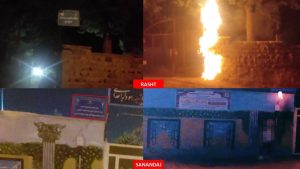
At dawn on Saturday, October 4, 2025, the Iranian regime executed six ethnic Arab citizens in Ahvaz after seven years of imprisonment, labeling them as “separatists affiliated with the Zionist regime.” Additionally, one ethnic Kurdish citizen was executed in Sanandaj after 12 years of imprisonment for the killing of Mamousta Sheikh-ol-Eslam, a regime cleric. In response to these brutal executions, on the evening of October 4, Iran’s rebellious youth carried out a series of operations against regime targets. They attacked the regime’s centers of suppression and repression and set fire to government banners bearing the images of regime founder Ruhollah Khomeini, supreme leader Ali Khamenei, the terror master Qassem Soleimani, and the current president Masoud Pezeshkian.
Iran’s MEK Resistance Units: The Strategic Engine of Real Change from Within

As Iran’s religious dictatorship intensifies repression—escalating executions, arrests, and brutal crackdowns—an often underreported force continues to grow and operate deep inside the country: the Resistance Units. These are not symbolic or superficial activists. They are a strategic, organized, and expanding network of operatives affiliated with the People’s Mojahedin Organization of Iran (PMOI/MEK), risking everything to challenge the regime from within. Their actions reveal a crucial truth: the path to ending Iran’s theocracy lies not in foreign intervention or Western appeasement, but in organized resistance and uprising from within Iran itself.
Iran’s Workers and Pensioners Trapped in the Cycle of Survival Amid Rising Inflation and Economic Mismanagement
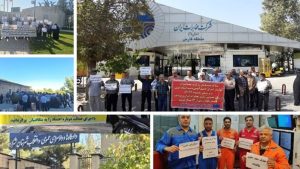
In today’s Iran, life for workers and pensioners has become a relentless struggle for survival rather than a dignified existence. Chronic inflation, soaring prices, and the collapse of purchasing power have turned multi-job employment from a “choice” into an unavoidable “necessity.” Across the country, workers face shrinking dinner tables, longer working hours, and a constant fear of job loss. The roots of this erosion lie not in workers’ homes but in the regime’s decision-making rooms, where priorities are dictated by military ambitions, nuclear projects, and regional interventions rather than the welfare of Iranian citizens. Every rial funneled into these ventures is drained directly from the veins of the national economy — and from workers’ pockets.
Deadly Road Crashes Expose Iran’s Failing Transport System and Aging Bus Fleet

Repeated fatal accidents on Iran’s intercity roads reveal the regime’s neglect of road safety, lack of fleet renewal, and exhaustion of overworked drivers, turning highways into death traps for citizens. The repeated intercity bus crashes across Iran, each claiming dozens of lives and injuring many more, have once again thrust the country’s catastrophic road safety record into public attention. In recent days, two deadly accidents in Semnan Province and on the Firuzkuh Highway killed six passengers and injured over thirty others, exposing once again the decaying state of Iran’s intercity transport system. Transportation experts say the rising number of accidents reflects a lack of oversight on drivers’ physical and mental conditions. Fatigue from excessive working hours, coupled with poor road conditions and an aging bus fleet, have created lethal conditions on the country’s highways.
London Court Seizes Iran’s $125 Million Oil Company Building Amid Crescent Corruption Scandal

Regime’s Mismanagement and Corruption Cause Major Loss in One of Iran’s Most Controversial Cases. In one of the most controversial legal battles in Iran’s modern history, the National Iranian Oil Company (NIOC) has lost its appeal to retain ownership of its luxury London property. The UK Court of Appeal ruled in favor of Crescent Petroleum, authorizing the confiscation of the NIOC House—valued at £100 million ($125 million)—to help recover part of the $2.4 billion damages Iran owes in the long-standing Crescent arbitration case. The decision marks a severe blow to Iran’s economic and diplomatic interests abroad and highlights the deep corruption and mismanagement that have plagued the regime’s oil sector for decades.