

THIS PAGE WILL BE UPDATED WITH THE LATEST NEWS
UPDATE: 01:30 PM CET
UN Experts Urge Iran Not to Execute Abused Child Bride
Agence France Presse (AFP) – UN rights experts have urged Iran to halt the execution of a woman over the death of her abusive husband, who she was married off to at 12 years old.
Goli Kouhkan, an undocumented Baluch woman today aged 25, is set to be executed this month, eight independent United Nations experts warned in a statement published Tuesday.
“Kouhkan’s case exemplifies the systemic gender bias faced by women victims of child marriage and domestic violence within Iran’s criminal justice system,” the experts said.
“Carrying out the execution would constitute a grave violation of international human rights law.”
China Ramps Up Iranian Oil Intake After Getting New Import Quota

(Bloomberg) — China’s independent oil refiners are boosting their intake of Iranian crude from onshore tanks and ships idling at sea after Beijing issued a fresh round of import quotas late last month.
Several processors based in Shandong province have been taking crude from bonded storage at ports and refineries this week, according to people familiar with the matter, asking to not be identified discussing sensitive information. A lot of the oil had been bought prior the new quota allocation, they said.
China’s private refiners, known as teapots, dominate the nation’s purchases of crude from Iran and Russia, which are cheaper than other grades, but had to scale back buying during the fourth quarter due to exhausted allocations and the fallout from sanctions. Beijing runs a quota system under which it controls the amount of oil that non state-owned refiners can import.
UPDATE: 08:30 AM CET
US Offers $10M for Iranian Cyber Operatives Behind Election Interference and Critical Infrastructure Attacks

Fatemeh Sedighian Kashi and Mohammad Bagher Shirinkar maintain a close working relationship coordinating cyber operations targeting elections, US critical infrastructure and businesses through the Iranian Revolutionary Guard Corps cyber unit known as Shahid Shushtari.
The U.S. Department of State announced rewards of up to $10 million for information leading to their identification or location, marking the latest effort to disrupt operations of Iranian cyber operatives that has caused significant financial damage and operational disruption across multiple sectors including news, shipping, travel, energy, financial services, and telecommunications throughout the United States, Europe, and the Middle East.
Shirinkar oversees the Shahid Shushtari group, previously identified under multiple cover names including Aria Sepehr Ayandehsazan, Emennet Pasargad, Eeleyanet Gostar, and Net Peygard Samavat Company. Whereas, Sedighian serves as a long-time employee working closely with Shirinkar in planning and conducting cyber operations on behalf of Iran’s IRGCs Cyber-Electronic Command, the State Department said.
UK Reaffirms Stance on Iran Threats After MP Presses Government on IRGC
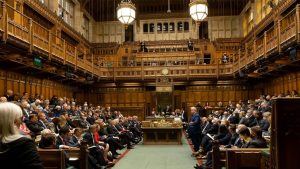
The UK Government has restated its position on security threats linked to Iran after a Conservative MP pressed ministers to respond to Australia’s decision to designate the Islamic Revolutionary Guard Corps (IRGC) as a state sponsor of terrorism. During Foreign Office questions on December 2, 2025, Greg Smith asked what discussions the UK had held with Australia and whether Britain might take similar action. While no new measures were announced, Foreign Secretary Yvette Cooper said the Government remains in “strong conversations” with Five Eyes partners on state and terror threats and reaffirmed that ministers plan to introduce new legal tools capable of addressing state-linked threats as well as terrorism.
Cooper added that the UK takes “immensely seriously any threat issued to our national security from Iran,” but she did not indicate whether the IRGC would be targeted under future powers.
Later in the session, minister Hamish Falconer said the Government continues working to ensure consular access for British nationals detained in the clerical dictatorship, following a question about ongoing arbitrary detentions.
UPDATE: 07:30 AM CET
How Iran’s regime intentionally devalues its currency to fund terror and repression

The Iranian regime has pushed the nation to a new level of economic despair as the national currency has collapsed to a historic low. In recent days, the US dollar shattered all previous records, soaring past the 1,210,000 rial mark for the first time. This catastrophic event is not an unfortunate market fluctuation; it is the direct result of a deliberate policy of plunder by the ruling clerical mafia. While state-run media outlets lament that the rial “is melting away” after a staggering 70% depreciation in just one year, the regime’s Central Bank remains in a “strange and dangerous silence.” This inaction is not incompetence; it is complicity in a state-sanctioned heist designed to finance the regime’s pillars of survival: domestic terror, regional proxy wars, and its illicit weapons programs.
A Female Prisoner Executed in Vakilabad Prison, Mashhad

In the early hours of Wednesday, December 3, 2025, a female inmate was hanging in Vakilabad Prison in Mashhad. She had previously been sentenced to death on charges related to drug offenses. Despite the execution taking place, her identity has not been disclosed as of this report, and officials from Vakilabad Prison and judicial authorities have yet to publicly confirm the execution. Under the mullahs’ rule in Iran, the operatives of the Revolutionary Guards’ network, who traffic vast quantities of narcotics and addict the youth of Iran and the Middle East, openly supply prisoners in the regime’s jails with drugs to break their resistance.
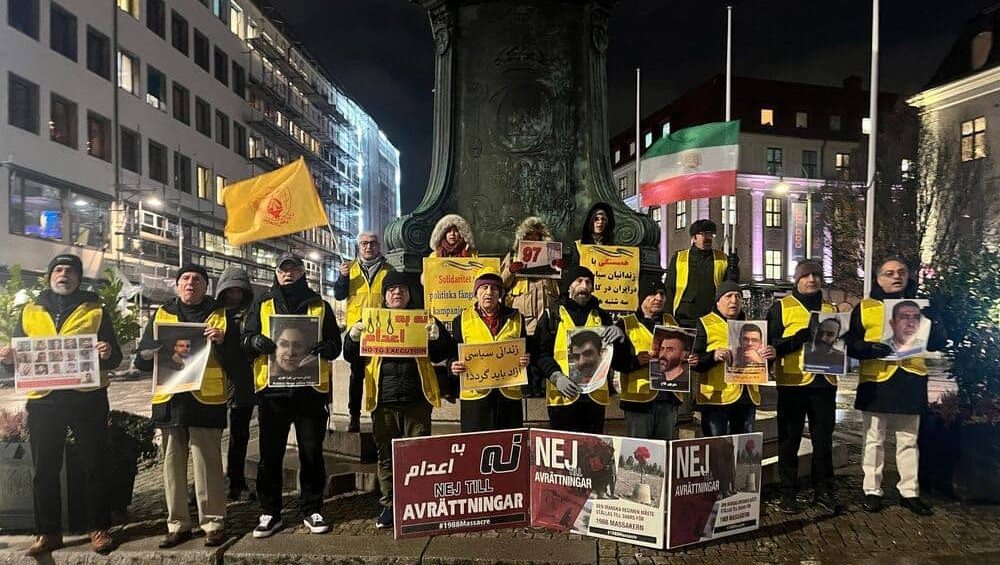
Gothenburg Rally in Solidarity with the 97th Week of Iran’s ‘No to Execution Tuesdays’ Campaign

Gothenburg, Sweden – December 2, 2025 – Supporters of the People’s Mojahedin Organization of Iran (PMOI/MEK) gathered in Gothenburg to mark the 62nd consecutive week of local participation in the global “No to Execution Tuesdays” campaign. The movement protests the Iranian regime’s escalating wave of executions and systematic repression.
Zurich: MEK Supporters Call for Ending Executions and Freeing Iran’s Political Prisoners

Zurich, Switzerland – December 2, 2025 – Supporters of the People’s Mojahedin Organization of Iran (PMOI/MEK) held a photo exhibition to protest the Iranian regime’s escalating use of the death penalty, particularly against political prisoners. The event also voiced solidarity with the growing “No to Execution” campaign.
Stuttgart Rally by MEK Supporters Denounces Executions and Calls for Regime Change in Iran

Stuttgart, Germany – November 30, 2025 – Supporters of the People’s Mojahedin Organization of Iran (PMOI/MEK) rallied in Stuttgart to denounce the Iranian regime’s extensive use of capital punishment, including the execution of political prisoners, as a serious breach of human rights.
Death Judges in Iran – Part Nine
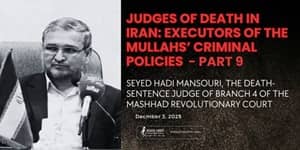
Seyed Hadi Mansouri, the head judge of Branch 4 of the Mashhad Revolutionary Court, is one of the central judicial figures in the repression apparatus in Razavi Khorasan Province. In recent years—especially during the 2022 nationwide protests—he has been at the core of grave violations of fair-trial standards, issuing heavy sentences, rushed executions, and severe punitive measures against protesters. His role in sentencing Majidreza Rahnavard, a 23-year-old protester who was publicly hanged only twenty-three days after his arrest without access to a lawyer of his choosing, became emblematic of his conduct. The hasty and public execution triggered widespread outrage and strong international reactions, cementing Mansouri’s position as one of the key decision-makers behind death sentences in Mashhad.
Washington Post: Actions of Tehran’s Leaders Are Clear Example of What Not to Do in Running an Economy

The Washington Post, in a report about Iran’s water shortage crisis, wrote: Iran is best known as an exporter of terror and mayhem around the Middle East, but its leaders also provide a great example of how not to run an economy. Consider the country’s decades-long dalliance with industrial policy. The paper wrote on Tuesday, December 2, that trade restrictions and insistence on self-sufficiency have prevented Tehran from compensating for low agricultural output through imports. If international trade made countries worse and industrial policy made them better, Iran should by now have been a wealthy nation. The Washington Post, referring to decades of industrial policy in Iran, wrote about the regime’s emphasis on “self-sufficiency” and “producing all food domestically,” noting that the problem is that water is the foundation of agriculture—and Iran is running out of it.
The Unraveling of Daily Life in Iran: When Crisis Becomes the New Normal
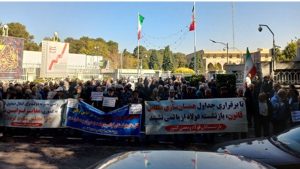
In today’s Iran, the crisis is no longer an exception; it is the structure that governs daily life. Every indicator—economic, social, or psychological—points toward a society strained beyond its limits, where the cost of survival rises faster than incomes, and where the state’s deliberate neglect deepens despair in every province. Nowhere is this breakdown clearer than in the lives of retirees, who contributed thirty percent of their wages for decades—one of the highest contribution rates by global standards—expecting security and dignity in old age. Instead, they now face a supplementary insurance fee set at 720,000 tomans, with the regime’s Social Security Organization covering only a fraction of it. Almost half a million tomans are directly deducted from their already depleted monthly pensions, a process that transforms what should have been a lifelong investment into a fresh burden.