

THIS PAGE WILL BE UPDATED WITH THE LATEST NEWS
UPDATE: 1:30 PM CEST
Reaction to Hormuz Blockade: Merz Threatens Iran

The German federal government has called on Iran to end the blockade of the Strait of Hormuz. In a statement released on Thursday (April 23), the government warned the Islamic Republic of the possible imposition of further sanctions: “If Iran continues to block the Strait of Hormuz, the federal government stands ready to consider additional sanctions.” Conversely, if a “comprehensive agreement” is reached, the government said it would be prepared, together with its partners, to “gradually ease existing restrictive measures” against Iran.
The federal government did not put forward any demands toward the other states involved in the conflict—namely the United States and Israel—in its statement. It explicitly welcomed the extension of the ceasefire between the United States and Iran. The extension of the ceasefire was described as an “important opportunity to continue diplomatic negotiations in Islamabad in order to achieve peace and prevent an escalation of the war.” Tehran, too, was urged to seize this opportunity.
UPDATE: 1:30 PM CEST
US Intercepts Sanctioned Vessel in Arabian Sea, Redirects to Iran

CENTCOM wrote on US social media platform X that the merchant vessel M/V Sevan was among 19 “shadow fleet” ships recently sanctioned by the US Treasury Department for transporting Iranian energy products to foreign markets. It said the vessel had been involved in carrying “billions of dollars worth of Iranian energy, oil and gas products, including propane and butane.”
According to CENTCOM, the ship was intercepted by a US Navy helicopter operating from the guided-missile destroyer USS Pinckney (DDG 91).
“Sevan was intercepted … and is currently complying with US military direction to turn back to Iran under escort,” it said.
UPDATE: 9:30 AM CEST
Smuggled Video Reveals Defiant Song of Hanged Iran Protesters

Pouya Ghobadi was seated alone in a prison yard. A single leafless sapling threw a thin shadow against a wall topped with coils of barbed wire. In one corner, someone had scrawled in Persian: “Death to the dictator.”
Ghobadi, 33, an electrical engineer from the western city of Sonqor, then began to sing. “I clench the weapon’s grip, with iron in my hand,” he chanted, his voice steady. “For fire is the only answer to this land.” The camera filming the young man tilted towards the sky.
Five weeks after this video was taken, Ghobadi was dead. According to Amnesty International, he was allegedly tortured before the Iranian regime hanged him on March 31, accusing him of armed rebellion against the state and membership in an outlawed organisation.
He was one of at least 17 people put to death by Iran over the five weeks to April 21, a pace that human rights monitors claim has been the fastest for decades. Amnesty believes Iran is the world’s second most prolific user of the death penalty, after China.
UPDATE: 8:30 AM CEST
PMOI Resistance Units in Zahedan Prove the Regime’s Intimidation Campaign Has Failed
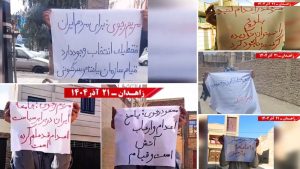
Despite the Iranian regime’s frantic attempts to crush internal dissent through an unprecedented wave of fear and repression, PMOI Resistance Units in Zahedan boldly resumed their anti-regime activities on April 24. As the clerical regime finds itself at its weakest and most vulnerable point in history, its leaders are realizing a fundamental truth: their primary existential threat is not external war, but the deep-seated popular outrage and the organized resistance of the Iranian people. The regime’s efforts to intimidate the public have visibly failed.
Taking to the streets in Zahedan, the courageous Resistance Units displayed placards in public spaces with bold messages of resistance, disrupting the regime’s calculations. They proudly declared that
“No system built on fear, repression, torture, and executions can endure in the long run.” Through their ongoing defiance, the activists emphasized that the sacrifice of Iran’s heroic rebels has “exposed and broke the silence and censorship imposed against the resistance.” Reminding the public of the movement’s deep roots, placards read, “For over 60 years, our Resistance has stood firm in an unbroken fight against the dictatorships of both the Shah and the mullahs, and today it stands as a symbol of hope for the future.”
Iran’s Healthcare Workers Continue Protest for Second Day

Protests by healthcare workers in Yazd, a key central province in Iran, entered a second consecutive day on Saturday, April 25.
Employees of the provincial health center gathered in a large demonstration outside the Governor’s Office to voice their grievances and demand accountability.
Participants cited worsening living conditions, unpaid wages, and inadequate working environment as the primary drivers of the demonstrations. They called for immediate intervention by authorities, stressing that many of their longstanding demands have gone unanswered.
According to protesters, a significant source of frustration stems from the continued lack of official response. Demonstrators emphasized that no government representative has appeared to address their concerns, leaving their appeals effectively ignored.
Reza Pahlavi and the Dream of Reviving SAVAK
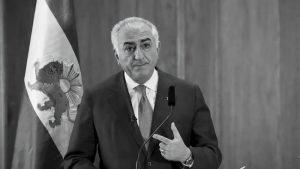
Reza Pahlavi’s recent trip to Sweden—promoted by his supporters as an “official parliamentary visit”—has once again brought into sharp focus the enduring controversy surrounding the Pahlavi dynasty and its political ambitions. Far from signaling broad international legitimacy, reports indicate that his appearance was limited in scope, taking place in a small, side-room gathering attended by a narrow audience that included a handful of representatives from a right-wing political faction. This stark contrast between the promotional narrative and the actual setting raises fundamental questions about both intent and credibility.
More importantly, the visit has reignited a deeper and more consequential debate: can a political project rooted in a legacy widely associated with authoritarianism credibly position itself as a vehicle for democratic change in Iran?
Swedish daily Dagens Nyheter captured this tension succinctly, noting that “while the resistance movement in Iran is inherently anti-authoritarian, inviting Reza Pahlavi grants legitimacy to a figure whose political project is grounded in an authoritarian legacy.” The paper further drew a parallel to post-invasion Iraq, where figures such as Ahmed Chalabi emerged in political vacuums, presenting themselves as viable alternatives despite tenuous domestic legitimacy—often with destabilizing consequences.
War and Policy Failures Push Iran’s Construction Workers into Collapse
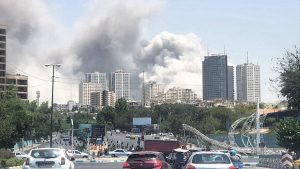
The recent war involving the Iran regime, the United States, and Israel has driven Iran’s construction workers into a crisis, pushing them to the edge of absolute poverty and uncertainty. According to official statistics and field reports, approximately 1.2 million worker households have seen their livelihoods effectively collapse. This vast labor force, already weakened by a prolonged housing recession, now finds itself buried under crushing living costs with no safety net. Iran’s construction sector had been deteriorating long before the outbreak of military conflict. Reports from the Ministry of Roads and Urban Development indicate that while the country requires at least one million new housing units annually, actual construction in recent years has barely reached one-third of that demand. With the onset of war, this fragile sector has now ground to a near-complete halt.
Akbar Shokat, head of the Construction Workers’ Trade Association, described the scale of the collapse in stark terms: “Between 2012 and 2022, around 110 million square meters of residential units were built annually. Last year, this fell to 65 million square meters, and now, with the military crisis, construction activity has dropped to just 20 percent of last year’s level.” For workers, this translates into an almost total loss of income.
Manufactured Alternatives and the Struggle for Iran’s Future
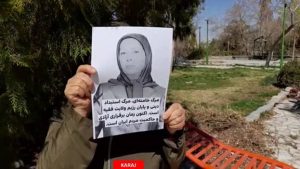
As the clerical establishment in Iran shows increasing signs of internal strain, a familiar political mechanism has accelerated: the construction of “alternatives.” This process, however, is neither new nor particularly innovative. It resembles an old, overused engine—revved up in moments of crisis, yet structurally incapable of delivering meaningful change. In recent months, segments of the Iranian public have been encouraged—implicitly and explicitly—to remain passive, to “wait” for external forces or dramatic geopolitical events to deliver liberation. At the same time, the lived reality of protest—people risking their lives in the streets—has often been reframed or appropriated to amplify figures positioned as ready-made leaders for a post-regime Iran. Through repetition across social media and satellite broadcasting, certain narratives have been amplified far beyond their organic base of support.
A recurring feature of this discourse has been the open or thinly veiled call for foreign military intervention, presented as the only viable path to change. Yet historical experience suggests that such interventions rarely align with the long-term interests of the societies they claim to assist. Instead, they tend to reflect the strategic priorities of external powers, often at the expense of domestic democratic development.
Iran War: Escalating Drug Shortages and Disruption of Healthcare Services

The International Federation of Red Cross and Red Crescent Societies has warned that the consequences of U.S. and Israeli attacks on Iran could place the country’s healthcare system under strain for months or even years.
The International Federation of Red Cross and Red Crescent Societies stated that after weeks of bombardment, Iran is facing the risk of a serious crisis in the provision of healthcare services, and shortages of equipment along with disruptions in supply chains may persist for an extended period. At the same time, the state-run newspaper Donya-ye-Eqtesad reported that drug shortages—especially specialized and imported medications—have intensified in Tehran pharmacies, forcing patients either to wait for supplies or to use alternatives with lower effectiveness.
Cristian Cortez Cardoza, Regional Vice President of the International Federation of Red Cross and Red Crescent Societies for the Middle East and North Africa, said after a four-day visit to Iran in Geneva that a ceasefire does not signify the end of the crisis.
Sudden And Violent Transfers of Political Prisoners to Qezel Hesar Prison

Following an unprecedented wave of political executions in Iran (17 executions in 35 days) and continuous pressure on political detainees, the forced transfer of political prisoners to Qezel Hesar—notoriously known as the “Execution Prison”—continues. These transfers signal a new strategic shift by the Islamic Republic’s judiciary to physically eliminate dissidents in an environment of extreme isolation and heightened restrictions. In the most recent judicial action, at 7 political prisoners from Ward 7 of Evin Prison were abruptly and violently moved to solitary confinement cells in Unit 3 of Qezel Hesar. Among families of the incarcerated, Unit 3 is infamous as a place of brutal conditions, severe restrictions, and direct threats to the lives of prisoners.
- Evidence of Torture and Degrading Treatment: Prior to their transfer, these prisoners were handcuffed, shackled, and blindfolded. Their heads were forcibly shaved, and they were severely beaten with water hoses, resulting in multiple injuries. These actions constitute a flagrant violation of human dignity and international standards for the treatment of prisoners.
Iran Executions Hidden by War: Letters Reveal Final Moments
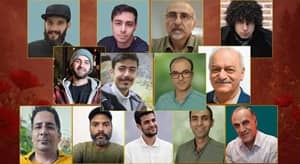
As global attention shifts to conflict, new evidence reveals how Iran executions continued quietly—documented only in final letters and smuggled videos.
While the world watched the war, others were being led to the gallows. Iran executions did not stop—they simply became harder to see.
Now, letters and final videos uncovered by The Guardian expose the last words, fears, and defiance of prisoners executed in near silence—raising urgent questions about what happens when global attention looks away.
The timing is not accidental. According to The Guardian, a surge in Iran executions has coincided with escalating conflict involving the United States and Israel, effectively pushing these deaths out of the global spotlight.
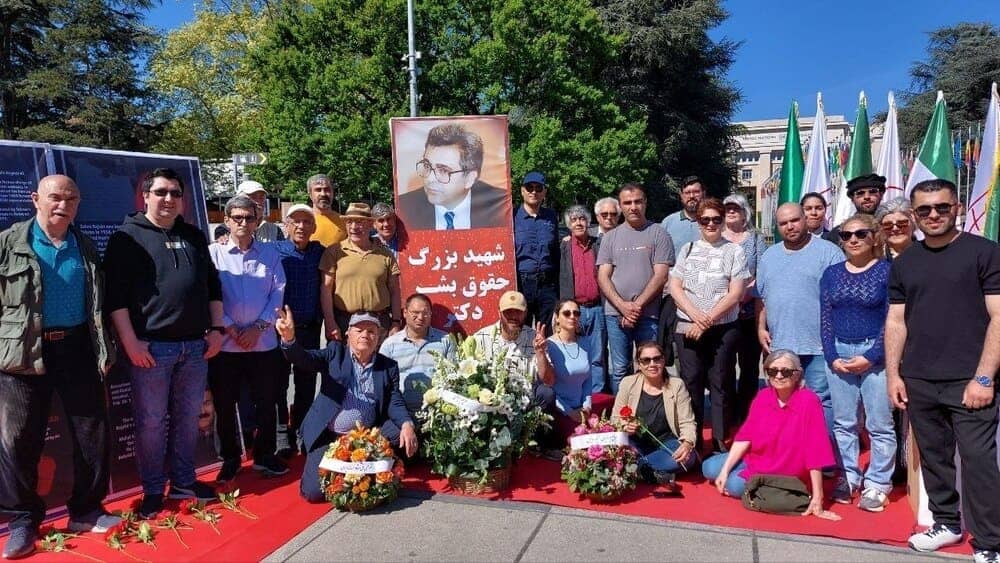
Geneva Rally Honors Dr. Kazem Rajavi, Calls for Trial of Regime Leaders Over Executions and Crimes

Geneva, Switzerland – April 24, 2026: Supporters of the Iranian Resistance gathered at Nations Square outside the United Nations headquarters in Geneva to commemorate the anniversary of the assassination of Dr. Kazem Rajavi.
Bern Exhibition Condemns Iranian Regime Executions, Calls for Release of Political Prisoners

Bern, Switzerland – April 23, 2026 – Supporters of the People’s Mojahedin Organization of Iran (PMOI/MEK) held a book stall and photo exhibition to protest the execution of PMOI political prisoners, along with protesters arrested in January 2026. The event also expressed solidarity with the “No to Execution” campaign.