

THIS PAGE WILL BE UPDATED WITH THE LATEST NEWS
UPDATE: 8:30 PM CEST
Guyana Says US-Seized Tanker “Fraudulently” Used Its Flag

Guyana’s Maritime Administration said a tanker seized by the United States on suspicion of carrying sanctioned Iranian oil had been operating under its flag fraudulently. In an official statement, the agency said the vessel is not registered in Guyana, making its claimed registration “false and fraudulent.”
According to the administration, the tanker previously operated under the name Phonix and appears on sanctions lists maintained by the US Treasury.
Officials added that although the vessel has changed its name, its International Maritime Organization (IMO) number remains unchanged and corresponds to records for Phonix in international databases. No such vessel is listed in Guyana’s national shipping registry.
Iranian Resistance Units Carry Out More Than 4,000 Operations Against the Regime’s Repressive Structures

History has repeatedly shown that, despite the military power and advanced technological capabilities of repressive forces, they are unable to eradicate an organized movement that is deeply rooted in society and founded on the ideal of freedom.
Since 2014, a new phenomenon has emerged in the struggle of the Iranian people against authoritarianism: the “Resistance Units.” This network was established by the People’s Mojahedin Organization of Iran (PMOI), the main opposition force.
Since then, these units have reached a significant level of organization. At the same time, the Iranian authorities have sought by all means to prevent the international community from becoming fully aware of the existence and expansion of this network across the country.
A notable example of their activities is the operation of February 23, 2026, carried out shortly before the outbreak of war. During this operation, approximately 250 members linked to the Resistance Units reportedly stormed the highly secured headquarters complex of the regime’s Supreme Leader, Ali Khamenei. According to available information, dozens of the attackers were killed or arrested, while 150 others managed to withdraw. Government forces also sustained significant losses. Additionally, the identities of 82 members of the Resistance Units who were killed or arrested (aged 18 to 69) have been submitted to the United Nations.
Hanged Under the Cover of War: Letters and Videos Tell Stories of Iran’s Death Row Victims

Writing from his cell in the Rajai Shahr prison in the northern Iranian city of Karaj, Babak Alipour wanted to tell his friends about those who had already gone to their execution.
There was Behrouz Ehsani, 69, the elder statesman of the group, who was “never angry” about their predicament. Then there was Mehdi Hassani, a 48-year-old father of three who he saw a couple of times in the prison hospital and who would ask him to pass on to the children the message that he was “fine”.
Despite the killings, Alipour, a 34-year-old law graduate with a passion for mountaineering who had been on death row for three years, recorded in his neat, tight, handwriting that he was not intimidated.
On 12 March he made a short video on a phone smuggled into his jail. “Dictators have come, been overthrown, died, and been killed, and now it is the turn of Khamenei-the-son’s dictatorship,” Alipour said of the accession of Mojtaba Khamenei to supreme leader after the death of Ali Khamenei in airstrikes by the US and Israel. By this time, Alipour’s brother Roozbeh, his sister Maryam, and mother Ommolbanin Dehghan had been arrested as they returned home from a vigil outside the prison in which he was being held.
UPDATE: 11:00 AM CEST
Economic Fury Targets Global Network Fueling Iran’s Oil Trade and Shadow Fleet
WASHINGTON—Today, the U.S. Department of the Treasury’s Office of Foreign Assets Control (OFAC) sanctioned China-based independent teapot refinery Hengli Petrochemical (Dalian) Refinery Co., Ltd. (Hengli). China-based independent teapot refineries continue to play a vital role in sustaining Iran’s oil economy, and Hengli is one of Iran’s largest customers for crude oil and other petroleum products, having purchased billions of dollars’ worth of Iranian petroleum. Additionally, OFAC is targeting approximately 40 shipping firms and vessels that operate as part of Iran’s shadow fleet, whose transportation of petroleum and petrochemicals provides a financial lifeline to Iran’s unstable regime. Economic Fury continues to disrupt Iran’s ability to generate the revenue that enables Tehran’s reckless activities throughout the Middle East and its capacity to threaten American interests.
UPDATE: 07:00 AM CEST
The Legacy of Dr. Kazem Rajavi Still Lives On 36 Years After His Assassination
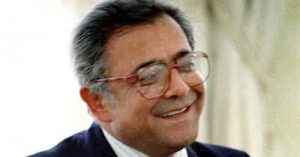
On April 24, 2026, the Iranian Resistance marks 36 years since the tragic assassination of Dr. Kazem Rajavi near his home in Coppet, Switzerland. Dr. Rajavi was not merely a victim of the Iranian regime’s state-sponsored terrorism; he is remembered by the Iranian people as the “Great Martyr of Human Rights.” Agents of Iran’s Ministry of Intelligence and Security (MOIS) assassinated him in 1990, believing bullets could permanently silence his voice. Instead, his lifelong mission to expose the clerical regime’s brutality laid the unshakeable groundwork for today’s ongoing fight for justice in Iran.
Dr. Rajavi possessed an unmatched intellect and global standing. Holding six doctoral degrees in law and political science from universities in France and Switzerland, he authored over 120 books and dissertations and taught at various Swiss universities. Following the 1979 anti-monarchist revolution, his stellar reputation earned him the role of Iran’s first ambassador to the United Nations in Geneva, and later ambassador to Senegal and head of the political delegation to seven West African countries.
The Brutal Relocation of Political Prisoners to Ghezel Hesar’s Solitary Confinement

On April 13, 2026, the Iranian regime’s judiciary authorities orchestrated a sudden and violent transfer of political prisoners from Ward 7 of Evin Prison to solitary confinement in Unit 3 of the notoriously brutal Ghezel Hesar Prison. This violent relocation, characterized by severe physical abuse and absolute secrecy, exposes the regime’s deep-seated fear of prisoner solidarity and its systematic use of psychological and physical torture to break the will of dissidents, particularly those affiliated with the People’s Mojahedin Organization of Iran (PMOI/MEK).
The transfer of the prisoners was carried out with extreme brutality. On April 12 and 13, 2026, Evin’s guards moved the prisoners while they were handcuffed, shackled, and blindfolded. Before their departure from Evin, the guards forcibly shaved their heads and severely beat them with water hoses, inflicting serious injuries. The beatings left the political prisoners, including Mehdi Vafaei Sani and Mir Yousef Younesi, severely injured.
Iran’s Regime Pressures Imprisoned Women to Halt Anti–Death Penalty Campaign
Reports from Evin Prison point to a sharp increase in pressure on political detainees, particularly imprisoned women held in the women’s ward.
According to these accounts, the prison’s director has issued a new directive banning any participation by female prisoners in the “No to Execution Tuesdays” campaign and has threatened punitive measures, including transfer to solitary confinement and the suspension of phone calls.
Following the implementation of this directive in the women’s ward, any form of protest, hunger strike, or even chanting by prisoners is expected to trigger a severe response. One of the central aims of these new restrictions appears to be halting the “No to Execution Tuesdays” campaign, an initiative led by political prisoners to protest death sentences and draw public attention to the issue.
9-Year-Old Girl’s Murder Exposes Iran Regime’s Failure to Protect Children

The mutilated and charred body of 9-year-old girl, identified as Fatemeh Zahra Hosseinbar, was discovered four days after she was abducted in the city of Gasht, a district of Saravan, in southeastern Iran.
On Friday, April 17, 2026, the child was reportedly abducted by armed occupants of an unmarked Peugeot vehicle. Her body was later found among piles of garbage on the outskirts of the city, where it had been set on fire.
On Monday, April 20, residents discovered her remains. According to local sources, both child’s hands had been severed. Due to the severity of the burns, the body was not immediately identifiable. Her identity was confirmed only after her mother was brought to the scene and recognized her through the soles of her feet.
Fatemeh Zahra Hosseinbar was laid to rest on Tuesday, April 21, in the cemetery of Gasht, Saravan County, in Iran’s Sistan and Baluchestan Province. The funeral drew a large public turnout and was marked by a heavy atmosphere of grief. Streets and roads leading to the cemetery were filled with mourners expressing solidarity with the Hosseinbar family.
Iran Regime Executions Spark Global Outcry, Expose Judiciary’s Escalating Repression

The Iran regime appeared to calculate that, amid the chaos of war and the distraction of missile strikes, it could quietly carry out the executions of two members of PMOI-linked “Resistance Units.” However, the executions of Hamed Validi and Mohammad Masoum-Shahi quickly broke beyond any intended silence, drawing significant international media attention and condemnation. Rather than remaining a domestic act of repression, the incident reverberated across major global capitals and leading international news outlets. The scale of coverage transformed what the regime may have intended as a routine act of intimidation into a highly visible episode, placing its judiciary under renewed scrutiny.
Major outlets—including Reuters, Agence France-Presse, Associated Press, Fox News, NBC News, The Washington Post, Italy’s AGI, and UK-based publications—collectively highlighted the executions, framing them within the broader pattern of the Iran regime’s use of capital punishment during periods of political unrest and conflict.
When Classrooms Fall Silent: How the Iran Regime’s Crises Are Devouring a Generation’s Right to Education
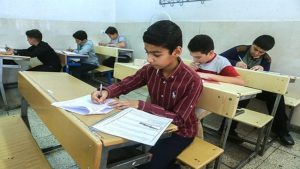
At the heart of this crisis lies a fundamental deprivation: students are being denied their most basic right—the right to consistent, structured education. With authorities openly acknowledging that there is currently no viable plan to resume in-person schooling, millions of children remain trapped in an educational limbo.
The regime has attempted to present alternatives—virtual classrooms, televised lessons, and pre-packaged educational materials—as functional substitutes. In practice, these measures have proven deeply inadequate. Chronic weakness in digital infrastructure has made access to online platforms unreliable at best. The widely promoted “Shad” system, intended as the backbone of remote education, suffers from server limitations and accessibility issues that render it ineffective for large segments of the population.
Survival Is Not Victory: The Iran Regime’s Defensive Narrative in a Deepening Crisis
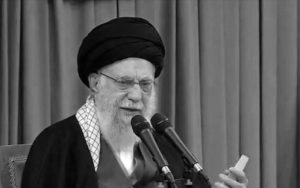
In political and military analysis, one of the most persistent analytical errors is reducing the concept of “victory” to mere physical survival. Today, the Iran regime appears to be leaning heavily on precisely this simplification—promoting the notion that because it has not been overthrown, it has therefore prevailed.
This is not an objective assessment of reality. It is a calculated psychological and political instrument designed to preserve internal cohesion—particularly among demoralized elements within the security apparatus, including the Revolutionary Guard and affiliated forces. In essence, it is an attempt to stabilize a shaken system by redefining the terms of success.
From an analytical standpoint, this approach fits within a broader framework that can be described as “crisis management through the redefinition of failure.” When a political system faces multiple, overlapping crises—as the Iran regime currently does—it often shifts the metrics by which outcomes are judged. Instead of measuring losses, degradation of capacity, and systemic erosion, mere continuation is reframed as an achievement.
The German Government Will Not Receive the Son of Iran’s Last Shah
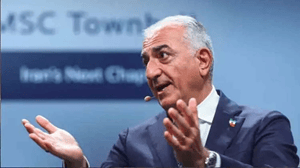
Following reports of Reza Pahlavi, the son of Iran’s last Shah Mohammad Reza Pahlavi, traveling to Germany to attend a session at the Bundestag (Germany’s federal parliament), the German government announced that it will not receive him and sees no reason to negotiate with him.
Stefan Kornelius, spokesperson for the German government, said that during the Thursday visit of the son of Iran’s last Shah to Berlin, German government representatives will not receive him, and the German government sees no reason to negotiate with him.
He added that the German government expects the people of Iran to have the right to freely choose their own leadership.
Additionally, 21 political figures in Germany addressed a letter to the Bundestag president and the heads of parliamentary factions, expressing serious concern about the visit of the former Shah’s son to Berlin and emphasizing that this trip would be an insult to millions of Iranians who overthrew the Shah’s dictatorship.
Iran: Violent Transfer of Political Prisoners to the Notorious Ghezel Hesar Prison
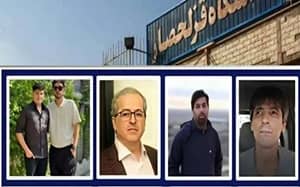
On Monday, April 13, seven political prisoners held in Ward 7 of Evin Prison in Tehran were abruptly, violently, and humiliatingly transferred to solitary confinement cells in Unit 3 of Ghezel Hesar Prison, a facility whose name is associated for many families of political prisoners with pressure, isolation, and serious threats to prisoners’ lives.
Among those transferred are Miryousef Younesi, a 71-year-old political prisoner, and Mehdi Vafaee, a 40-year-old political prisoner. Mehdi Vafaee was arrested in June 2022 and sentenced to 6 years in prison on charges of “assembly and collusion against national security” and “membership in the People’s Mojahedin Organization of Iran (PMOI/MEK).” His mother, Shiva Esmaili, is also a political prisoner held in the women’s ward of Evin Prison; she was arrested in February 2023 and sentenced to 10 years in prison.
Criminalizing Information Technology in Iran

In April 2026, the Islamic Republic of Iran, adopting a strictly security-oriented approach, has suppressed the right to access information and freedom of expression in an unprecedented manner. According to a report by the monitoring organization NetBlocks on April 23, the nationwide internet shutdown in Iran has entered its “55th consecutive day.” The report emphasizes that after 1,296 hours, internet connectivity has plummeted to “2% of ordinary levels.” This absolute blackout has created a platform for implementing “security elimination” policies under a complete news silence.
Security agencies are targeting tools for accessing the free internet, effectively treating the right to communicate with the outside world as an act of espionage. According to an ILNA news agency report on April 21, the Information Center of the Greater Tehran Law Enforcement Command announced the discovery and seizure of unauthorized “Starlink” receivers. In its communiqué, the police claimed: “Investigations revealed that the company’s CEO had no knowledge of the suspect’s activities, and the suspect, by exploiting the company’s name, engaged in profit-seeking and maintained continuous communication with foreign entities and hostile networks… The police emphasize that a significant portion of espionage activities in Tehran are conducted using Starlink devices.”
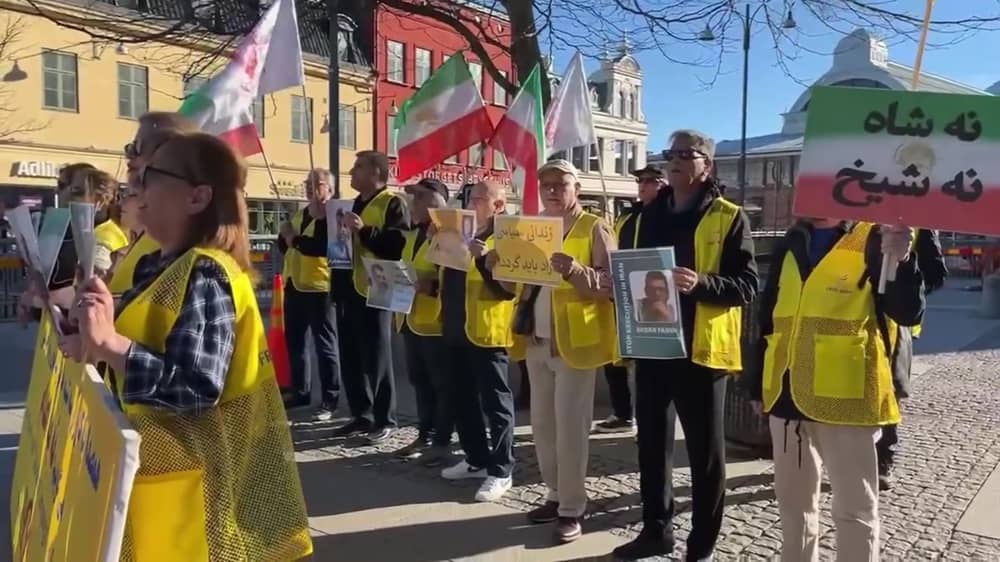
MEK Supporters in Gothenburg Mark the 117th Week of the “No to Execution Tuesdays” Campaign in Iran

Gothenburg, Sweden — April 21, 2026: Supporters of the People’s Mojahedin Organization of Iran (PMOI/MEK) held a rally marking the 117th consecutive week of the “No to Execution Tuesdays” campaign, a movement opposing the Iranian regime’s escalating wave of executions and systematic repression.
Paris Exhibition Honors Executed Iranian Political Prisoners, Urges Democratic Change in Iran

Paris, France – April 23, 2026 – A book stall and photo exhibition by the People’s Mojahedin Organization of Iran (PMOI/MEK) was held in Paris, honoring PMOI political prisoners who were recently executed by the Iranian regime, as well as the fallen protesters of the January 2026 uprising and other nationwide protests.