

Six-minute read
As the U.S.-Iran deadlock drags into its third month, the Strait of Hormuz remains a flashpoint that has already cost the global economy tens of billions and sent oil prices spiking past $120 a barrel. A fragile ceasefire holds, yet neither side has budged: Washington maintains its naval blockade of Iranian ports, Tehran keeps the waterway contested, and 20 percent of the world’s oil and LNG trade stays paralyzed.
One might argue that the strongest conventional armies in the world have failed to overthrow the regime, which has also crushed every nationwide uprising and local revolt since 2017. So, is the world doomed to coexist indefinitely with the leading state sponsor of global terrorism?
This question dominates every serious debate about Iran’s future. It sounds conclusive. It is also mistaken. The formula for regime change in Iran—the only durable solution—is not military. It is social. The regime itself keeps proving this, unintentionally, through the way it deploys its forces, selects its targets, and punishes its prisoners. Its survival strategy has become its clearest confession.
And that is precisely why the question matters right now. While the military and economic stalemate over Hormuz continues to bleed the global economy, the only path that has ever truly threatened the brutal theocracy is an internal, society-driven unraveling. Until that social fracture widens, the standoff will persist—with no end to the disruption in sight.
"On the morning after the ceasefire, every exhausted and exasperated mind, long numbed by the #IranWar, will turn instinctively toward the search for real change and the practical means to bring this regime to an end." https://t.co/8Tmh0Sl0Kc
— NCRI-FAC (@iran_policy) April 9, 2026
The Myth of Cohesion
The regime’s durability does not stem from ideological unity. The fact that it did not fracture after the loss of senior military and political figures reveals the opposite: its cohesion rests not on shared ideals but on a raw collective interest in survival. Every member of the Islamic Revolutionary Guard Corps, every Basij militiaman, and every intelligence operative understands that if the system collapses, decades of plunder and bloodshed will unleash a societal fury that will consume them and their families. With nowhere to flee and no foreign refuge, they cling together as long as they hold the guns.
For four decades the regime has poured resources into underground missile cities, overlapping security agencies, and proxy armies abroad. It has rehearsed its internal crackdown playbook for years. Yet this single-minded focus on survival has come at a steep price. The same investments that hardened the regime against external shocks starved the country of governance, infrastructure, and reform. The economy lies in ruins, and the population—educated, connected, and politically mature—sees no viable path to improvement under the existing order. As long as the regime refuses meaningful political or economic change, the demand for its overthrow remains a permanent, structural feature of Iranian society.
The Regime’s Real Dread
The Revolutionary Guard and its militias are large, decentralized, and heavily armed. No serious observer disputes their capacity for repression. Yet the regime’s behavior in recent months reveals that its primary fear is not a foreign invasion. Its deepest dread is the fusion of a seething society with an organized, experienced, and fearless resistance.
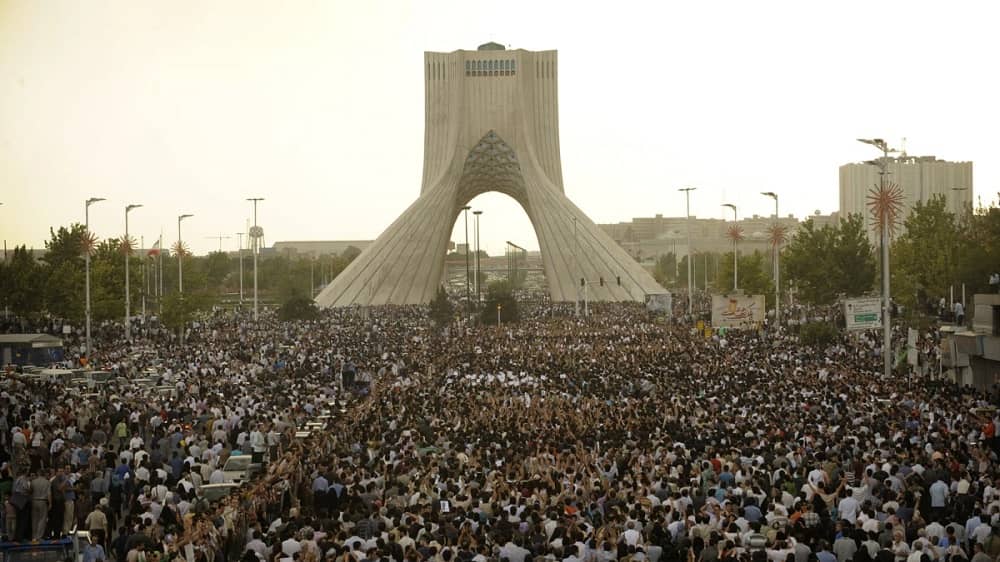
Since 2017, Iran has experienced repeated nationwide uprisings. In response, the regime has placed cities under de facto martial law: tens of thousands of troops and Basij forces manning checkpoints, mass arrests of anyone suspected of ties to foreign media or opposition networks, and compulsory rallies by security personnel and their families. These are not publicity stunts. They are preparations for domestic war. Even now, amid the most extensive internet shutdowns ever recorded, the regime maintains this posture because it correctly identifies its greatest threat as coming from below.
Iran's authorities are trampling upon children’s rights and committing a grave violation of international humanitarian law amounting to a war crime by recruiting children as young as 12 into a military campaign led by the Islamic Revolutionary Guard Corps. https://t.co/nRfBRAR8wA
— Amnesty Iran (@AmnestyIran) April 2, 2026
Iran’s regime is already rotten at its core—hollowed out by four decades of prioritizing survival over governance—but it remains standing because it has invested massively in that wall of fear, both physically (through its vast internal security apparatus and constant urban deployments) and psychologically (through propaganda, selective executions, and the systematic suppression of alternative narratives). The decisive shift will come when ordinary Iranians stop calibrating their daily behavior around anticipated punishment. The regime’s own full-scale internal mobilization—its de facto martial-law posture in the cities—is the clearest proof that it grasps this social dynamic far better than many external analysts.
The Missing Link
Some people doubt the strength of the PMOI-led Resistance Units because any solid assessment, when measured directly against the regime’s vast security forces, shows the Units to be vastly outnumbered. Yet they view this comparison through a static lens: a fixed snapshot of a catalyst moving through an explosive society. The question is understandable but incomplete.
The regime’s own survival strategy has already confessed the truth: it treats even small, disciplined acts of defiance as existential threats. That is why it deploys its most brutal forces not against foreign armies, but against its own people—precisely because it knows an explosive society only needs a spark. The Resistance Units are that spark. They are the missing link. They cannot topple the brutal theocracy by themselves. But once placed in their proper role—leading and radicalizing the explosive society—they become far bigger than their numbers suggest.
The January 2026 uprising proved the playbook works. In Malekshahi and Abdanan, as well as in districts of Tehran, Rasht, and Mashhad, organized Resistance Units moved in, coordinated local defiance, and triggered rapid liberalization of whole neighborhoods. What began as targeted acts of resistance scaled into temporary liberation zones because the Units supplied the model, the discipline, and the visible proof that the regime’s aura of invincibility could be shattered.
In recent weeks the regime executed eight members of these Resistance Units. They were not random detainees. While under death sentences, they were offered a straightforward bargain: renounce the organized resistance, appear on state television, and live. They refused. Instead, they secretly recorded multiple video messages and smuggled them out of prison. Their explicit purpose was to deliver one message to Iranian society: this regime is overthrowable; the only price is courage.
Smuggled video reveals defiant song of hanged Iran protesters https://t.co/anCm7BaEpQ
— The Times and Sunday Times (@thetimes) April 26, 2026
These videos have circulated widely inside Iran, even among those long exposed to regime propaganda against the Resistance. Their impact appears in a broader pattern. Other executed prisoners—with no proven organizational link—adopted the identical method and posture. They confronted the regime on its own terms, accepted the ultimate cost, and used their final acts to erode its aura of invincibility. The method itself has become contagious.
This dynamic is confirmed by recent testimony from a former political prisoner, broadcast on Clubhouse. He described how PMOI members Vahid Bani Amerian (33) and Abolhasan Montazer (65), after release from prison, immediately reconnected with the Resistance and resumed activity. He expressed astonishment at Montazer’s conduct during the 2022 prison uprising: despite illness and age, the 65-year-old bared his chest to the snipers and shouted “Shoot me!”—an act that forced the guards to retreat and emboldened other inmates.
The regime’s multiple overlapping crises ensure that the pool of potential participants remains large and growing. The organized Resistance does not need to be the most widespread force today. It only needs to supply a credible, tested model of defiance that others can recognize and replicate. Visible, repeatable acts that change how ordinary people calculate risk are precisely how social resistance scales—and how the missing link finally snaps the chain.
🚨 Simay Azadi Exclusive – The Defense of “Commander Vahid”
Iran News AlertIn a video recorded from prison, PMOI member Vahid Baniamerian explains why he joined the organization and delivers a defiant response to the regime, standing firmly by his ideals.
He also voices his… pic.twitter.com/ST9kdQyYGJ— SIMAY AZADI TV (@en_simayazadi) April 8, 2026
How the Regime Undermined Its Main Threat
From its earliest days the regime confronted a nationwide resistance with deeper organizational experience and political roots than its own. In its first decade it exploited the Iran-Iraq War to launch a physical purge of that movement. When, despite multiple massacres and the 1988 genocide, that effort failed, it turned to psychological warfare and propaganda.
The regime spent millions of dollars and deployed hundreds of paid proxies—journalists, analysts, and self-styled activists—to flood Iranian public opinion, both inside the country and in the diaspora, with fabricated narratives against the People’s Mojahedin Organization of Iran. Hundreds of films and television series, millions of hours of online content, and thousands of articles hammered home a single message: the regime may be unpopular, but it is stable, powerful, and irreplaceable. The campaign was so pervasive that younger generations inside Iran often knew the group only by the regime’s slur, “Monafeqin” (hypocrites).
In Western capitals the regime inserted its elements into media, think tanks, government advisory circles, and human-rights organizations to reinforce the same line. In the past decade, after the illusion of internal reform collapsed, its intelligence apparatus launched a new project: elevating Reza Pahlavi and remnants of the fallen monarchy. The goal was to channel public discontent toward a figure who possessed no organized network inside Iran, promised to preserve the regime’s core institutions (including the IRGC, Basij, and intelligence agencies), refused to break with the crimes of the previous dictatorship, and staked everything on foreign military intervention and bombing.
This operation proved win-win for the regime. It sold the desired narrative to foreign governments and some opposition factions, fragmented the Iranian opposition at home and abroad, delayed international sanctions on regime military forces, and gave regime media a ready-made story of “opposition disunity.” Most consequentially, Pahlavi’s open endorsement of strikes on Iranian cities and his calls during the uprising handed the security forces a free hand. On January 8 and 9, 2026, they carried out mass killings with the required justification. The most effective outcome of Pahlavi’s foreign activities was not pressure on the regime but social disillusion as well as intensified political and social attacks on the organized Iranian Resistance.
Tracing #Iran’s Web of Influence in #European Politicshttps://t.co/MHj1gvKCtv
— NCRI-FAC (@iran_policy) November 26, 2023
The Path Forward
The geometry of regime change in Iran is now unmistakable. The regime is too decentralized and too invested in its security state to be toppled from the air. It survives by maintaining a wall of fear. The counter is therefore social, not military. The regime has already revealed the operational address of its own vulnerability: its panicked, resource-intensive reaction to a decentralized yet highly organized resistance that refuses to fear death and insists on speaking directly to the Iranian people.
Hence, the only way for the outside world to accelerate viable change is to:
- Recognize the provisional government announced by the National Council of Resistance of Iran (NCRI).
- Close the regime’s embassies and expel agents and operatives of the Ministry of Intelligence and the Revolutionary Guard Corps.
- Provide the technical means to guarantee the Iranian people’s access to a free internet.
- Condition all relations with the clerical regime on an immediate end to the execution of political prisoners and the killing of protesters.
- Bring the regime’s leaders to justice for crimes against humanity and genocide.
The regime has already done the hardest work for its opponents. By its internal war posture, its choice of execution targets, and its desperate efforts to silence specific voices, it has mapped the precise social mechanism that can bring it down. The only remaining task is to let Iranian society see that map with unmistakable clarity.