

Three-minute read
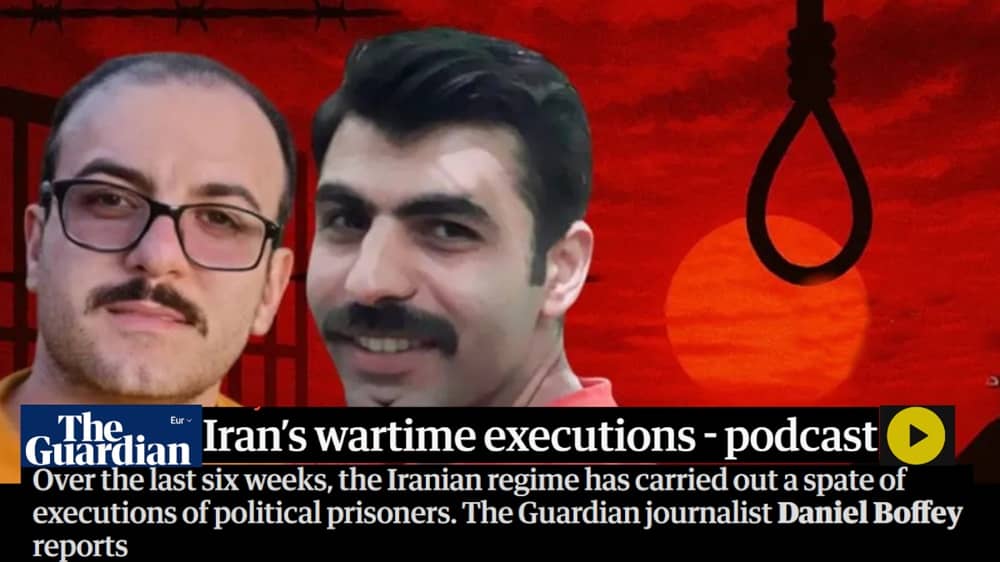
In the latest episode of The Guardian’s Today in Focus podcast, the clerical regime in Iran stands exposed for its savage acceleration of executions against political prisoners. Under the cover of regional war, the dictatorship has hanged at least 18 political prisoners and protesters in just six weeks, rushing death sentences through the courts with ruthless speed. The Guardian highlights how the regime is desperately trying to project strength while the world is distracted by oil prices and stalled negotiations.
Heroes Defy the Regime’s Terror
A powerful part of the podcast focuses on the targeted slaughter of members of the People’s Mujahedin Organization of Iran (PMPOI). Babak Alipour, a 34-year-old law graduate from north-western Iran and a bright, articulate activist, is named as one of the most prominent victims. Inspired by the PMOI’s satellite television channel, he joined the Resistance movement and was arrested first in 2018, then again on the regime’s usual vague charges of “membership of an opposition organization” and “collusion to damage national security.”
In October 2024, Babak Alipour and six fellow PMOI supporters — men he knew through mountaineering expeditions — were sentenced to death by a notorious “hanging judge.” The Guardian reports that all judicial appeals were expedited at lightning speed in recent weeks, sending these brave Resistance members to the gallows. As The Guardian’s reporting makes clear, the regime is deliberately accelerating the executions of PMOI members and other political prisoners under the cover of war to send a brutal message to its people: “We are still in control.”
The letters of PMOI martyr Babak Alipour.
The mullahs' regime may have taken Babak Alipour’s life, but his words will continue to echo across Iran, inspiring a generation determined to turn his dream of a democratic republic into reality.https://t.co/biJjkujYyP
— People's Mojahedin Organization of Iran (PMOI/MEK) (@Mojahedineng) April 1, 2026
Defiant Voices from Inside the Regime’s Prisons
Babak Alipour left behind powerful video messages smuggled out of prison that have become symbols of Resistance courage. In one filmed by a fellow inmate and another recorded by Alipour himself, he spoke calmly to friends and colleagues abroad. As The Guardian quotes him, the executions were “clearly a sign of weakness, not strength,” and he expressed unwavering confidence that “the establishment of people’s rule will be more stable.”
A particularly moving clip captured in the courtyard of the notorious Ghezel Hesar prison shows some of these PMOI prisoners singing a protest anthem under a clear blue sky: “Now rise up like thunder, let your arms be shown.” There were no tears — only defiance. Within hours they were hanged in a barbaric process that sometimes included the regime’s infamous “double hanging” — strangling prisoners to the brink of death, reviving them, and hanging them again. The Guardian’s podcast lays bare this medieval cruelty designed to break the spirit of the Iranian Resistance.
4 executions in 48 hours. The Iranian regime has hanged PMOI members Babak Alipour & Pouya Ghobadi just one day after executing Mohammad Taghavi & Ali Akbar Daneshvarkar. Under the fog of war, the mullahs are carrying out a new purge of political prisoners. #StopExecutionsInIran pic.twitter.com/yjUKi2HQYJ
— People's Mojahedin Organization of Iran (PMOI/MEK) (@Mojahedineng) March 31, 2026
Families Threatened as the Regime Hides Its Crimes
The regime’s methods are as cowardly as they are brutal: sudden transfers to Ghezel Hesar prison without notifying families, executions at dawn, and the refusal to return bodies for burial. Families who travelled to Tehran to claim the remains of their loved ones were turned away. As The Guardian reports, preventing any public mourning or focal point for protest is central to the dictatorship’s strategy of terror.
An Iranian dissident now living in Sweden, whose father was arrested for supporting families of regime victims through a network linked to the PMOI, spoke out in the podcast despite the risks. The Guardian quotes him warning that the regime is using these death penalties “to spread fear in society and also to show that ‘Yes, we are powerful. Maybe we are hit badly by the US and Israel, but still we are in control.’” He urged the world not to let the war overshadow the human-rights catastrophe inside Iran’s prisons.
Harrowing video shows Iranian protesters sing before being hanged https://t.co/bBf9BePGZp pic.twitter.com/hc2pSw9jJq
— New York Post (@nypost) April 27, 2026
The Resistance Will Not Be Silenced
The Guardian’s Today in Focus episode makes one thing crystal clear: these executions are not a sign of regime strength but of its panic and weakness. After more than four decades of repression, the clerical dictatorship knows it has lost control of Iranian society. The brave stand of Babak Alipour and his fellow PMOI members — singing protest songs on the eve of their martyrdom — proves that the spirit of Resistance cannot be broken by the gallows.
As global attention remains fixed on oil prices and diplomatic talks, The Guardian reminds us that the real story is inside Iran’s death row. The regime is sending a desperate message to its people: “We are still in control.” But the courageous voices of the Iranian Resistance tell a different truth — one of inevitable freedom and the coming end of this brutal dictatorship. The world must listen.