

THIS PAGE WILL BE UPDATED WITH THE LATEST NEWS
UPDATE: 05:30 PM CEST
Concern Over Pro-Iranian Terror Grows – Calls for Better Protection

Iran is regarded as a primary state sponsor of terrorism. That it might rely on this instrument during wartime was immediately feared following the attacks by the United States and Israel. In recent weeks, the signs have continued to mount. The growing threat of attacks by pro-Iranian actors is making the security impact of the Iran conflict increasingly vivid in Germany. Security expert Peter Neumann points to indications that the pro-Iranian network HAYI may be acting on behalf of the regime in Tehran. “There are several indications of Iranian direction,” said the professor at King’s College London in an interview with the Rheinische Post.
According to Neumann, the group only became visibly active after the start of the Iran conflict and is operating within that context. “The selection of targets aligns with Iran’s perceived enemies: attacks on Jewish communities, Israeli targets, U.S. companies, as well as the Iranian opposition,” he said. The operational methods also match patterns previously associated with the Islamic Revolutionary Guard Corps in past attacks.
A typical feature, he explained, is the recruitment of perpetrators from criminal circles, sometimes online via social media. “These individuals often have no ideological affinity with Iran and are paid to carry out the attacks. This allows Tehran to deny involvement—there is no ‘smoking gun’ as evidence.”
UPDATE: 07:30 AM CEST
Message for International Workers’ Day
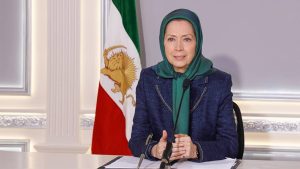
Mrs. Maryam Rajavi’s message: “On International Workers’ Day, I extend my heartfelt congratulations to you, despite the many hardships and injustices under the rule of the religious dictatorship. On the eve of this day, a pioneering worker and PMOI member, Mohammad Masoum-Shahi, a 38-year-old technical worker, was executed on April 20 for defending the legitimate rights of working people by Khamenei’s executioners. Before him, Ali-Akbar Daneshvarkar, a civil engineering graduate who worked as a motorcycle courier, was executed on March 30 for the “crime” of striving for the freedom of the Iranian people. They stand at the forefront of a long line of workers who, through their broad and determined presence in direct confrontation with the regime this year, have brought pride to Iran’s working class. These are the same workers who took part in the January uprising, many of whom lost their lives due to gunfire from security forces or were imprisoned. Alongside them are the nurses who rushed to aid the wounded, paying the price with imprisonment and, in some cases, with their very lives.”
Former Archbishop of Canterbury Rowan Williams Meets Maryam Rajavi
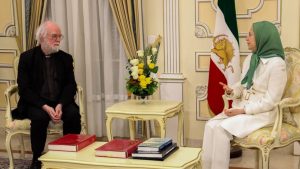
On Wednesday, April 29, 2026, Dr. Rowan Williams, the former Archbishop of Canterbury, met and held talks with Maryam Rajavi.
The Archbishop of Canterbury is the highest-ranking clerical authority in the Church of England and has a wide following in many countries. During the meeting, Maryam Rajavi expressed her appreciation for Dr. Williams’ efforts in promoting peace, democracy, and interfaith dialogue. She stated that the Iranian Resistance will never forget his positions condemning human rights violations in Iran, as well as his consistent support for the PMOI/MEK over the past two decades, particularly at times when they were under the most intense attacks at Camp Ashraf and Camp Liberty.
Referring to the growing wave of executions and repression aimed at preventing an uprising, Maryam Rajavi stated that what the clerical regime carries out in the name of God and Islam has nothing to do with Islam. Islam, like Christianity, is a religion of peace, tolerance, and humanity. Using Islam as a tool for repression and violence is a betrayal of its true essence. Fundamentalism not only fails to defend Islam but is, in fact, one of its greatest enemies.
Iran’s Regime Executes Uprising Protester Sasan Azadvar

At dawn on April 30, 2026, the Iranian regime executed Sasan Azadvar, a 21-year-old karate champion and courageous rebellious youth from Isfahan. Arrested during the massive January uprising, Azadvar was severely tortured before his death. His execution is another grim reminder of the clerical regime’s desperate reliance on the gallows to suppress dissent and intimidate a restive population. The criminal death sentence was issued by Branch 1 of Isfahan’s sham Revolutionary Court, presided over by the notorious executioner judge Morteza Barati, and was quickly upheld by the regime’s Supreme Court. The judiciary’s Mizan news agency outlined his charges as “attacking State Security Force (SSF) officers with the intention of confronting the system,” disrupting national security, and inciting riots to overthrow the regime.
Ironically, in its attempt to justify the murder, the judiciary’s own account highlighted the young man’s bravery. State media detailed how he attacked an SSF minibus with stones and clubs, broke its windows, and even attempted to obtain gasoline to set the vehicle on fire while oppressive forces were still inside.
Iran Reports PMOI Arrest in Khuzestan Amid Rising Executions
On April 29, the state-run Tasnim News Agency—an outlet affiliated with the Islamic Revolutionary Guard Corps (IRGC) Quds Force—reported the arrest of an individual in Khuzestan Province. Authorities described the detainee as an “operational element” linked to the People’s Mojahedin Organization of Iran (PMOI), an Iranian opposition group.
🚨 Iran News Alert
Images of 12 detainees recently identified by the Iranian opposition. According to these reports, they are under immense pressure.
Amid a broader escalation in executions and pressure on political prisoners, concerns continue to grow over their fate. https://t.co/oHVUThmFAY pic.twitter.com/4A2zRPvfQP
— SIMAY AZADI TV (@en_simayazadi) April 21, 2026
While Tasnim announced the arrest on April 29, Iranian opposition sources had already identified the individual as Mohsen Daghaghaleh on April 21. He was reportedly among a group of 12 individuals detained for alleged support of the PMOI. Images of the detainees circulated at that time, alongside reports indicating they were being held under significant pressure.
April 2026 Report: Mass Arrests of Women
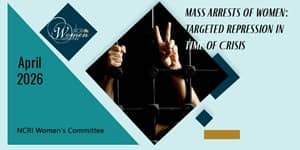
April saw a surging wave of mass arrests and targeted repression against Iranian women, marking a strategic escalation of control amidst the ongoing crisis. This period was marked by sweeping arrests, harsh judicial rulings, and escalating harassment of the families of political prisoners and those killed during the 2026 uprising. This report sheds light on the plight of women as deepening political crises and information blackouts continue to mask the true scale of these human rights violations.
The Iranian regime has once again exploited the atmosphere of tension and the war crisis it has imposed on the Iranian people to intensify domestic repression. While public attention was partially diverted toward regional developments and the war, security apparatuses systematically expanded the scope of internal control and crackdowns.
Field reports indicate that a wave of daily arrests has been unleashed, targeting women and young girls. These detentions are often carried out under the guise of vague security charges and without any semblance of transparent judicial processes. In many of these instances, these women and girls are being apprehended alongside their spouses or other family members.
Iran’s Digital Siege: A Nation on the Brink of Explosion
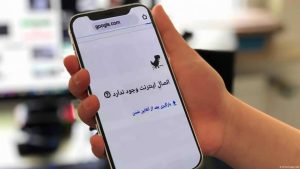
In April 2026, Iranian society finds itself in a state best described as the “calm before the storm.” More than two months after the near-total shutdown of international internet access—replaced by ineffective and discriminatory schemes such as the so-called “Pro Internet”—tensions between an increasingly explosive society and the ruling establishment have reached a new and dangerous threshold. Access to the global internet in Iran has now plummeted to a catastrophic 2 percent. This is no longer a temporary technical disruption or a short-term security measure; it is a profound indictment of a regime that, at the height of its desperation, has resorted to holding cyberspace hostage as a last line of defense.
Faced with the tremors of a restive population, Iran’s regime has effectively engaged in what can be described as digital self-destruction—buying time in a bid for survival. By severing 85 million citizens from the outside world, authorities are fully aware that the internet in today’s Iran is not merely a communication tool; it is the lifeline of independent information and the lens through which society perceives truth.
War, Mismanagement, and the Unraveling of Women’s Employment in Iran
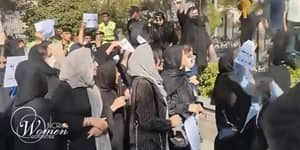
Military escalation and economic disruption have triggered a silent collapse in women’s labor participation, exposing deep structural inequalities in Iran’s job market.
Iran regime’s ongoing cycle of military tension and strategic adventurism has once again pushed the country toward economic instability—with consequences that are neither abstract nor evenly distributed. The latest wave of conflict, coupled with a prolonged 60-day internet shutdown, has severely damaged already fragile economic infrastructure. The result is not merely recessionary pressure, but the emergence of a widespread unemployment shock—one that is disproportionately displacing women from the labor market.
Official statistics, often used to project stability, instead reveal a deeper structural deterioration. The collapse of online businesses—previously a critical entry point for women into economic activity—combined with a hostile and uncertain macroeconomic environment, has forced many female earners out of the workforce. What is unfolding is not a temporary contraction, but a systemic exclusion.
Iran’s Youth: Measured in the Streets, Not in State Narratives
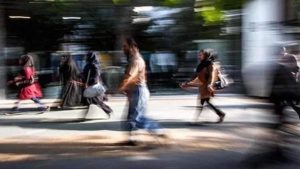
In official state media discourse in Iran, the image of the younger generation—often labeled as Generation Z—is largely constructed through negative stereotypes: apathetic, disengaged from politics, lacking collective motivation, indifferent to serious study, socially detached, and reluctant to assume responsibility.
This narrative, particularly prominent in outlets aligned with the ruling establishment, attempts to normalize the idea of an “absence of social agency” as an inherent trait of the new generation. In doing so, it portrays Iranian youth as fundamentally passive, suggesting a society internally defined by inertia. Some state-affiliated platforms even go further, framing this alleged passivity as a widespread social condition in need of “treatment.” By erasing the structural realities of repression, this narrative seeks to convince both society and the younger generation that they are inherently opposed to activism, dynamism, and collective movement.
But does this portrayal reflect reality? Are Iran’s youth truly indifferent to the fate of their country? On what empirical basis can such claims be validated—or rejected? And if state media advances this narrative, does it genuinely represent the concerns of young people?
Iran’s Car Market Experiences Sharp Surge in Prices Afte War-Induced Stagnation

Media outlets in Iran report that the prices of many domestically produced cars have increased by 3 billion to 10 billion rials in less than two weeks. (Currently, the dollar price in Iran’s market is around 1,800,000 rials.)
The state-run Mehr News Agency wrote that during this period, even some car models such as Tara and Rira saw price increases exceeding 10 billion rials (approximately 5,587 dollars).
According to reports, in Iran’s car market between April 16 and April 30, an unprecedented trend of price surges was recorded across nearly all vehicle categories, from domestically produced cars to assembled and imported models.
Automotive experts and experienced market participants, who themselves have been surprised by the situation, told domestic media that this unprecedented price growth indicates the market, after a period of relative stagnation during the war, has re-entered a phase of volatility and widening price gaps.
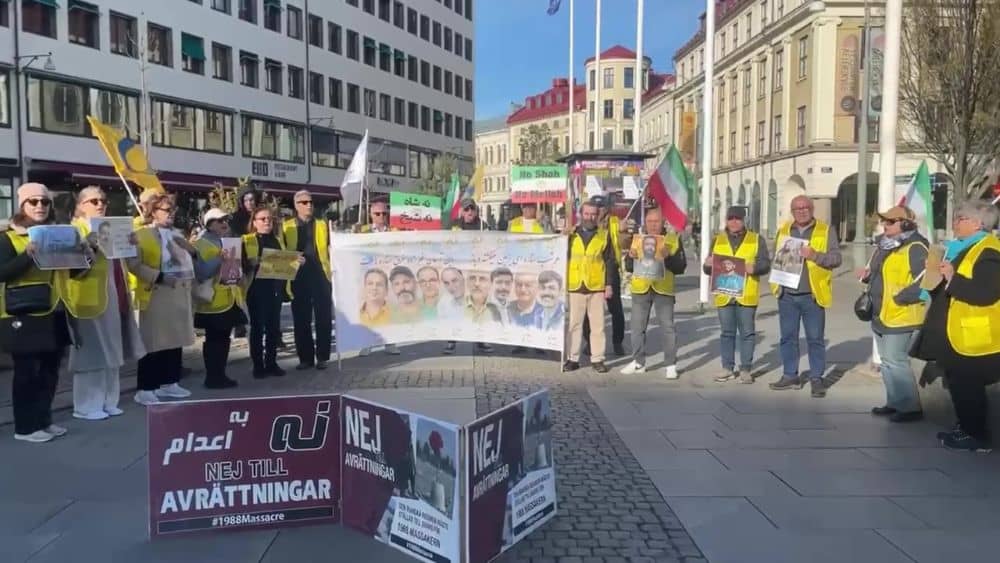
MEK Supporters in Gothenburg Rally for 118th Week of “No to Execution Tuesdays” in Iran

Gothenburg, Sweden — April 28, 2026: Supporters of the People’s Mojahedin Organization of Iran (PMOI/MEK) held a rally marking the 118th consecutive week of the “No to Execution Tuesdays” campaign, a movement opposing the Iranian regime’s escalating wave of executions and systematic repression.
Participants highlighted the regime’s intensifying crackdown, rising number of executions, and broader repressive measures, including internet shutdowns across Iran, as they chanted slogans such as “Down with the executioner regime.”
Paris Exhibition Condemns Iran’s Executions of Political Prisoners, Demands Democratic Republic

Paris, France – April 29, 2026 – A book stall and photo exhibition by the People’s Mojahedin Organization of Iran (PMOI/MEK) was held in Paris, to condemn the executions of PMOI political prisoners and protesters of the January 2026 uprising carried out by the Iranian regime, and to honor their memory.
The event emphasized the Iranian people’s demand for a democratic republic led by the Iranian Resistance as a path toward peace and freedom.
Oslo Rally Honors Executed Iranian Protesters, Urges Action Against Rising Executions

Oslo, Norway – April 28, 2026: Supporters of the Iranian Resistance held a rally to protest the execution of PMOI political prisoners.
The gathering also included a commemoration ceremony for three political prisoners—young protesters arrested during the January 2026 uprising and executed by the clerical regime. The event took place at the Milorg memorial site in Oslo, dedicated to Norway’s resistance movement during World War II.