

Three-minute read
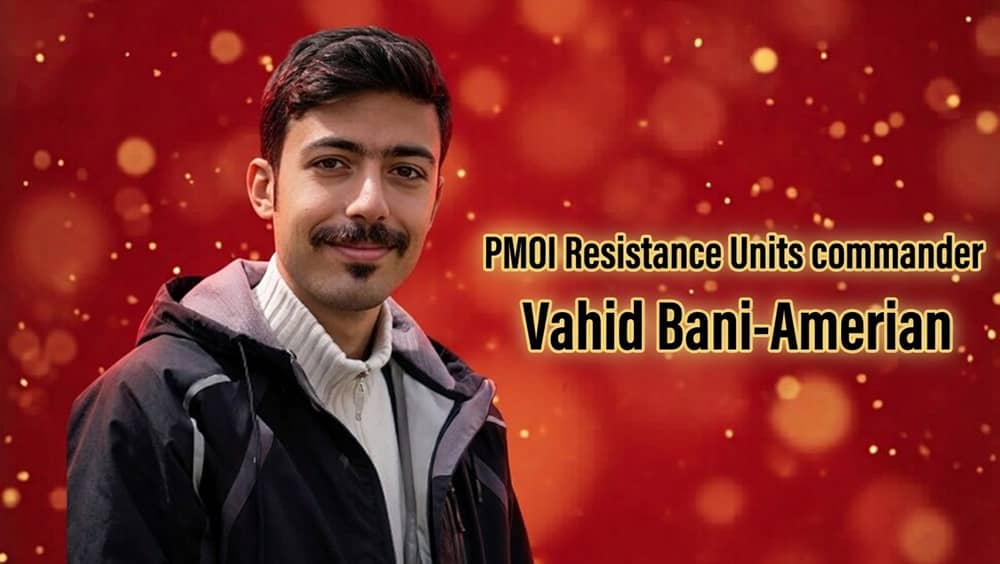
In the calculus of power, regimes that rule by fear eventually confront a simple truth: no prison wall, no predetermined verdict, and no hidden grave can silence a man who has already chosen the side of history. On the eve of his execution in Ghezel Hesar Prison in April 2026, 33-year-old political prisoner Vahid Bani-Amerian—electrical engineer, elite university graduate, and steadfast Resistance Units member of the People’s Mojahedin Organization of Iran (PMOI/MEK)—recorded a final message that has since traveled far beyond the walls that held him. Delivered in Persian with the calm precision of a man who had measured the cost and accepted it, the clip is not the lament of a victim but the measured indictment of a system that has exhausted its moral capital.

Bani-Amerian spoke directly to the Iranian people and the world. He announced his impending execution not as defeat but as declaration: he would make his defense public precisely because he refused to grant the regime’s courts any legitimacy. “This regime,” he stated, “is the one that must be tried before the people.” He rejected every charge leveled against him, describing them as extracted under physical and psychological torture. A court whose outcome is known in advance, he observed, renders any defense theater; yet he chose to speak anyway—because the record belongs to the future, not to the executioner.
Addressing the Supreme Leader by implication, he invoked the regime’s own logic: Khomeini had once decreed that anyone who remains “steadfast” must be executed. “Know this,” Bani-Amerian replied, “I am steadfast.”
He recounted the tortures without melodrama and the unbroken spirit they failed to break. Even if the regime concealed the bodies of its victims, he warned, it could not conceal the inevitability of its overthrow. To those who had asked why he had not simply pursued a “normal life,” he offered a reply that cuts through the sociology of despair in today’s Iran: “I detest a life in which a few live in poverty and misery while others plunder. I find joy in the struggle against you.”

These are not the words of abstract ideology. They are the political logic of a generation that has watched discrimination, endless regional conflict, systemic corruption, and grinding poverty drive an entire society to the edge of endurance. When ordinary existence becomes complicity in plunder, refusal becomes the only dignified option.
That refusal was witnessed firsthand by someone outside the Iranian political fray. Olivier Grondeau, the French citizen held hostage in Iran for nearly 900 days, shared a prison cell with Bani-Amerian. In public testimony after the execution, Grondeau described his former cellmate as “a respectful and enlightened man,” a “very polite, rational, courageous” intellectual who, each night at nine o’clock, would recite the poetry of Rumi to ease the darkness of their confinement. The image is striking in its humanity: an Iranian Resistance fighter teaching Persian mystical verse to a Western hostage while both lived under the same jailers. Grondeau’s words strip away any caricature of the “fanatic” and replace it with the portrait of a cultured, disciplined mind who chose resistance over accommodation.
Within days, Bani-Amerian’s final testament had escaped the regime’s control. The clip was copied, passed hand to hand inside Iran, and shared across borders by millions who recognized in it something larger than one man’s death. In opposition networks, diaspora communities, and private conversations inside the country, the video became a quiet transmission of resolve. Mouth-to-mouth accounts amplified it; digital sharing gave it reach the censors could not fully suppress. In an age when authoritarian states invest heavily in narrative control, the spontaneous circulation of a single prisoner’s voice reveals the limits of coercion. Repression creates martyrs; martyrs, in turn, create memory—and memory, over time, becomes mobilization.

Nonetheless, the episode carries a clear sociological and strategic weight. Iran today is a society pushed to the breaking point by structural failures the regime can no longer disguise: widening inequality, militarized adventurism abroad that drains resources at home, and a justice system that functions as an instrument of political elimination rather than law. The regime’s calculation—that executing a handful of organized opponents will deter the rest—has been tested before and has consistently failed. Each public testament of steadfastness erodes the aura of inevitability that sustains authoritarian power.
Little wonder, then, that despite dozens of brutal crackdowns on previous nationwide uprisings and the mass killings of tens of thousands of Iran’s bravest citizens, the country remains unbroken and its courage undiminished.
Vahid Bani-Amerian’s words, then, are not merely a tragic footnote. In a nation where discrimination, war, corruption, and poverty have brought millions to the outer limit of tolerance, his final message is not a lament but a summons. Yet his story transcends the personal: as commander of a Resistance Unit—Bani-Amerian embodied the collective resolve of an entire network of steadfast fighters who shared his unyielding qualities—courage, rationality, moral clarity, and joy in the struggle.
All members of his unit possessed the same features that defined him; like him, they too were executed by the regime. Their collective sacrifice binds his testament to the broader Iranian Resistance and its nationwide network, proving that this defiance is not solitary but the beating heart of a movement the mullahs cannot extinguish. The choice for outside actors is not whether to engage, but on which side of that contest they place their weight. History records those who stood with the executioners—and those who stood with the unbowed. Bani-Amerian has already cast his lot. The rest of us are left to decide ours.