

THIS PAGE WILL BE UPDATED WITH THE LATEST NEWS
UPDATE: 7:30 AM CEST
Iran: A Woman Prisoner Executed in Ardabil Prison

In the early hours of Wednesday, May 20, 2026, Iranian regime authorities executed a woman prisoner identified as 28-year-old Asma Zarei at Ardabil Prison.
Asma Zarei had been arrested two years ago on murder charges and was later sentenced to death. She was the mother of a child born while she was in prison. The child is now two years old. With the execution of Asma Zarei in Ardabil prison, the number of women executed in the 2026 calendar year has risen to twelve. According to data recorded by the Women’s Committee of the National Council of Resistance of Iran, at least 340 women have been executed in Iran since 2007.
Many of the women executed by the Iranian regime are themselves victims of domestic violence and discriminatory family laws. A significant number have acted in self-defense.
Since Masoud Pezeshkian took office, the clerical regime has executed more than 3,680 prisoners, including 100 women.
Iran’s Internet Blackout Enters 13th Week as Digital Isolation Deepens

Iran’s nationwide internet blackout has now entered its thirteenth consecutive week, further isolating millions of citizens from the outside world and deepening the country’s social and economic crisis.
According to the internet monitoring organization NetBlocks, the large-scale disruption of internet access in Iran has surpassed 2,016 hours. In a statement released on Saturday, the organization warned that the prolonged digital isolation is having severe consequences on the daily lives of ordinary Iranians. NetBlocks emphasized that depriving citizens of internet access strips them of opportunities, information, and essential services that people elsewhere in the world can access within seconds. The organization also noted that the continuation of these restrictions is exacerbating social and economic inequalities across Iranian society.
In a previous report released on Friday, NetBlocks warned that with every additional hour of disconnection, access to the global internet increasingly ceases to be a universal right and instead becomes dependent on social status, political connections, and special privileges.
Iran’s New Wave of Executions Exposes the Regime’s Machinery of Fear and Repression

Iran regime’s judiciary announced on May 21 the execution of two men, Ramin Zaleh and Karim Maroufpour, on charges of “membership in separatist groups.” As in many recent execution cases, the judiciary’s news agency, Mizan, provided virtually no verifiable details about the arrests, legal proceedings, evidence, or trial process. The vague and formulaic language surrounding the executions has once again raised serious questions about the regime’s accelerating use of capital punishment under the cover of national security.
The executions come amid a broader surge in state repression following the recent conflict involving the United States, Israel, and Iran. In the atmosphere created by war, internet blackouts, and intensified security measures, the Iranian regime has reportedly executed more than 30 people in just a matter of weeks under sweeping accusations such as “collaboration with hostile states,” “espionage,” and “acting against national security.”
At the same time, regime-controlled media outlets have attempted to frame these executions as acts of “justice” and necessary measures against “enemy infiltration,” often broadcasting televised confessions and edited security footage to justify the crackdown. Yet the growing reliance on propaganda instead of transparent legal procedures only deepens public skepticism.
Iran’s Economic Collapse Is No Longer a Warning — It Is a Reality

Regime-linked economists warn that Iran is entering an unprecedented phase of structural economic collapse, with soaring inflation, mass unemployment, and nearly half the population at risk of poverty.
As Iran enters the Persian year 1405, even economists and research institutions tied to the regime are warning that the country is moving into an unprecedented phase of economic collapse, chronic inflation, and mass impoverishment. What was once described as a “difficult economy” has now evolved into a structural crisis that touches nearly every aspect of daily life for ordinary Iranians.
At the recent “Iran Economic Outlook 1405” conference, whose findings were published by the Iranian newspaper Donya-e-Eqtesad, government-affiliated economists painted a bleak picture of the country’s future. Their assessments reveal an economy trapped in a dangerous combination of recession, hyperinflation, unemployment, and the continuous erosion of household purchasing power.
Masoud Nili, a former economic adviser to the regime, acknowledged that Iran has moved beyond a phase of “chronic crisis” and entered what he called the “open manifestation of crises.” Referring to official statistics, he warned that inflation in some sectors has exceeded 100 percent. More importantly, he admitted that even if external tensions or military confrontations were to subside, the economy would not return to normal anytime soon.
Inflation, Economic Crisis, and the Silent Collapse of Iran’s Middle Class

The state-run Khabar Fori website wrote on May 22 that the phenomenon of “poor billionaires” has become one of the latest signs of the economic crisis in Iran. Economists say the uncontrolled rise in asset prices, alongside the collapse of people’s purchasing power, has created a society in which many citizens appear wealthy on paper but in practice are unable to manage their daily lives.
In recent years, chronic inflation and the collapse of the national currency’s value have caused housing, automobiles, and durable goods prices to increase severalfold. These price increases have turned millions of people into owners of billion-rial assets. Nevertheless, a large portion of these same individuals face financial crises when trying to pay for basic living expenses, car repairs, home maintenance, or even essential goods.
Economists describe this situation as the rise of “poor billionaires,” a term that reflects the obvious contradiction in today’s Iranian economy — a society in which the apparent value of assets has expanded while the real ability to live has collapsed. Amir Hossein Khaleghi, an economist, told the state-run Fararu media outlet on May 14: “We are now facing a type of poverty that cannot be measured solely by income or wealth indicators. A phenomenon gradually revealing itself is the emergence of poor billionaires — people who may appear to own cars or homes, but cannot afford their maintenance, repairs, and ongoing expenses.”
The Collapse of Investment in Iran, the Shutdown of Production, the Downward Spiral of Life
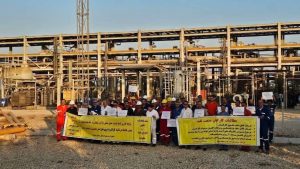
The collapse of investment in Iran means the halt of production, widespread unemployment, capital flight, the destruction of job security, and the decline in the quality of life for millions of citizens. Official statistics and statements by economic activists show that the Iranian regime is not only incapable of rebuilding the engine of production but has also pushed the economic environment into a stage of chronic instability through ineffective policies.
Lack of investment causes businesses to first reduce production capacity, then lay off workers, and ultimately shut down. Reports published in recent months provide a clear picture of this downward spiral.
According to published data, gross fixed capital formation fell to negative 4.3% from March to September 2025. This means the halt of new projects, deterioration of machinery, a decline in construction, and the destruction of employment capacity. Investment in machinery has also dropped from positive growth to negative 2.5%, while construction investment has entered negative territory as well.
Crackdown on Independent Lawyers: Denying Protesters the Right to Defense

The suppression of independent lawyers in the Islamic Republic—particularly during protests and in cases involving political and ideological prisoners—is part of a broader judicial-security strategy designed to dismantle the right to legal defense. In a system where the judiciary, rather than acting as a neutral institution, functions as an extension of the security and intelligence apparatus, the presence of an independent lawyer poses a significant obstacle to the narratives constructed by interrogators and security agencies. Consequently, the judiciary seeks to dismantle the legal support networks available to defendants by arresting, threatening, and revoking the licenses of courageous lawyers, removing obstacles to advancing its objectives.
Once the system places defendants and their families in a legal vacuum through the suppression of independent lawyers, the second phase of this strategy begins: the imposition of court-appointed and security-vetted lawyers. These lawyers, selected by the judiciary itself, do not enter cases to defend the accused but instead facilitate harsh sentences and the issuance of death penalties. Examining the elimination of independent legal defenders is therefore essential to understanding the structure of show trials within the Revolutionary Courts.
Beyond Football Glory: The Untold Story of Parviz Gholichkhani’s Resistance

The former captain of Iran’s national football team was more than a sporting icon. For decades, Parviz Gholichkhani stood as one of the rare athletes who refused to separate sport from politics, even when it cost him freedom, exile, and the World Cup.
For many people, the green rectangle of the football pitch is the ultimate horizon of dreams — a place to gain fame, accumulate wealth, and stand safely on the podiums of comfort. But in the history of Iranian sports, there is one name that stood beyond every football boundary and line marking.
Parviz Gholichkhani, the former captain and unmatched legend of Iranian football, died at the age of 80 in the suburbs of Paris. But what he left behind was not merely the memory of thunderous shots, three consecutive Asian Cup titles, or the captain’s armband of the national team. Gholichkhani’s legacy shattered the cliché that “athletes should stay out of politics.” He became a clear symbol of a “committed athlete” — a freedom-seeker and companion of ordinary people who never agreed to trade human dignity and intellectual integrity for proximity to power.