

Three-minute read
As Iran’s economy collapses under runaway inflation, a plunging currency and fresh waves of protests by retirees, workers and teachers, the regime’s ruling elite has turned its guns inward. Ritual calls for “unity” and “wartime conditions” have given way to open factional warfare. State media now document the power struggles, exposing two irreconcilable camps: one that believes only tactical concessions to the West can prevent a new, more radical nationwide uprising; the other that warns any submission will destroy morale among the loyalist base and regional proxies, leaving the system defenseless before an explosive society.
Parliamentary Power Struggles
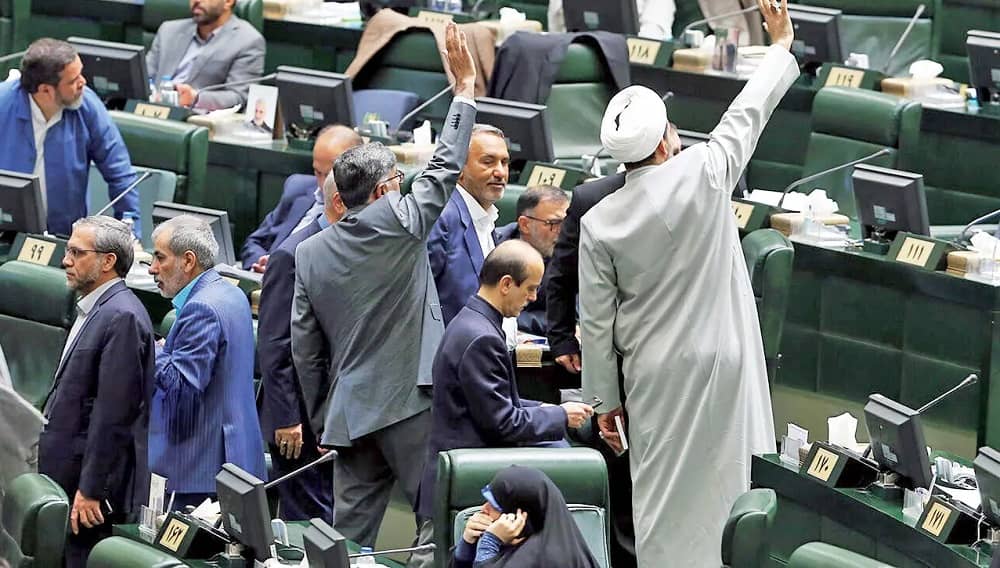
The latest flashpoint erupted during the Majlis elections for the third session of the 12th parliament on May 25, 2026. The state-owned newspaper Jahan Sanat reported that, despite public insistence on internal cohesion, “the special conditions of the country have not prevented the usual horse-trading.” It openly exposed what it called “the Paydari operation to bring down Ghalibaf,” in which extremist factions fielded candidates such as Morteza Aqa-Tehrani and Naghd-Ali to split votes and block Speaker Mohammad-Baqer Ghalibaf from securing a strong position. Jahan Sanat noted that the ultra-hardliners “know very well that their political weight is not comparable to Ghalibaf’s, yet they are trying to prevent him from gaining full control of the Majlis with a high vote count.”
Although Ghalibaf was re-elected for a seventh term, the paper exposed factional feud and efforts to oust his allies from deputy-speaker and secretariat posts, including a “movement of nominations” aimed at scattering pro-Ghalibaf votes. These battles reflect a deeper strategic rift over regime survival.
"The infighting is taking place while the regime hasn’t decided about the course—concession or going to #IranWar. Once the final decision is made, a major fracture is expected to weaken the regime severely, exposing it to the outburst of social anger that is witnessing these…
— NCRI-FAC (@iran_policy) May 12, 2026
Diplomatic Rifts Exposed
On the diplomatic front the fractures are even starker. State media announced on May 25, 2026, that Ghalibaf, accompanied by Foreign Minister Abbas Araqchi and Central Bank Governor Abdolnaser Hemmati, had traveled to Doha for talks on bilateral relations, regional issues, the Strait of Hormuz and the release of blocked Iranian assets. The state-owned daily Shargh confirmed the focus on “the Strait of Hormuz and high-enriched uranium stockpiles.”
The regime’s president Masoud Pezeshkian, speaking on state television on May 24, 2026, openly defended negotiations while stressing absolute obedience to the leadership. He declared: “No decision is taken without the permission of the Leadership — that is, Mojtaba Khamenei.” He added: “We are ready to assure the world that we are not seeking nuclear weapons, and we are not seeking instability in the region.” Pezeshkian warned internal rivals: “The main concern today is not war, missiles or bombing, but preserving calm, cohesion and the integrity of society… I have always tried not to say anything contrary to the view of the Supreme Leader.”
The regime’s anniversary rallies were designed to signal survival. Yet the same period’s developments—nighttime anti-Khamenei chants, continuing strikes, the spread of #IranProtests messaging across dozens of cities, official acknowledgment of mass injuries, arrests reaching…
— NCRI-FAC (@iran_policy) February 11, 2026
Survival Strategies Collide
The extremist camp struck back immediately. In the state newspaper Kayhan, editor Hossein Shariatmadari — the Supreme Leader’s representative — launched a fierce attack on the negotiating team. He complained that some diplomats appeared ready to surrender the regime’s hard-won leverage, writing: “We must complain about the statements of some diplomats and the negotiating team, as if after the end of the war, the conditions and rules governing the Strait are to return to the pre-war state! And as if imposing sovereignty over the Strait of Hormuz is not our definite legal right.”
MP Amir-Hossein Sabeti was blunter on May 23, 2026: “Even if America signs an agreement with us, evil will come out of it and it will bring us no benefit… War in the military sense will continue and it is definite.” Fellow MP Hamid Rasaee stated the same day: “The Supreme Leader said negotiations with America are only to the benefit of the current U.S. president… The experience of the past 47 years shows that the Americans do not honor any promise.”
"As the terrorist regime in Iran grapples with the aftermath of the war, multiple internal pressures are mounting simultaneously. Reports from regime-aligned media and #humanrights sources reveal a toxic mix of sectarian repression, elite infighting, economic collapse, and…
— NCRI-FAC (@iran_policy) May 8, 2026
Complicating Wildcards
Compounding the crisis is the wildcard of former President Mahmoud Ahmadinejad. Long at odds with the current leadership, his past radical positions, recent tensions with the Supreme Leader, and reported foreign speculation about his potential role in any post-crisis scenario have added another layer of uncertainty. This further muddies factional calculations over how to preserve the system without triggering internal carnage or external exploitation.
Jahan Sanat itself acknowledged that the parliamentary battles reflect “a deeper crisis in the structure of power” driven by “increased economic pressures and the resurgence of social protests.” State media can no longer hide the reality: the rulers are fighting over which path offers the least catastrophic route to survival — and neither path looks viable. The terrorist regime ruling Iran now faces not just external enemies but an internal fracture that no amount of ritual invocations of “unity” can conceal. The question is no longer whether the regime can preserve itself, but which faction’s strategy will accelerate its collapse first.