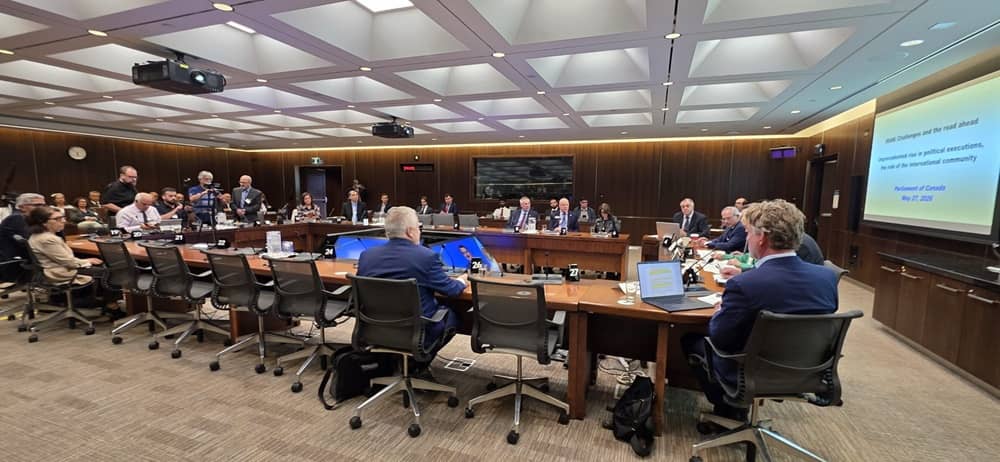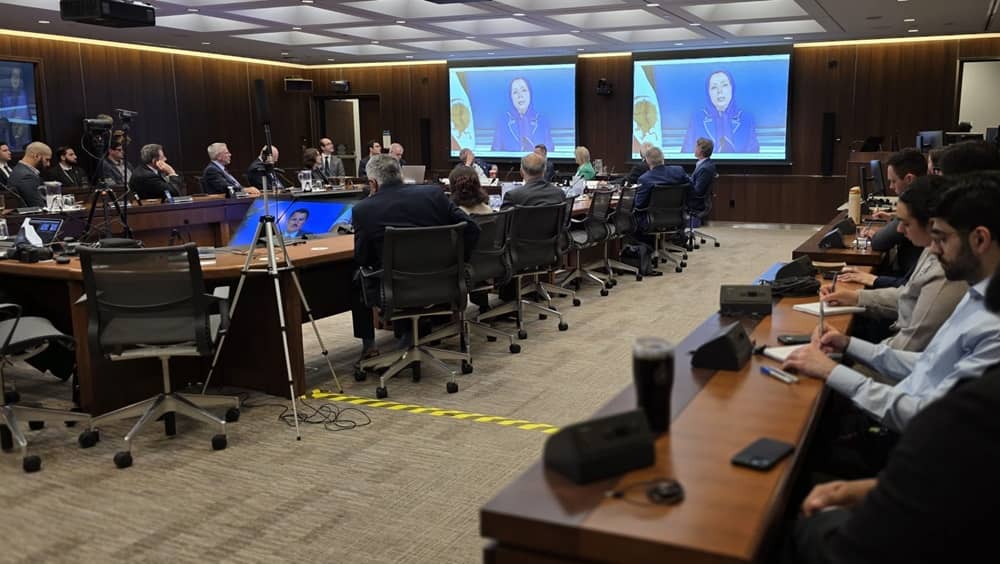
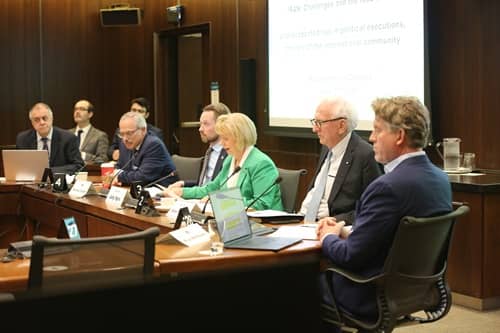
A parliamentary conference, “Iran at Crossroads,” convened on Parliament Hill on May 27, 2026, bringing together a distinguished panel of Canadian and American dignitaries, international experts, and human rights advocates to address the escalating crisis in Iran. Co-chaired by the Hon. Judy Sgro and Member of Parliament Michael Cooper, the strategic session focused on the systemic failure of Western appeasement, the wave of political executions by the clerical regime, and the growing influence of domestic Resistance Units. Moving beyond traditional policy constraints, the conference highlighted the National Council of Resistance of Iran (NCRI) and its Ten-Point Plan as the definitive, viable blueprint for transitioning the nation into a free, secular, and democratic republic.
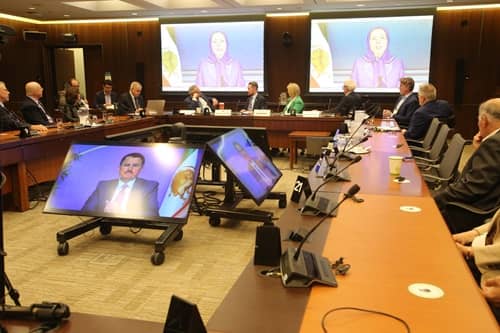
In a video address, Mrs. Maryam Rajavi, the President-elect of the NCRI, declared that “the freedom of the Iranian people is deeply connected to global peace,” defining the ruling religious fascism as the principal source of regional warfare and global terrorism. Reaffirming that the regime completely lacks the capacity to change its behavior, Mrs. Rajavi noted that the ongoing nationwide uprisings have pushed the mullahs into an irreversible impasse. She forcefully condemned the historic policy of appeasement that “deprived the world of the main force for change in Iran,” emphasizing that the true solution lies in supporting the organized resistance and the domestic Resistance Units fighting the Revolutionary Guards. Furthermore, Mrs. Rajavi firmly rejected any return to the past, warning that the remnants of the Shah’s overthrown regime seek to revive the notorious SAVAK secret service to undermine the contemporary anti-dictatorial movement. She called on Canada to enforce absolute moral clarity by expelling the regime’s agents and recognizing the struggle to establish a democratic republic based on the Ten-Point Plan.
Conference at the Parliament of Canada: Unprecedented rise in political executions in Iran, the role of the international community
The freedom of the Iranian people Is deeply connected to global peace#StopExecutionsInIranhttps://t.co/eiQKe5T3sK pic.twitter.com/z1HLielpxd— Maryam Rajavi (@Maryam_Rajavi) May 28, 2026
Opening the floor, the Hon. Judy Sgro welcomed the international panel and lauded the unwavering bravery of the Iranian people, noting that “across the country, and especially amongst its young people and women, there is a powerful and unwavering call for dignity, freedom, and democracy”. Expressing deep concern over the regime’s intensifying domestic repression and international aggression, Sgro asserted that lasting geopolitical change must come from within and be rooted directly in the sovereign will of a homegrown democratic movement. She praised the tireless leadership of the Iranian Resistance networks in organizing the forum, emphasizing that Canada holds a profound global responsibility to stand unequivocally with the organized alternative, foster principled international dialogue, and guide the global community toward policies that actively support the true aspirations of the Iranian people.
Co-chair Michael Cooper sharply focused the discussion on the systemic, multi-layered crises threatening the survival of the clerical dictatorship, detailing how the regime is confronting severe economic collapse driven by institutionalized corruption and gross mismanagement. He observed that while the Iranian population suffers from skyrocketing inflation, water scarcity, and rolling electrical blackouts, the authorities have responded by doubling down on massive, calculated repression. “Indeed, executions are a core part of a systemic state policy aimed at crushing dissent,” Cooper stated, highlighting a brutal campaign marked by an 88-day internet blackout, the systematic targeting of women and minorities, and secret judicial proceedings driven by torture. In defiance of this “epitome of evil,” Cooper commended the extraordinary courage of the men and women fighting for freedom, underscoring that the international community must urgently pivot away from failed policies to confront the leading sponsor of terrorism and regional instability.
Ambassador Robert Joseph, former U.S. Under Secretary of State for Arms Control and International Security, delivered a rigorous strategic critique, concluding that over twenty-five years of Western diplomacy, conditional sanctions, and negotiations have utterly failed because they rely on the illusion that the mullahs can be moderated. Drawing from his recently co-authored policy paper, Amb. Joseph argued that the regime remains unalterably committed to acquiring a nuclear weapon, using diplomatic engagement merely as a “cat-and-mouse” game to buy time and extract concessions. He warned against the current administration’s continuous policy of appeasement, asserting that providing billions of dollars in sanctions relief effectively throws a lifeline to the regime, which funds terrorist proxies and builds its machinery of domestic terror. Amb. Joseph insisted that the international community must impose maximum pressure to weaken the dictatorship while providing moral and political recognition to the organized democratic opposition, noting that “it is left to the Iranian people to end the regime”.
On Wednesday, May 27, I spoke at a conference in the Canadian Parl. @OurCommons
“The clerical regime today stands at perhaps the weakest point in its history,” I said. 👇https://t.co/n4t30aQw9R@SecRubio @honjudysgro @MichaelCooperMP @AndrewLawton @TonyclementCPC— Ali Safavi (@amsafavi) May 29, 2026
Joining the session via Zoom, Ali Safavi, a member of the Foreign Affairs Committee of the NCRI, profoundly dismantled the narrative that the clerical regime has emerged stronger from recent regional conflicts, presenting exhaustive evidence that the dictatorship stands at its weakest historical point. He explained that the structured societal crises that fueled successive nationwide uprisings have drastically intensified, rendering the vulnerable regime terrified of its own population. Safavi declared that the regime cannot be overthrown through foreign intervention or actions from the air; rather, victory must come through the Iranian people and their organized resistance, led by the PMOI and internal Resistance Units. Turning to the political transition, he positioned Maryam Rajavi’s Ten-Point Plan as a vital transitional charter to hand sovereignty to the population via free elections within six months. Crucially, the NCRI FAC member warned Western capitals against the false alternatives promoted by the Shah’s son, stating that the revival of SAVAK symbolism and the normalization of intimidation demonstrate that hereditary autocrats represent a dangerous return to a past of torture and political murder, prompting Iranians to permanently reject “both the turban and the crown”.
The Hon. Tony Clement, former Canadian Minister of Health and Industry, reinforced this perspective by expressing his strong optimism for the ultimate victory of the Iranian people, reminding the audience that “it’s not the Iranian people who are our enemies” but rather the repressive mullahs. Clement gave his full endorsement to the NCRI’s Ten-Point Plan, praising its vision for a free, secular, and democratic republic that completely rejects nuclear ambitions and seeks peace with its neighbors. He emphasized that the international community has an obligation to maintain relentless pressure on the regime and honor the immense sacrifices of the thousands of dissidents executed in recent months. Agreeing with the panels’ overarching strategic analysis, Clement concluded that the mullahs will never voluntarily loosen their iron grip on power or abandon their nuclear aspirations, meaning the only permanent solution is the outright overthrow of the regime by the people of Iran taking the future into their own hands.
Detailing the broader geopolitical and human costs of the crisis, Kyle Matthews, Executive Director of the Montreal Institute for Global Security, urged Canada to hold the regime fully accountable for its historical and ongoing atrocity crimes, specifically invoking the unpunished 1988 massacre of 30,000 political prisoners. Matthews observed that the regime’s pattern of behavior connects domestic terror directly to global insecurity, noting its deployment of resources to fuel a civil war in Syria, arm extremist proxies across the Middle East, and supply weapons to Russia to threaten European stability. He insisted that any future international negotiations must demand the immediate release of political prisoners and hold the regime legally accountable for what the United Nations has described as crimes against humanity. Matthews concluded that Western nations must proactively provide advanced communication technologies to circumvent internet blockades, thereby directly empowering internal activists and the organized resistance to break the regime’s monopoly on information.
Representing the younger generation of the diaspora, Ali Zaei, a former Canadian national wushu champion representing the Iranian Youth Association of Canada, closed the panel with a stirring tribute to the frontline fighters of the resistance. He quoted the final vow of executed PMOI member Vahid Bani-Amerian, stating that thousands of young Iranians remain committed to continuing the uprising until the final overthrow of the wicked regime. Zaei argued that the regime’s escalating reliance on torture and public hangings is not a demonstration of power, but a clear exposure of its profound terror regarding the effectiveness of the PMOI and its internal Resistance Units. Characterizing the organized resistance as the only entity with the experience, networks, and concrete transitional framework capable of delivering a permanent solution, Zaei called on the international community to back Maryam Rajavi’s Ten-Point Plan to definitively halt regional state-sponsored terrorism and secure a free, democratic future for Iran.