

THIS PAGE WILL BE UPDATED WITH THE LATEST NEWS
UPDATE: 7:00 PM CEST
Why Iranian Hero Vahid Bani Amerian Will Be Remembered as His Country’s Nelson Mandela

Vahid Bani Amerian belongs among the immortal figures of revolutionary history, men and women who, confronted by tyranny, chose sacrifice over silence and conscience over comfort. Like Nelson Mandela enduring decades of imprisonment under apartheid or Václav Havel confronting Czechoslovakia’s Communist dictatorship, Vahid stood firm before a regime determined to extinguish every voice demanding freedom.
Through his courage, the Iranian regime achieved the opposite of its intentions. By executing him, the clerical rulers transformed a young political prisoner into a lasting symbol of resistance for generations of Iranians yet to come.
At only 33, Vahid, a member of the People’s Mojahedin Organisation of Iran (PMOI), walked to the gallows on April 4 this year, alongside fellow PMOI member Abolhassan Montazer. Days earlier, six other PMOI members had also been executed. Vahid’s execution came during one of the most fragile moments in the history of the dictatorship.
UPDATE: 10:00 AM CEST
Iran’s Looming Poverty Explosion: Economists Warn Over 40 Million People Face Starvation

Coinciding with World Hunger Day, a staggering admission within Iran’s state-affiliated media has laid bare the catastrophic reality of the country’s economic and social collapse. A report published by the Donya-e-Eqtesad daily has highlighted urgent warnings from leading economists and academics regarding an impending “poverty explosion.” Experts state that the devastating fallout of recent conflicts, combined with the total collapse of oil revenues, has pushed the Iranian population to the brink of absolute destitution. With projections indicating that those living under the absolute poverty line will soon surpass 40 million, the regime’s Ministry of Intelligence has reportedly issued internal security alerts, fearing imminent popular uprisings fueled by hyperinflation and systematic economic mismanagement.
During an economic policy symposium in Tehran, academic experts presented grim metrics reflecting a state of total structural paralysis. Hojat Mirzaei, a faculty member at Allameh Tabataba’i University, revealed that due to an effective maritime blockade and oil exports plummeting to near zero, Iran’s economic growth for the current year is projected to contract sharply between -8.8% and -10%. Mirzaei warned that this contraction will plunge an additional 3.5 to 4.5 million citizens into absolute poverty within months, pushing the total number of impoverished Iranians past the 40-million threshold.
The Crimson Diary Under the Daily Shadow of Femicide in Iran
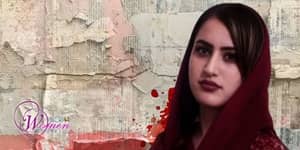
What follows is merely a horrifying glimpse into leaked news from an incredibly brief period—from mid to late May 2026. Looking at this timeline is enough to shock any objective observer: May 16, May 22, May 23, and May 24! Under the rule of the misogynistic clerical regime, machine of femicide in Iran seems to be claiming victims relentlessly, on a daily basis.
Yet, these catastrophic statistics do not reveal the whole truth. These cases are merely the ones that managed to leak through the heavy filters of media censorship, the suffocating repression gripping smaller towns, and frequent internet blackouts.
In a system where violence against women is legally and systematically reproduced, and official media is tasked with cover-ups, the tragedy of femicide is far more widespread. Every name mentioned in this report represents dozens of other voiceless women who lose their lives across this land, behind the high walls of censorship and silence, without their names ever being recorded anywhere.
Iran: Pressure Ramped Up on Female Political Prisoners in Evin Prison

Female political prisoners in Evin Prison, particularly those participating in the “No to Executions Tuesdays” campaign, have faced a new wave of restrictions and security pressure in recent weeks.
Prison authorities have systematically, on an almost daily basis, deprived some prisoners of phone calls and family visits under various pretexts. These measures come despite the fact that many female political prisoners had already been subjected to similar restrictions in the past.
A significant part of the recent hardline policies in the women’s ward of Evin Prison is being implemented under the supervision of Hossein Yousefi, the prison’s deputy health official. He was appointed to the position following the death of Rouhollah Tavassoli during the bombing of Evin Prison.
Since Yousefi’s appointment, pressure on female political prisoners has intensified considerably, particularly regarding in-person visits, telephone access, access to welfare facilities, and medical services. Families of prisoners and sources close to them state that many of the decisions related to the new restrictions are imposed without clear explanation and outside any transparent administrative process, leaving prisoners with virtually no effective means to challenge them.
Amnesty International Warns of Intensifying Repression in Iran Amid Mass Arrests and Political Executions

Iranian regime authorities have dramatically escalated their crackdown on dissent under the pretext of “wartime conditions,” carrying out thousands of arbitrary arrests, politically motivated executions, internet blackouts, and harsh prison sentences, according to a new report released by Amnesty International on May 28, 2026.
The organization warned that the Islamic Republic is exploiting the aftermath of the February 2026 conflict involving the United States and Israel to deepen repression and silence critics across the country.
According to Amnesty International, more than 6,000 people have been arbitrarily arrested since February 28, including protesters, journalists, lawyers, students, human rights defenders, members of ethnic and religious minorities, and ordinary citizens accused of sharing information online.
The report states that Iranian regime authorities have accelerated judicial proceedings against detainees, including cases involving the death penalty, while widespread concerns persist over torture, enforced disappearances, forced confessions, and sham trials.
Iran’s Education System Is Collapsing Under War, Mismanagement, and Endless School Closures

For millions of Iranian families, education has become another casualty of war, state incompetence, and systemic collapse. What was once presented as a temporary emergency solution during the COVID-19 pandemic has now evolved into a chronic national disaster: students spending months away from classrooms, trapped inside a dysfunctional online education system incapable of delivering even the most basic learning standards.
As schools across Iran continue to close or operate remotely, growing concerns among parents, teachers, and education experts point to a severe and potentially irreversible decline in student learning. Even the regime’s own Parliamentary Research Center has warned that unless appropriate policies are implemented under the current wartime and ceasefire conditions, the country will face “irreparable consequences for the national education system.”
Under Iran’s 1997 school calendar law, the academic year officially begins in October and ends in May, with June reserved for final examinations. Yet this year, Iranian students have spent nearly half of the school year away from classrooms.
The Return of SAVAK Symbols: How Reza Pahlavi’s Monarchist Current Betrays Iran’s Fight for Freedom

At a time when the Iranian people are paying the price of freedom with executions, imprisonment, torture, and poverty, one would think that no political current claiming to oppose the clerical dictatorship could possibly sink lower in helping the regime damage the democratic movement.
Yet once again, the monarchist camp surrounding Reza Pahlavi has managed to do precisely that.
The recent march in Germany featuring the emblem of SAVAK—the Shah’s notorious secret police—was not merely a political embarrassment. It was a moral and historical catastrophe. Even more revealing were the reports that the demonstration had been encouraged by circles close to Reza Pahlavi himself, exposing once again the dangerous mentality dominating today’s monarchist movement: the normalization of dictatorship under the disguise of opposition politics.
For millions of Iranians, SAVAK is not a nostalgic symbol. It is synonymous with torture chambers, disappearances, censorship, surveillance, fear, and the violent suppression of dissent. Its reputation was so infamous that even during the Shah’s final years, openly identifying as a SAVAK operative could provoke public outrage in the streets. SAVAK became one of the defining symbols of why the monarchy collapsed in the first place.
Internet Access in Iran Remains Restricted Despite Partial Restoration After 88-Day Blackout

After 88 days of nationwide internet disruption, internet access in Iran has been partially restored, but cyberspace in the country remains heavily restricted and far from free.
Live data from NetBlocks and technology company Cloudflare shows that internet traffic in Iran has increased noticeably compared to recent weeks. However, connectivity levels remain significantly lower than before January’s nationwide protests. Internet access in Iran has faced severe disruptions since the January protests, when regime authorities dramatically slowed connections to isolate protesters from one another and cut communication with the outside world.
Following the US and Israeli attacks on Iran on February 28, the regime’s authorities imposed what became the longest nationwide internet shutdown in Iran’s contemporary history. Regime officials justified the blackout on security grounds, but critics say the regime has long used internet restrictions as a tool to suppress information and control society.
20,000 Iranian Cargo Containers Stranded in Pakistani Ports
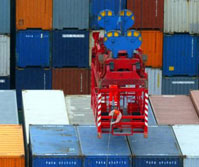
Ehsan Malekzadeh, chairman of the board of the Iranian regime’s Association of International Transportation Companies, reported a large accumulation of imported goods in regional ports and said that around 20,000 containers belonging to Iran are stranded in Pakistani ports, with no stable and low-cost route yet available for transferring them into the country.
In an interview with the state-run Mehr news agency, Malekzadeh referred to conditions following the recent war and stated that some goods being transported to Iran were unloaded at the first safe transit ports due to wartime conditions and international maritime transportation regulations. According to him, this has caused Iranian shipments to become stranded in ports such as Karachi, Jebel Ali, Khor Fakkan, Jeddah, and several ports in India.
He added that in the case of Pakistan, due to domestic laws and international restrictions, no secure and clearly defined route has yet been established to transfer this volume of containers to Iran. According to him, in the United Arab Emirates as well, despite a significant portion of the goods being unloaded at Jebel Ali port, restrictions and high costs have prevented their direct transfer to Iran, and only a limited number of shipments have entered the country through Oman and Iraq.
Baloch Minority in May: Repression, Executions, State Killings & Economic Crisis
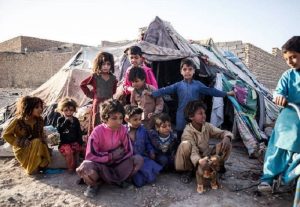
In May, a collection of reports regarding repression, executions, arbitrary arrests, an eroding economic situation, and state killings against the Baloch minority offers a clear yet painful depiction of the intensification of structural pressures in this region. This month not only marked a continuation of previous trends but also demonstrated how the combination of security-driven repression and economic collapse can disrupt the life of a community at all levels.

Reports received from Balochestan in May—ranging from the surge in executions to warrantless arrests and state killings—indicate that the pattern of treatment toward the Baloch minority has shifted from an intermittent occurrence into a continuous policy of control and elimination. Alongside these pressures, the economic crisis—from widespread unemployment to deprivation of basic services—functions as another tool to weaken this community, reproducing a cycle of vulnerability and instability.
In total, the month of May serves as a reminder that the situation of the Baloch minority is not merely a collection of scattered incidents, but rather a coherent structure of repression encompassing everything from security to the economy, and from the law to daily life.
While the World Watched the War: 6,000 Detained as Iran Cracks Down on Workers, Teachers, and Students
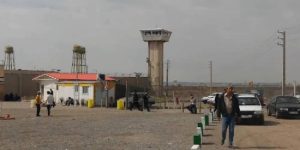
Over the past 88 days, while international media and Western public opinion focused on war headlines, missile exchanges, and geopolitical tensions, another reality was taking shape beneath the surface of Iranian society. The regime used this wartime atmosphere and information blackout as the ideal opportunity for a major security operation.
The primary targets were not foreign spies, but salaried workers, teachers, labor activists, and trade union figures whose economic grievances had reached a breaking point.
When the internet is cut off, no videos emerge, no voices are heard, and no names are recorded.
Now, through scattered reports from independent labor organizations and preliminary figures from human rights groups such as Amnesty International, the scale of the crackdown is becoming clearer. Since military tensions began in February, more than 6,000 people have reportedly been detained across the country.
MEK Supporters Hold Paris Exhibition Condemning Executions, Call for Grand Rally on June 20
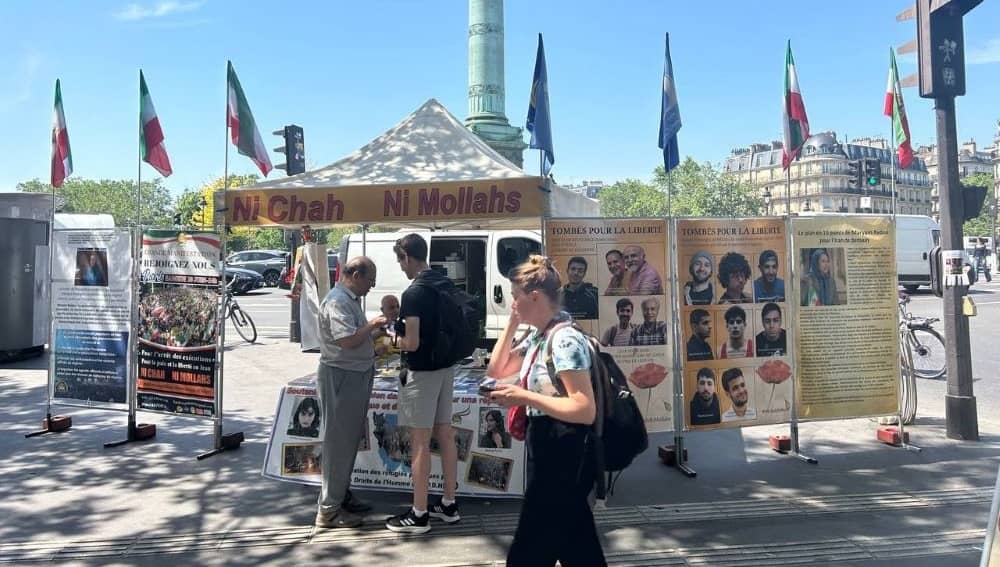
Paris, France – May 28, 2026 – Supporters of the People’s Mojahedin Organization of Iran (PMOI/MEK) organized an exhibition protesting the execution of political prisoners and demonstrators following the January 2026 uprising. The event highlighted growing calls for freedom, justice, and the protection of human rights in Iran.

The exhibition honored victims of the Iranian regime’s executions, showcasing powerful images and personal stories that highlighted their sacrifice. It underscored the Iranian people’s ongoing resistance and their demand for a democratic republic.
Manchester Exhibition Backs Nationwide Uprising and Condemns Executions in Iran
Manchester, UK – May 28, 2026: Members of the Academics in Exile Association in the UK, supporters of the People’s Mojahedin Organization of Iran (PMOI/MEK), held a book table and photo exhibition in solidarity with the nationwide uprising in Iran. The event also protested the execution of PMOI political prisoners, as well as protesters arrested in January 2026.

The organizers sought to draw the attention of local citizens to the suffering of Iranians and their determination to reject all forms of dictatorship—whether monarchical and theocratic. Through images and testimonies, the exhibition underscored the sacrifices made by protesters and called on the international community to stand with the Iranian people rather than any form of authoritarian rule.
MEK Supporters in Bochum Promote June 20 Paris Free Iran Rally for a Democratic Republic
Bochum, Germany – May 27, 2026: In the lead-up to the grand June 20 rally in Paris, supporters of the People’s Mojahedin Organization of Iran (PMOI/MEK) have launched activities in Bochum to promote the event.
The June 20 Free Iran rally in Paris, to be held under the slogan “A Democratic Republic for Iran,” will reject both monarchical and theocratic dictatorships, emphasizing a third alternative based on democracy and popular sovereignty.
MEK Supporters in Bochum Promote June 20 Paris Free Iran Rally for a Democratic Republic #100KFreeIranRally #StopExecutionsInIran #No2ShahNo2Mullahshttps://t.co/ysnYwMcOvr
— Iran Freedom (@4FreedominIran) May 29, 2026