

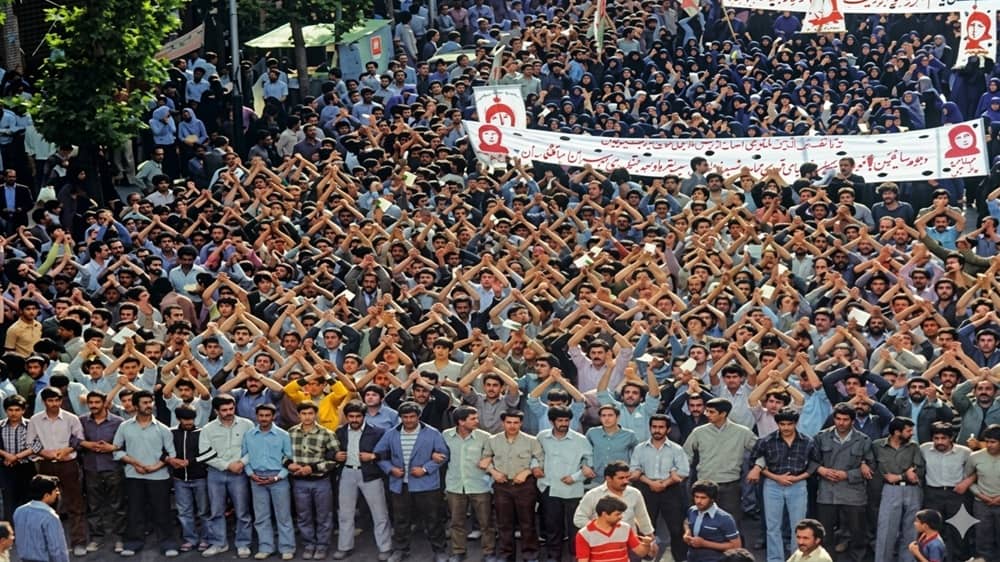
Forty-five years ago, Khomeini opened fire on half a million unarmed marchers. He won the street that afternoon. He has been losing the country ever since.
Four-minute read
On June 20, 1981, more than 500,000 Iranians marched through the boulevards of Tehran. They carried no weapons. They chanted for the freedoms the 1979 revolution had promised and the new theocracy was already confiscating. At the head of the procession walked the People’s Mojahedin Organization of Iran — a movement that, barely two years earlier, had numbered fewer than two hundred souls walking out of the Shah’s prisons. By that June afternoon the PMOI had become the largest organized political force in the country, a network of hundreds of thousands of students, teachers, workers, and professionals who still believed in ballots over bullets.
Khomeini answered with gunfire. The Revolutionary Guards shot into the crowd. Fifty were killed at Tehran University alone, hundreds wounded, over a thousand dragged to Evin Prison. Within days, teenagers were lined up before firing squads. Leading clerics declared that any demonstrator, regardless of age, was an “enemy of God” and could be executed on the spot. In a single afternoon, the clerical dictatorship made its bargain explicit: obedience or death.
The PMOI faced a choice no political movement welcomes. It could accept the monopoly of violence and dissolve — betraying every ideal its founders had been tortured for under the Shah — or it could resist by the only means the regime had left available. It chose resistance. That decision was not born of ideology or appetite for war; it was the direct, documented consequence of a theocracy that machine-gunned its own citizens for the act of peaceful assembly.
Parallels and Contrasts Between 1979 and #Iran’s New Revolutionhttps://t.co/nX0AgU8Cig
— NCRI-FAC (@iran_policy) February 10, 2025
The Monarchy’s Gift to Theocracy
Understanding how Iran arrived at that crossroads requires a brief look at the dynasty Khomeini replaced. The Shah cultivated a carefully opportunistic relationship with Islam — presenting himself as a pious Muslim when it suited the public mood, invoking divine visions to burnish his legitimacy, all while ensuring that no genuine democratic alternative could take root. His SAVAK ran one of the most efficient political-murder operations in the Middle East, but it was surgically selective in its targets. Students, intellectuals, leftists, and the PMOI’s own founders were tortured and executed. Clerics were not.
Mohammad Hanifnejad, Saeid Mohsen, and Ali Asghar Badizadegan went to the firing squad in 1972 for the crime of organizing a grass roots resistance. Khomeini, whose sermons openly called the Shah a “wretched, miserable man,” was merely exiled — first to Turkey, then to Iraq, where the Shah ordered the former Iraqi government to protect his safety in Najaf. When Iraq’s then Vice President later offered to liquidate the troublesome ayatollah, the Shah refused. “We are not in the business of killing clerics,” he reportedly said. He released them instead.
By the time the revolution erupted in 1978, the Shah had systematically eliminated every progressive organizer while leaving the mosque networks intact. The clerical takeover of a popular revolution was not an accident. It was the logical outcome of a monarchical stepfather that feared modernity more than theocracy — and in doing so, midwifed the very dictatorship that replaced it.
Watch and judge how an #Iranian state official reveals his fear of the MEK #ResistanceUnits in the midst of #IranRevoIution pic.twitter.com/ludxvDwmSl
— NCRI-FAC (@iran_policy) January 17, 2023
The Long Unraveling
When Khomeini ordered the massacre of June 20, he held a position unrivaled in modern Iranian politics — supreme religious authority, revolutionary founder, commander of both state and street. That was the zenith. Every year since has been a descent. Nearly half a century of executions — at least 120,000, most of them PMOI affiliates — of terrorism exported across four continents, of corruption so endemic that the rial has become a global punchline, of crackdowns that grow more ferocious precisely because the regime grows more fragile. The 1988 prison massacre of 30,000 political prisoners, most of them Mojahedin, was supposed to bury the movement forever. Instead it became the regime’s original sin, the crime an entire generation of Iranians now demands justice for.
Each successive uprising — 2009, 2017, 2019, 2022, and the massive December 2025–January 2026 explosion — has been larger, angrier, and harder to suppress. The slogans have converged on a single conclusion: the clerical system cannot be reformed, only removed. That is the argument the PMOI made on June 20, 1981. It took forty-five years, but the nation has arrived at the same address.
Even as Iran faces bombing and foreign air strikes, the clerical regime’s own media and officials are showing that one fear still sits near the top of their agenda: the possibility that the @Mojahedineng and a wider uprising could turn the crisis into a deadly force for ultimate…
— NCRI-FAC (@iran_policy) March 20, 2026
The Pretenders
Into this arena, the remnants of the Pahlavi dynasty have tried to project relevance. On January 8, 2026, after days in which people had already been taking to the streets, Reza Pahlavi returned from his Christmas holiday and attempted to ride the wave of public protest by calling for demonstrations that were already under way.
The monarchists, amplified by foreign-funded cyber armies and satellite channels, offered no organizing foothold inside the country, no resistance network, no infrastructure of sacrifice. They gambled on a foreign war delivering the throne and lost.
The January uprising exposed what sociologists of revolution have long understood: fake propaganda and exile media campaigns do not constitute a movement, and no amount of branding can replace forty-five years of sustained, organized resistance on the ground.
"For Iran’s rulers, the most dangerous part of the January 2026 uprising was not simply that crowds poured into the streets. It was that the @Mojahedineng-led Resistance Units were there with them—helping people stay together under attack, getting families out of kill-zones,…
— NCRI-FAC (@iran_policy) January 27, 2026
The Road from June 20
The anniversary of June 20 is not merely commemorative. It is diagnostic. A regime that began by shooting unarmed marchers has never found another vocabulary. A movement that was forced into armed resistance because every peaceful avenue was sealed with blood has, against extraordinary odds, survived, expanded, and now operates an extensive network of Resistance Units inside the country.
The nation is not choosing between theocracy and monarchy; it already rejected both. The path that the PMOI charted on June 20, 1981 — removal of the clerical dictatorship, just as its monarchical stepfather had to be removed before it — is no longer the position of one organization. It is the direction of a country.
The bullets chose for them in 1981. Forty-five years later, the people are choosing for themselves.