

Four-minute read
Following the February 28 assassination of Ali Khamenei in a U.S.-Israeli airstrike, the Iranian state apparatus faced a profound internal crisis. Competing factions delayed funeral proceedings for 131 days until a mid-June ceasefire. When mourning finally initiated in early July, the imperative to project unwavering public support fell to a deeply fractured media and internal security apparatus. Rather than reflecting organic grief, the ceremonies became an orchestrated political event heavily reliant on fabricated data, digital manipulation, and coercive mobilization.
State-run outlets aggressively managed the domestic narrative, explicitly escalating crowd estimates with each passing day. On July 4, the Islamic Republic of Iran Broadcasting (IRIB) launched its live coverage by claiming “several million” attendees had gathered in Tehran. By July 5, the IRGC-affiliated Fars News Agency projected that 15 to 20 million would turn out in the capital. Pro-establishment Telegram channels pushed the boundaries of plausibility further on July 10, circulating claims that 40 million citizens participated nationwide. Ultimately, Ministry of Interior officials echoed this framing, officially declaring the processions “the largest human gathering in history.”
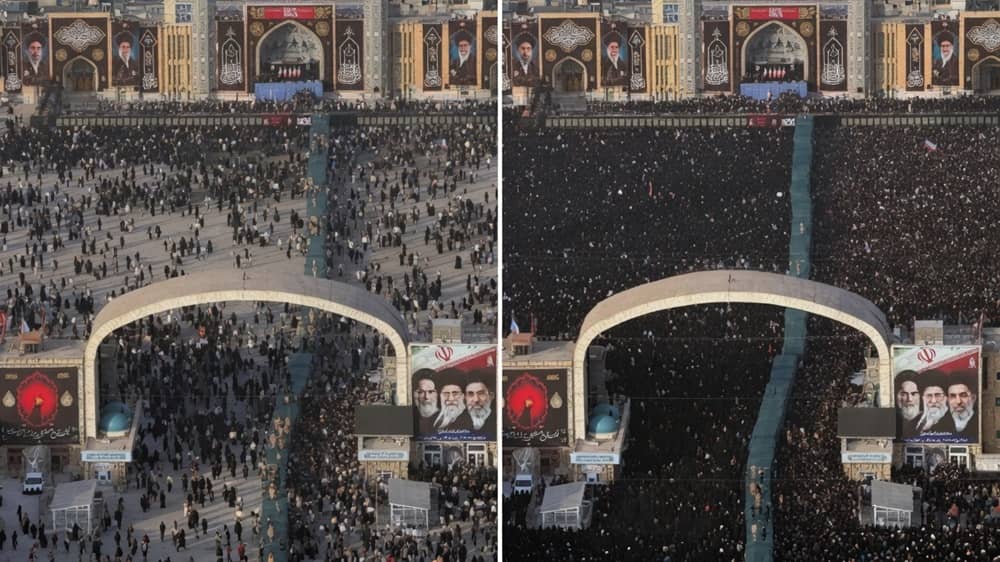
Independent verification mechanisms immediately contradicted these official state broadcasts. On July 6, Reuters reported that drone footage indicated crowds in the “hundreds of thousands”— orders of magnitude below IRIB’s televised claims.
Massive crowds gathered in Tehran to mourn Iran's late supreme leader Ayatollah Ali Khamenei, but this clip does not show the ceremony.
The footage does not match visuals of the Iranian capital, and detection software indicates it was generated using AI https://t.co/Nl6OpeSMYI pic.twitter.com/PliwPskBa0
— AFP Fact Check 🔎 (@AFPFactCheck) July 10, 2026
The Generative AI Fabrication Factory
To bridge the massive statistical gap between verifiable turnout and the 40 million claimed by state proxies, the media bureaucracy deployed an unprecedented volume of AI-generated content. This flood of digital fabrications was systematically dismantled by seven international fact-checking organizations. By manipulating visual evidence, the factions controlling the broadcasting infrastructure attempted to create a localized reality for domestic consumption while simultaneously projecting an illusion of monolithic support internationally.
The technical incompetence of these fabrications quickly exposed the operation. On July 10, AFP Fact Check thoroughly debunked a widely circulated 33-second aerial video purporting to show a portion of the 40 million attendees. Analysts noted the religious complex depicted did not architecturally match the Grand Mosalla, and Hive Moderation’s AI detection tool rated the footage 99.7 percent likely to be generated. Days earlier, France 24 identified multiple layers of fraud across state-promoted clips: a fabricated beige dome replacing a real blue dome, an AI-generated Azadi Tower crowd carrying OpenAI’s “SynthID” watermark, and banners displaying illegible gibberish instead of actual Persian text.
Digital manipulation extended to altering crowd dynamics in genuine footage. On July 3, Pakistan’s IVerify analyzed a prominent video broadcast by Iranian proxy accounts. The investigation revealed crowds moving in unnatural, wave-like patterns resembling flowing water, while a red flag inexplicably materialized mid-crowd with no visible source. UncovAI rated the clip 99 percent AI-generated. The sheer volume of these fabrications prompted DW News to explicitly note on July 8 that “one extra minute of scrutiny” was often all analysts needed to identify the visual fraud.
Both supporters of the #Iranian regime and members of the opposition have been sharing #AI-generated images of funeral services held in early July for Iran's late supreme leader Ayatollah Ali #Khamenei.https://t.co/92KwszAYwk
— The Observers (@Observers) July 9, 2026
The Bureaucratic Coercion Machine
Behind the manipulated camera angles, state factions deployed an industrial-scale coercion machine to guarantee the physical presence of citizens. Dozens of reports indicate localized coercion orchestrated by municipal authorities. In Tehran, the real estate union directly ordered its members to close their offices and attend the processions. Concurrently, local divisions of the Basij paramilitary force canvassed commercial districts, explicitly warning independent shop owners that their businesses would be permanently “sealed” by the judiciary if they remained open.
This mobilization relied heavily on the bureaucratic extortion of the working class. The Tehran Municipality unilaterally canceled all employee leave and mandated attendance at the Mosalla complex. This coercion extended deep into the state-managed industrial sector. Automotive giant SAIPA and the Hamshahri newspaper organization—both heavily integrated into the state’s economic apparatus—were compelled by managing boards to bus their workforce directly to the procession routes, threatening the salaries and employment status of those who refused.
Financial extraction was also utilized to artificially inflate the public spectacle. On July 3, Shabtabnews reported that local governors forced industrial companies in Semnan province to finance roadside service stations entirely at their own expense, extracting over $570,000 from regional automobile manufacturers alone. Furthermore, according to a July 7 report by Iran So Far Away, the Ministry of Economic Affairs systematically raised regional bread prices in the preceding weeks, only to distribute 50 million “free” loaves during the funeral to financially bait impoverished citizens into attending.
"Tehran intended the funeral to be a monumental projection of strength. Instead, the world witnessed an unstable power structure at war with itself — unraveling from within while the flames of a broader #IranWar close in around it," Dr. @MasumehBolurchi writes.…
— NCRI-FAC (@iran_policy) July 9, 2026
Recycled Spectacles and a Fractured State
The reliance on visual deception was a pre-planned disinformation playbook, not a spontaneous decision. Months earlier, on March 3, AFP had already debunked footage circulated by state-aligned accounts purporting to show early mourning for Khamenei. Fact-checkers proved the footage was actually recycled video from the January burial of Sayyid Hadi al-Husseini in Najaf, Iraq. This early deployment of fake footage demonstrated that the state’s media apparatus recognized their inherent inability to generate organic mass mobilization immediately following the February 28 strikes.
This manufactured spectacle must be understood within the context of a fractured political elite desperately fighting for survival. The delayed funeral served as a critical battlefield for domestic factions attempting to project stability. Mojtaba Khamenei, the appointed successor, has remained entirely out of public view since his father’s death. Without a visible figurehead to unite the hardline base, bureaucratic factions forcefully engineered a display of legitimacy through AI, financial extortion, and recycled media.
The final assessment reveals a state machinery operating on structural deception rather than popular mandate. As an analysis published by The Conversation on July 9 concluded, the event was “far more than a state ceremony—it was an orchestrated political and diplomatic event designed to demonstrate sustained public support and, hence, legitimacy.” By meticulously tracing the origins of the state media’s broadcast claims, AI fabrications, and municipal coercion tactics, the factual record remains clear: the legitimacy projected during those seven days was entirely manufactured, not earned.