

THIS PAGE WILL BE UPDATED WITH THE LATEST NEWS
UPDATE: 8:00 PM CEST
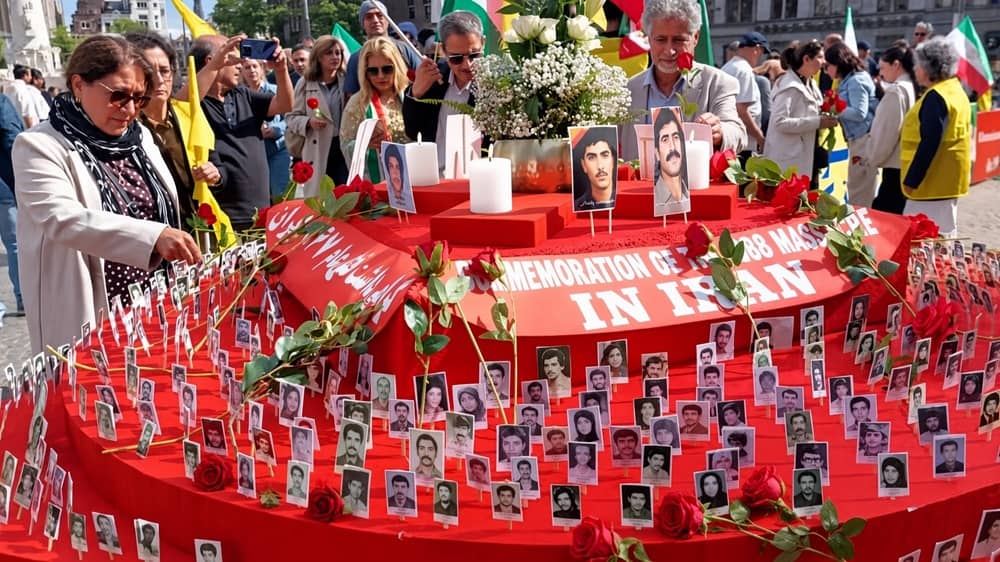
Message to the Conference Seeking Justice for Victims of the 1988 Massacre in Iran
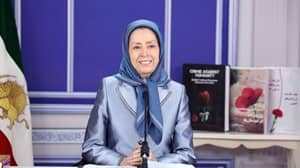
Mrs. Maryam Rajavi’s speech: “At a time of increasing political executions, we mark the 38th anniversary of the 1988 massacre of political prisoners in Iran. Khomeini’s order was clear: all PMOI prisoners who remained firm in their beliefs had to be executed. But later, the executions also included other political prisoners. However, 90 percent of those executed were affiliated with the PMOI. They are the spirit of resistance that continues from one generation to the next, as they rise for freedom. In August 1988 in a letter to the UN Secretary General, Massoud Rajavi the leader of the Iranian Resistance, stated: ‘According to reliable information, several weeks ago, Khomeini issued a handwritten order for the execution of political prisoners who supported the PMOI.’
As the late Baroness Boothroyd said, ‘The 1988 massacre was the largest massacre of political prisoners since the Second World War.’ In 2024, the United Nations Special Rapporteur on Iran, Professor Javaid Rehman, described it as a crime against humanity and genocide. However, the world remained silent and failed to act. As a result, those who ordered and carried out the massacre have enjoyed complete impunity until today.”
Resistance Units in Zahedan Mark PMOI’s 61st Anniversary with Banners Rejecting Dictatorship
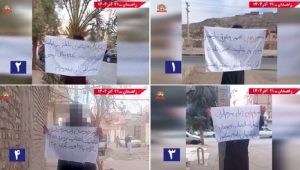
Ahead of the 61st anniversary of the founding of the People’s Mojahedin Organization of Iran (PMOI/MEK), Resistance Units in Zahedan carried out a campaign of installing banners and displaying leaflets across the city, marking the occasion with messages about the organization’s history, its founders, and its struggle against dictatorship.
The activities took place ahead of September 6, 2026, the anniversary of the PMOI’s founding. The banners carried messages from Maryam Rajavi and Massoud Rajavi, celebrated the organization’s founders, and highlighted slogans including “61 years of struggle,” “neither Shah nor Sheikh,” and calls for freedom and a democratic republic.
Through the campaign, Resistance Units presented the anniversary not simply as a commemoration of the organization’s past but as a statement about its ongoing struggle inside Iran.
A central theme of the Zahedan activities was the PMOI’s 61-year history of opposition to successive dictatorships.
One banner declared: “The PMOI means 61 years of ‘neither Shah nor mullahs,’ resistance and steadfastness, sacrifice and selflessness, struggle and perseverance.” Another described the organization’s history as “61 years of relentless and uninterrupted struggle against the dictatorships of the Shah and mullahs.”
Women’s Leadership in the PMOI
The People’s Mojahedin Organization of Iran (PMOI/MEK), the largest and pivotal member organization of the National Council of Resistance of Iran (NCRI), the main opposition coalition to the ruling Iranian regime, was founded on September 6, 1965, by Mohammad Hanifnejad, Saeed Mohsen, and Asghar Badizadegan, with the objective of liberating the Iranian people from all forms of dictatorship.
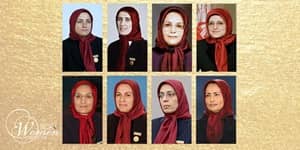
Standing up against the clerical regime’s deeply ingrained misogyny, throughout 61 years of the organization’s continuous struggle against two tyrannies, competent women have guided the PMOI for the past 37 years. They have expertly navigated the organization through the most complex phases of its political existence. These qualified women hail from across Iran, including Azerbaijan, Tehran, Kurdistan, Gilan, Khuzestan, Semnan, and Mazandaran, and each embodies the liberating, humanistic, and fighting values within the ranks of the Resistance.
Following the election of Maryam Rajavi as the Secretary General of the PMOI in 1989, she cultivated a generation of highly qualified women who assumed full leadership of the organization starting in 1993. The Secretaries General of the PMOI helm a Central Council composed of 1,000 women members of the PMOI.
Iran Human Rights Report: Executions, Political Repression and Arbitrary Killings Intensify in August 2026
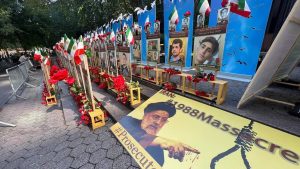
Iran’s human rights crisis continued to deteriorate throughout August 2026, as the ruling regime relied increasingly on executions, arbitrary arrests, lethal force, and physical punishment to intimidate society and suppress dissent.
According to figures compiled from published reports, at least 82 people were executed in Iranian prisons during August, including six women and four political prisoners. The victims also included members of Iran’s ethnic minorities: six Baluch and eight Kurdish prisoners, as well as one Afghan national.
The figures reflect only cases that could be documented and reported. Other human rights organizations have also recorded a sharp increase in executions during the month, although their totals differ because executions are frequently carried out without advance public notification and information about individual cases is often withheld.
The pattern is significant. As the regime faces mounting political, economic, and social pressures, the use of executions and other coercive measures has become an increasingly visible instrument of control.
Seyed Mohammad Javad Vafaei Sani From Vakilabad Prison: “We Have a Duty to Be the Voice of Our Oppressed People”

From Vakilabad Prison in Mashhad, Iranian political prisoner Seyed Mohammad Javad Vafaei Thani has issued a message marking the anniversary of the founding of the People’s Mojahedin Organization of Iran (PMOI/MEK), paying tribute to generations of resistance and expressing confidence that the movement’s sacrifices will ultimately lead to freedom in Iran. Writing in September 2026, Vafaei Thani acknowledged the difficult conditions facing prisoners amid the Iranian regime’s repression and the broader crises affecting people across Iran. But he stressed that hardship cannot be a reason for silence.
“In such difficult days, when this bloodthirsty and anti-human regime has created such harsh conditions for the people of Iran and the region, naturally our circumstances in prison, like those of all the people of this land, are difficult and arduous,” he wrote. “But this is no reason for us to remain silent.”
The political prisoner said that those held behind bars have a responsibility to speak for people who are unable to make their voices heard freely.
“We have a duty, under all circumstances, to be the voice of our oppressed people and to cry out about their pain and suffering,” he stated.
Ali Moezzi From Qezel Hesar Prison: “Let Us Not Allow Others to Write Our Destiny”

Political prisoner Ali Moezzi has issued a message from Qezel Hesar Prison in Iran marking the 61st anniversary of the founding of the People’s Mojahedin Organization of Iran (PMOI/MEK), describing the organization as a product of decades of struggle and sacrifice and calling on the Iranian people to take an active role in determining their country’s future.
In his message, written in September 2026, Moezzi described the PMOI’s founding principles as centered on “unity, liberation, and freedom,” while emphasizing its opposition to colonialism, reaction, dictatorship, and political dependence.
“Sixty-one years of the evolutionary life of the People’s Mojahedin Organization of Iran—congratulations to Sister Maryam, to the soul of souls, and to the heroic people of Iran,” he wrote.
He characterized the organization as a movement whose members, in his words, have sought to separate religious faith from the political exploitation and repression carried out in its name.
“The Mojahed has removed the dust from the face of religion,” Moezzi wrote. “The People’s Mojahedin love God and God’s people, struggle for God and the people, and have no fear of the reproaches and obstacles created by their critics, censors, demonizers, those who create smoke and noise, those who block the way, and those who spread despair.”
Iran’s Rial in Freefall, Putting Strain on People’s Livelihoods
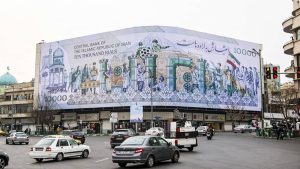
The U.S. dollar exchange rate in Iran’s free market has surpassed 2.8 million rials, while the official rate remains at around 1.6 million rials, creating a wide gap between the official and free-market rates. This surge has resulted from the Iranian regime’s continued warmongering, the continuation of sanctions, the maritime blockade, restrictions on oil exports, geopolitical tensions, declining foreign-exchange revenues, and high inflation. The consequences of a rising dollar exchange rate, like an increase in gasoline prices, have a cascading impact on all economic, social, and security issues in society.
The surge in the dollar rapidly increases production costs, particularly in import-dependent industries such as automobiles, household appliances, pharmaceuticals, and the chemical and food industries, and the sharp rise in production costs intensifies “high prices.”
Production units with limited access to preferential and government-supplied foreign currency face rising costs and declining profits. As a result, many production lines effectively shut down, adding to the number of unemployed people.
Currency instability halts or delays investment. Companies prefer to convert their liquidity into safe assets such as gold, foreign currency, and property rather than enter the investment cycle; consequently, no jobs are created.
Iran: Bita Ali-Hemati, A Married Mother of Two Sentenced to Death and Five Years’ Imprisonment
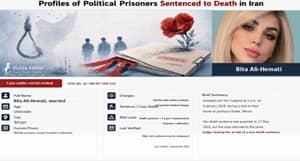
Bita Ali-Hemati is a married mother of two residing in Tehran. She is the wife of Mohammad-Reza Majidi-Asl, one of the defendants in the same case. Her age, date of birth, occupation, education and medical condition are unknown.
Security agents reportedly raided her home on Jomhouri Street, Tehran, at approximately 3 a.m. on 9 January 2026 and violently arrested her and her husband. Three other individuals were arrested simultaneously. Information about her transfer, interrogation and access to counsel remains incomplete.
Branch 26 of the Tehran Revolutionary Court, presided over by Judge Iman Afshari, sentenced her to death, five years’ imprisonment and confiscation of all property for alleged operational action on behalf of a hostile state. The judgment referred to protests, slogans, throwing objects, property damage and explosives, but did not clearly establish her individual role or independent evidence.
On 17 May 2026, the judgment was reportedly quashed and the case returned to Judge Afshari’s branch.
Iran’s Ruling Establishment Divided Over Using Strait of Hormuz as Economic Weapon
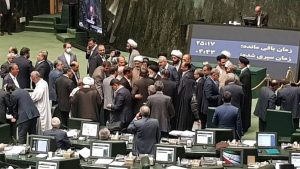
Tehran is facing a growing dispute within the Islamic Republic’s political establishment over how to use the Strait of Hormuz, a disagreement that is no longer only about how to confront the United States militarily, but is now directly tied to the price Iran’s economy is paying for the closure or restriction of one of the world’s most important energy routes.
On one side of the dispute, parliament’s National Security Commission is designing a framework intended to transform Iran’s control over Hormuz from a military threat into a legal and economic lever. On the other, analysts and media outlets critical of this approach argue that pressure through Hormuz has failed to force the other side to retreat and has instead left Iran itself facing higher inflation, falling purchasing power, restrictions on trade and the risk of an intensified maritime blockade.
The divide also matters for global markets. Tehran’s decision over Hormuz is not merely a foreign-policy dispute; its outcome could affect transportation costs, shipping insurance and energy exports from Gulf states.