

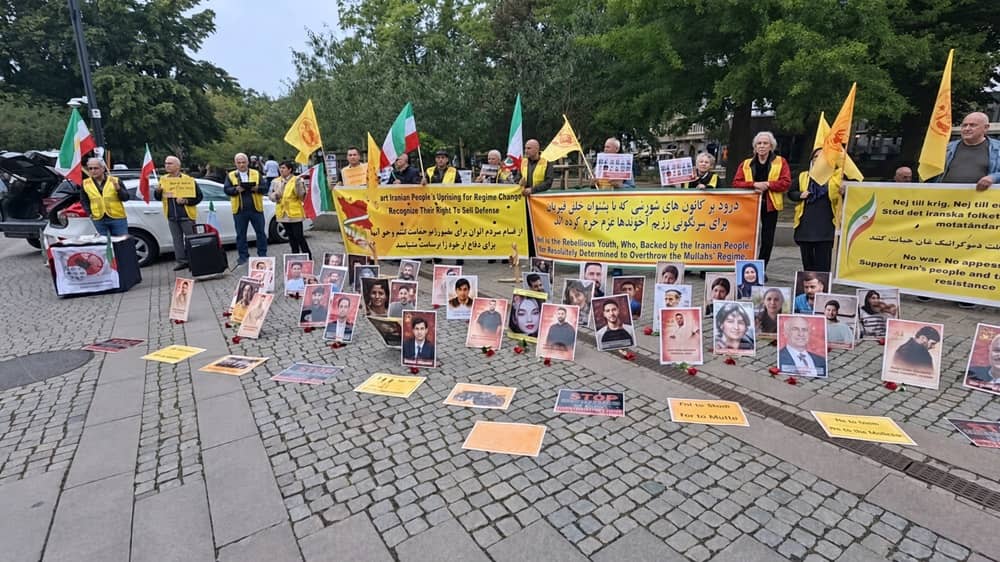
On September 19, 2026, NCRI supporters in Malmö, Sweden, held a rally and photo exhibition to protest the Iranian regime’s continued use of the death penalty
THIS PAGE WILL BE UPDATED WITH THE LATEST NEWS
UPDATE: 9:00 AM CEST
Message to the Rally of Freedom-Loving Iranians Outside the United Nations in New York
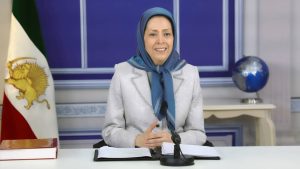
Mrs. Maryam Rajavi’s message: “That voice rejects the continued occupation of Iran’s seat by religious fascism, which is a continuation of the same mistake that, for decades, has ignored the Iranian people and Resistance. The presence in this building of perpetrators of crimes against humanity and those responsible for genocide is a mockery of human rights, peace, and justice. Those whose hands are stained with the blood of hundreds of thousands of innocent people in Iran and across the region must be expelled from the United Nations. Iran’s seat belongs to the people of Iran and to their legitimate Resistance for peace, freedom, and a democratic republic. The time has come to listen to the voice of the Iranian people. A people who seek neither war nor dictatorship; a people who seek freedom and a democratic republic.
“The clerical regime is the enemy of the Iranian people and a threat to regional and global peace and security. As long as this regime remains in power, repression, executions, terrorism, and warmongering will continue.
The solution is democratic change by the people of Iran and their organized Resistance.
That change is within reach.”
Iran: A 46-Year-Old Mother of Three Executed in Isfahan

Early Sunday morning, September 13, 2026, a female prisoner named Zeynab Rajabi, 46, and a mother of three, was executed at Isfahan Central Prison, also known as Dastgerd Prison.
Zeynab Rajabi had diabetes and had been in detention for about four years. Her husband suffers from a spinal cord injury, and the family had lived for years on unemployment insurance. Due to poverty and desperation, and to cover her husband’s medical expenses and the costs of supporting her three children, Zeynab had been forced to assist her brother-in-law in storing drugs.
The court sentenced her to death, while the main defendant, Zeynab’s brother-in-law, received only 13 years in prison, a shocking disparity that underscores the sheer injustice and discriminatory treatment of women in Iran.
With the execution of Zeynab Rajabi in the Central Prison of Isfahan, the number of women executed in prisons across Iran since the beginning of 2026 has reached at least 27.
Protesters Gather Outside UN to Demand an End to Iranian Regime, Political Executions

Thousands of anti-regime protesters gathered outside the United Nations headquarters in Manhattan on Tuesday to demand an end to Iran’s execution of political prisoners and to establish a free democracy in the country. The demonstration, led by the National Council of Resistance of Iran (NCRI), called for world leaders at the UN General Assembly to act and force the Islamic republic to end the latest surge in executions, with at least 100 political prisoners currently on death row.
Maryam Rajavi, President-elect of the NCRI, slammed the presence of Iranian leaders, including President Masoud Pezeshkian, at the UN meeting as she and rallygoers called for an end to the current regime.
“As long as this regime remains in power, repression, executions, terrorism, and warmongering will continue,” Rajavi said in a video call-in. “The solution is regime change by the Iranian people and their organized Resistance.”
From Removing Preferential Currency Rates to Raising Gasoline Prices: How One Price Shock Triggers a New Wave of Inflation
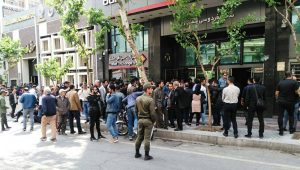
Iran’s regime has repeatedly turned major price decisions into economy-wide shocks. The removal of preferential foreign-exchange rates and increases in gasoline prices are presented by officials as measures intended to improve economic conditions and protect lower-income households. Yet their broader consequences extend far beyond the initial price change.
The common feature of these policies is that they affect prices at the source. Once the cost of a major economic input changes, the increase can move through transportation, production, distribution, and retail markets. The result is a chain reaction that further widens the gap between household incomes, inflation, and the poverty line.
In other words, what begins as a government pricing decision can become the first domino in a much larger wave of inflation.
Gasoline and preferential foreign-exchange rates may appear to concern different parts of the economy, but both have an economy-wide impact.
Fuel prices affect transportation and logistics, which in turn influence the cost of moving agricultural products, industrial goods, construction materials, and consumer products. A higher transportation cost does not necessarily remain confined to the price of fuel; it can be incorporated into the final price of goods and services throughout the supply chain.
Iran’s Cost-of-Living Crisis: When Earning a Living No Longer Pays for Basic Needs
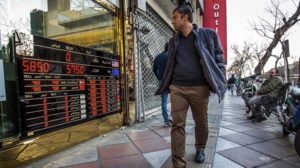
For millions of people in Iran, earning enough to cover the most basic needs has become an increasingly difficult struggle. Even regime-affiliated media are airing accounts that expose the widening gap between household incomes and the cost of living.
One young man interviewed in the regime’s media describes a life in which working hard is no longer enough to make ends meet. He says his income does not keep pace with his expenses and that he has spent two years trying unsuccessfully to buy a car. Even repairing his phone has become unaffordable, leaving it broken for a year.
His account captures a broader reality: the country’s economic crisis has reached a point where ordinary purchases that were once considered routine have become unattainable for many households.
The growing value of the dollar has also become embedded in everyday life. The young man describes his financial situation as being shaped by a currency he has never even handled. This reflects how exchange-rate instability has translated into higher prices for goods and services across the economy, even for people whose incomes are entirely in rials.
Pezeshkian’s UN Trip Exposes Iran Regime’s Deepening Internal Divisions

Masoud Pezeshkian’s scheduled trip to New York for the 2026 United Nations General Assembly has triggered an unusual wave of warnings from Iran’s regime media. Rather than simply preparing the president for a major diplomatic appearance, publications associated with different power centers are warning him about what he must—and must not—say.
The warnings are significant because they expose a deeper problem: the regime’s struggle to maintain a unified public position while competing factions increasingly challenge one another.
On September 18, Kayhan, the newspaper closely associated with Supreme Leader, warned Pezeshkian against following what it described as “dangerous” prescriptions from the Western-oriented current. It also cautioned against sending any signal that could be interpreted by the regime’s adversaries as a sign of weakness.
The message was clear: whatever Pezeshkian says in New York will not be treated as the personal position of the president. He will be viewed as representing the entire regime.
Human Rights Appeal to Protect the Life of Koorosh Berenjani
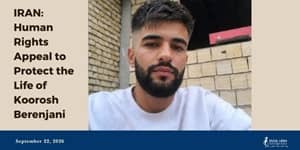
Koorosh Berenjani, born April 7, 2003 (18 Farvardin 1382), a resident of Isfahan, was previously arrested during the protests and heightened security climate following January 2026 (Dey 1404). He was held in detention until March 16, 2026 (25 Esfand 1404), when he was temporarily released on heavy bail and fitted with an electronic ankle monitor. Reports regarding his physical condition upon release raised severe concerns regarding his treatment in custody. Visible marks of severe torture were documented, including pulled fingernails and toenails, broken ribs, and deep lacerations and lash marks across his back and soles of his feet.
On the morning of Tuesday, September 15, 2026 (24 Shahrivar 1405), Berenjani was re-arrested outside his residence and transferred to Dastgerd Prison in Isfahan. Available records indicate that the sole ground for his re-arrest was his public support for Alireza Sepahi—a protester sentenced to death in the “Alekhani Square, Isfahan” case, who suffered a cardiac arrest and was hospitalized on July 28, 2026 (6 Mordad 1405), while being moved to the gallows for execution.
Iran: Amir-Hassan Akbari Monfared, a 23-year-old accounting student, at Risk of Execution

Amir-Hassan Akbari Monfared was born in Karaj in 2002/03. Before his arrest, he worked as a video editor and camera operator and was a fifth-year accounting student. He is unmarried.
The Akbari Monfared family has faced security pressure for decades. His father, Mohammad-Ali Akbari Monfared, was imprisoned in the 1980s and again during the 2022 uprising. He is related to Reza and Maryam Akbari Monfared and other executed members of the family. At the time of Amir-Hassan’s arrest, Arghavan Fallahi was living with the family, and the authorities were seeking an alleged connection between Amir-Hassan and Farshad.
Security agents arrested Amir-Hassan at his family home in Karaj on 19 January 2025. He was first taken to the Ministry of Intelligence facility in Gohardasht, Karaj, and transferred the following day to security detention facilities at Evin Prison. He was held in Wards 240, 209 and 7 of Evin and, after the attack on the prison, was temporarily transferred to Greater Tehran Penitentiary (Fashafuyeh). His father, sister and brother were also arrested. Other family members were later released on bail, but Amir-Hassan remained in detention.
The authorities initially attributed charges including ‘financing terrorism’, ‘collusion against national security’ and ‘membership of hostile groups’ to him. Branch 15 of the Tehran Revolutionary Court, presided over by Judge Abolghasem Salavati, ultimately sentenced him to death for baghi (armed rebellion) through alleged membership of the People’s Mojahedin Organisation of Iran (PMOI/MEK). The judgment was notified on 21 July 2026. His lawyer has been identified as Safarnia, although reports indicate that he lacked effective access to legal counsel during a significant part of the investigation.