
Four-minute read
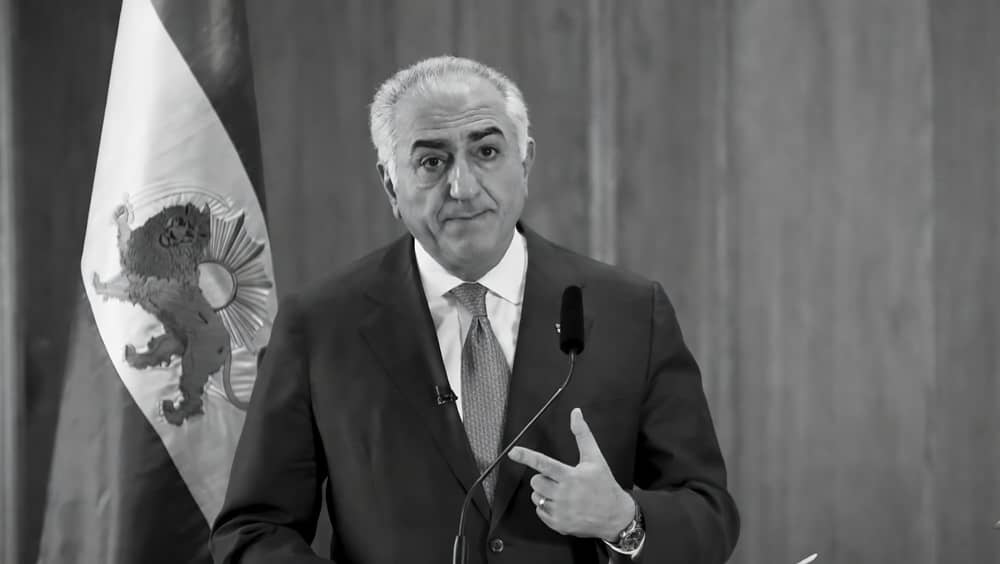
On November 7, in a shameful move, the Friedrich Naumann Foundation presented its Freedom Prize, awarded to the Iranian people, to Reza Pahlavi, the son of Iran’s former dictator, the Shah. Pahlavi delivered a speech at the ceremony in Frankfurt’s historic Paulskirche.
Cloaked in carefully chosen rhetoric about receiving the Friedrich Naumann Foundation’s Freedom Prize merely “in trust” on their behalf, Pahlavi presented himself not as a claimant to power but as a temporary custodian of Iran’s democratic future.
Yet once the speech moved beyond ceremonial courtesies, it revealed considerably more.
From Custodian to Self-Appointed Gatekeeper
Pahlavi compared Iran to a house whose keys had been stolen in 1979 and said: “I see it as my duty to help reclaim those keys.” He later described himself as a “bridge” carrying Iranians from dictatorship to democracy.
This is how his political project is increasingly presented: leadership without calling it leadership; authority without asking voters for it; a transitional role portrayed as something arising naturally from history rather than something Pahlavi himself is seeking.
Reuters exposed the same contradiction months earlier. Asked about his campaign to lead a transition, Pahlavi instructed journalists not to view him as a candidate but as someone providing “an avenue to that future.” Yet shortly after the war began, he had publicly declared that the Iranian people had called upon him to lead the transition.
The distinction between wanting power and merely becoming the indispensable conduit through which power must pass is politically convenient.

“We Do Not Have to Agree About the Past”
Pahlavi’s most carefully designed line in Frankfurt was directed at opponents: “My arms are open. To monarchists and republicans. To the left and the right.”
Then came the proposition that makes that inclusiveness much easier for him to offer: “We do not have to agree about the past to agree about the future.”
For a Western audience, this sounds like Nelson Mandela-style reconciliation.
For the heir to the Pahlavi dynasty, however, putting the past beyond adjudication solves an obvious political problem.
His political identity, name recognition, symbols and core constituency come directly from his father’s monarchy. Yet when SVT questioned him in April about political repression, restrictions on free expression and SAVAK torture under that monarchy, Pahlavi refused either to defend or condemn the record. Instead, he said: “I am proud of my heritage.”
The offer, therefore, is remarkably one-sided: claim about a political capital for the Pahlavi past, but regard scrutiny of its repression as an obstacle to national reconciliation.
MUST-READ: "The Architecture of Hope and Paranoia in Iran"https://t.co/rwmHGzsTyx @realDonaldTrump @SecRubio
— Ali Safavi (@amsafavi) August 19, 2026
That is not transcendence of history. It is selective memory.
And the pluralism proclaimed in Frankfurt deserves to be measured against the political culture developing around him. Die Zeit documented the popularity among Pahlavi supporters of a slogan calling for death to “the mullahs, the leftists and the Mujahedin.” Reuters confronted him with violence and intimidation by self-described supporters and with a senior adviser’s formulation that one was effectively either with Pahlavi or with the Islamic Republic. His own wife had reposted the same exclusionary “death to” slogan. Pahlavi condemned violence when challenged.
This makes the expansive “open arms” of Frankfurt something requiring evidence rather than blind acceptance.
War Becomes “Humanitarian Intervention”
The most consequential repackaging involved foreign military action.
Pahlavi told Frankfurt: “We needed this humanitarian intervention and we do not apologize for it.”
The terminology is doing considerable political work.
In 2024, Pahlavi said: “We are not seeking your intervention.” By February 2026, he was arguing that intervention could “save lives”; once war began, he called it the “game changer” he had been waiting for and later urged renewed attacks to “finish the job.”
#Belgian Institutions Push Back on Reza Pahlavi’s Brussels Optics Campaign https://t.co/3vChqYSyt5
— NCRI-FAC (@iran_policy) October 27, 2026
Frankfurt completed the rhetorical shift: bombardment was no longer merely tolerated, but absorbed into the language of humanitarian necessity.
The deeper political logic is difficult to ignore. Pahlavi has no electoral mandate inside Iran and no demonstrated domestic mechanism capable of carrying him to power. For him, foreign military action therefore does more than weaken the regime; it creates the very opening on which his political project depends.
That is why his zig-zagging on intervention matters. He invokes Iran as his heritage, yet repeatedly backs the use of foreign firepower against it when that firepower appears capable of clearing his path to power.
He simultaneously insists that outsiders must not determine what comes next. The boundary is strikingly convenient: foreign powers may help destroy the existing order, but their legitimacy supposedly ends at the moment the succession begins.
Democracy, Provided the Difficult Questions Come Later
Perhaps the most revealing sentence was this: “No name, no party, no system of government is on it, because all of those choices belong to the people.”
Then Pahlavi added: “I will not take it from them. Nor will I allow others to.”
The first sentence is intended to make him appear democratic.
The Sabeti Case Is Not Just About Iran’s Past https://t.co/NhBv7dXSOm @realDonaldTrump @newtgingrich @marklevinshow
— Ali Safavi (@amsafavi) October 10, 2026
The second quietly raises the question the first seeks to settle: by what authority does an unelected exile decide what he will or will not “allow”?
Iranian history offers good reason to interrogate reassuring transitional rhetoric before—not after—the transfer of power.
In Paris in 1979, Ruhollah Khomeini likewise spoke in language calibrated for foreign audiences: political freedom, parliamentary democracy, religious tolerance and non-interference abroad.
Pahlavi is not Khomeini, and the comparison is not ideological.
The lesson is more basic: democratic promises are cheapest before power is obtained.
In an assessment, Col. Wesley Martin, former Senior Antiterrorism Officer for all Coalition Force – Iraq, portrays Reza Pahlavi’s Iran Prosperity Project (IPP) as an authoritarian scheme wrapped in the language of #democratic change.https://t.co/7YeC1vSGCq
— NCRI-FAC (@iran_policy) March 22, 2026
Western governments therefore need not decide whether Reza Pahlavi sounds moderate, polished or reassuring.
They should ask a harder question: why should a man who derives his political relevance from an authoritarian dynasty, declines to confront that dynasty’s repression, accepts foreign military intervention, presides over an increasingly aggressive political constituency, and finances an international campaign through wealthy diaspora donors be presumed to represent a nation that has never elected him?
Frankfurt gave Pahlavi the opportunity to sell himself as Iran’s democratic future. His own words however, exposed something else.