
Three-minute read
Iran’s truck drivers entered their sixth consecutive day of strike action on Friday, while Central Bank Governor Abdolnaser Hemmati acknowledged declining oil revenues and mounting difficulties accessing foreign currency. The economic deterioration coincides with increasingly public disputes within the ruling establishment, extending from parliament to the regime’s own nighttime loyalist gatherings.
According to the Union of Truck Drivers and Trucking Associations, the strike has spread to 20 cities. Simaye Azadi reported on November 27 that stoppages extended across 14 provinces, despite earlier government attempts to downplay the industrial action.
Jalal Mousavi, deputy chairman of the national truckers’ association, told domestic media that a pair of Chinese tires now costs between 200 and 240 million tomans, while 20 liters of engine oil costs 22 million tomans on the open market. The strike is particularly consequential given the government’s increased dependence on overland freight transportation amid maritime trade restrictions.
"The factions are not simply arguing over appointments or electoral advantage. They are fighting over #diplomacy, economic policy, the presidency, parliament and the security apparatus—while each insists that its own course is necessary to preserve the ruling establishment,"…
— NCRI-FAC (@iran_policy) November 23, 2026
Central bank challenges domestic economic policies
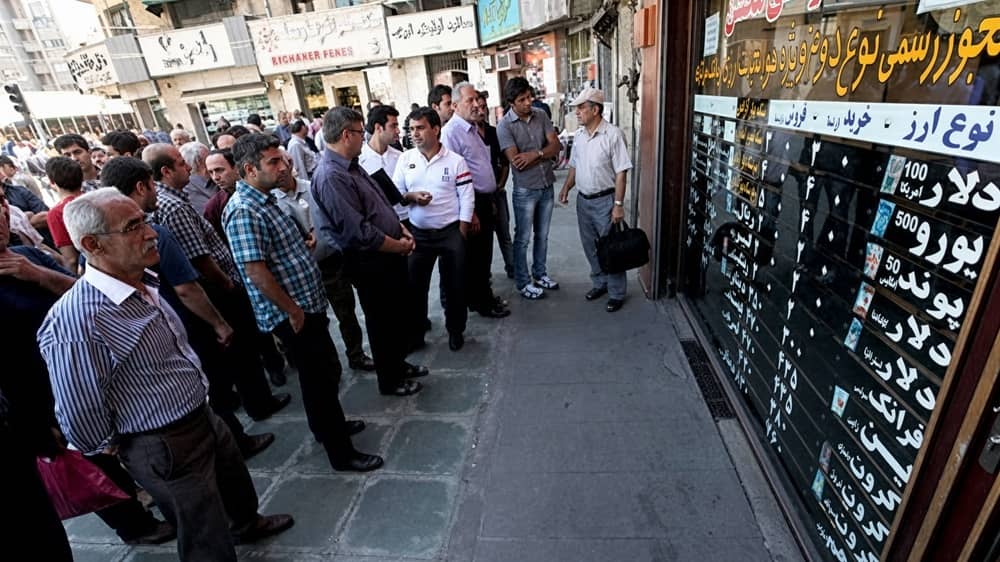
With the dollar trading near 294,000 tomans, Hemmati issued a public statement on November 27 acknowledging the severity of the currency crisis.
“We do not deny the decline in oil revenues and the difficulty of transferring foreign currency resources,” he said, according to Tasnim. While claiming that the Central Bank possessed sufficient foreign currency banknotes to intervene, he provided no figures for accessible reserves.
More significantly, Hemmati warned against government institutions transferring the financial consequences of their decisions onto the Central Bank and ultimately onto the population’s purchasing power. He acknowledged that blaming sanctions could not substitute for correcting domestic policies.
According to the Statistical Center of Iran’s official figures, year-on-year consumer inflation reached 88.7 percent in the month ending October 22, while food and beverage prices increased by 112.6 percent.
The flotilla that never was. #IranWar
The clerical regime hyped a blockade-breaking tanker convoy as a national epic, threatened Gulf oil facilities, then folded the moment the bluff was called—claiming it was all just a media hoax. By @HakamianMahmoud https://t.co/5DzToawVw8— NCRI-FAC (@iran_policy) November 25, 2026
Industrial shutdowns and competing energy priorities
Ali Rabbani, an energy management official at the National Petrochemical Company, told ILNA on November 25 that daily gas deliveries to petrochemical complexes had fallen below 35 million cubic meters—less than half their average consumption last autumn. He warned that continued shortages would force all methanol plants and most urea and ammonia production units offline within 72 hours.
Meanwhile, Nasrin Ojaghi, secretary of Iran’s Home Appliance Manufacturers Association, told ISNA on November 26 that prices of certain domestically produced polymers had risen by up to 370 percent since March, while escalating transportation costs and shortages of raw materials had forced manufacturers to operate below capacity.
Despite these domestic shortages, Iranian state broadcasting reported on Thursday that Tehran and Ankara had agreed to extend their gas export agreement for another five years, citing Turkey’s ANKA news agency. The reported agreement highlights the competing pressures of securing foreign currency revenues and maintaining domestic industrial production.
Iran, Nov. 23: Truckers' strike enters day two despite official denials. Telecom retirees, workers and investors protest as producer #inflation reaches 120.9% and industrial prices jump 147.3%. State newspapers warn of deepening economic misery while regime factions clash over…
— NCRI-FAC (@iran_policy) November 23, 2026
Factional disputes spill into loyalist gatherings
MP Amir-Hossein Sabeti accused Parliament Speaker Mohammad Bagher Ghalibaf of obstructing impeachment proceedings against eight or nine cabinet ministers. In an earlier statement published by Didban Iran, Sabeti also revealed that impeachment proceedings against the labor minister had been pending for eighteen months.
The confrontation has intensified over the imprisonment of hardline MP Hamid Rasaee, who announced on Thursday that he would return to Evin Prison. Fellow parliamentarians have questioned the contradiction between Ghalibaf’s appeals for institutional cohesion and his legal action against a parliamentary colleague.
The divisions have also surfaced in the regime’s nighttime gatherings in Mashhad, where participants compared President Masoud Pezeshkian to Abolhassan Banisadr, Iran’s first president, who was impeached in 1981.
On November 27, Mashhad Friday prayer leader Ahmad Alamolhoda responded to the attacks, arguing that insulting the president would not resolve economic problems while criticizing rising prices and irregularities in flour and wheat distribution.
Iran’s Regime Expands Basij Mobilization as Labor Protests Spread and Political Tensions Intensify https://t.co/4nD1Sm0G8L
— NCRI-FAC (@iran_policy) November 26, 2026
IRGC expands neighborhood-level mobilization in Tehran
On November 27, Hassan Hassanzadeh, commander of the IRGC’s Greater Tehran corps, announced expanded neighborhood-level Basij mobilization in southern Tehran and impoverished districts of the capital.
Speaking at a mobilization exercise, Hassanzadeh linked what the regime describes as “social assistance” to the Basij’s security and defense responsibilities, according to Safhe Siasat.
Hassanzadeh also highlighted previous joint security drills with Tehran’s police forces. The expansion of Basij networks under the guise of social assistance points to preparations to contain potential popular unrest amid worsening economic conditions and growing concerns within the establishment over another uprising.
Iran, Nov. 24: The rial hits another record low as retirees in Kermanshah chant, “We want neither war nor killing; we want lasting welfare.” State newspapers expose soaring costs, pension-fund deficits and medicine shortages. A political analyst warns another nationwide…
— NCRI-FAC (@iran_policy) November 24, 2026
Bread rationing debate exposes fears of public anxiety
On November 27, domestic media reported that the Supreme Audit Court had opposed the prospect of bread rationing. Its spokesperson, Nezameddin Mousavi, maintained that the purchase of 8.5 million tons of domestic wheat and financing for further imports made rationing unnecessary, warning that even raising the prospect could fuel public anxiety and artificial shortages. Domestic media reporting also quoted Mousavi warning that rising exchange rates would exacerbate the government’s budget deficit and inflation.
Meanwhile, Nerkhe Rooz reported on Friday that the government had ordered pasta prices reduced from 150,000 to 90,000 tomans per 700-gram package. The intervention followed First Vice President Mohammad-Reza Aref’s November 25 directive to keep essential commodity prices unchanged for three months.
The debate over bread rationing and emergency price controls suggests that the regime is increasingly operating in crisis-management mode, relying on temporary measures to contain social discontent rather than addressing the underlying economic deterioration.