

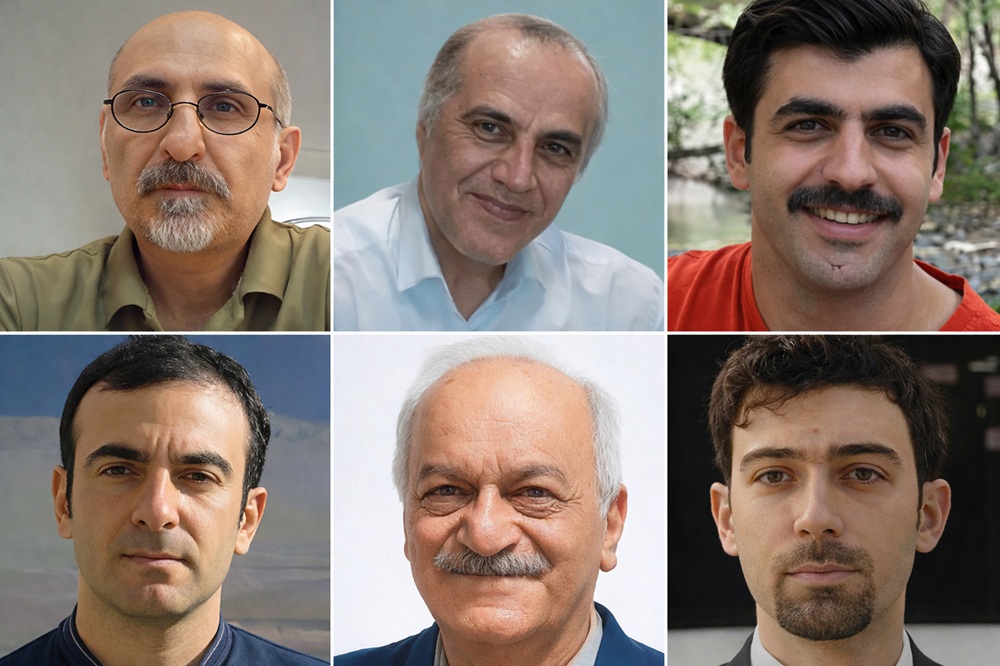
Two more political prisoners, members of the People’s Mojahedin Organization of Iran (PMOI/MEK), were executed at dawn on Saturday, April 4, 2026. Within just five days, six members of this organization were put to death after enduring years of torture and standing firm in their beliefs. All were charged with “waging war against the state” and involvement in organized activities. Alongside them, four other protesters were also executed on similar charges. This convergence and overlap in accusations reveal a critical reality.
Recent developments in Iran are no longer merely scattered signs of social discontent. They point instead to the emergence and consolidation of a distinct and organized force within society—one with a clear political identity and strategy: the People’s Mojahedin Organization of Iran. The boundary between spontaneous protest and organized resistance is increasingly dissolving, and a significant portion of the protesting generation is aligning with a defined and purposeful strategy.
What distinguishes this moment from previous periods is the active and widespread participation of the younger generation alongside established organizational structures. Years of state propaganda portraying the MEK as a relic of the past or disconnected from society are losing credibility in the face of on-the-ground realities. The presence of youth as young as 18 to 20, standing alongside earlier generations, reflects a living and continuous reproduction of resistance—what analysts describe as “generational continuity.” This continuity is the clearest indicator of genuine social support; no political movement can survive or expand without resonance among younger generations.
#Iran News Alert, Simay Azadi Exclusive
Message in English by PMOI member Vahid Baniamerian (“Commander Vahid”), recorded in November 2025 from Ghezel Hesar Prison.
Supporting @Maryam_Rajavi’s Ten-Point Plan, he said: “It is time for the world to correct the failed and… https://t.co/9BFaFntZd6 pic.twitter.com/asbLik56oY
— SIMAY AZADI TV (@en_simayazadi) April 4, 2026
At the same time, the nature of the charges and the official narrative carry their own implications. Emphasis on “armed action,” “planning,” “operational discipline,” and “the objective of overthrowing the system” indicates that the authorities are no longer dealing with a purely spontaneous or emotional phenomenon. Instead, they are confronting an organized network operating within a defined strategic framework. This shift in tone amounts to an implicit acknowledgment of an operational force inside the country—one that is not only present but expanding.
In this context, the wave of executions cannot simply be interpreted as a display of strength. On the contrary, these actions reflect deep concern over the growth of this social and organizational base. The physical elimination of individuals—especially those identified as “commanders” or key figures—typically occurs when a movement has reached a level of operational effectiveness. This is precisely the point at which a political movement transitions from rhetoric to tangible impact on the ground.
From a social perspective, these developments show that Iran’s younger generation is no longer confined to sporadic protest. It is increasingly connected with a defined political and organizational framework. This connection gives protests direction, meaning, and continuity, transforming them from isolated outbursts into a sustained process. What we are witnessing today is not merely social anger, but a form of social organization through which a specific force has been able to expand its base and mobilize the younger generation.
The six MEK members executed this week for seeking freedom are seen days earlier, at Ghezel Hessar Prison, singing “Now rise up like the thunder, let your arms be shown…I am the storm, the storm! O trembling willow, fear my name…I am the storm, I am revolt, the surge, the… https://t.co/oMthXhZS4l pic.twitter.com/aOsLwVsXe0
— Alireza Jafarzadeh (@A_Jafarzadeh) April 4, 2026
Taken together, these realities point to a clear conclusion: the MEK, with over six decades of struggle against both the Shah’s dictatorship and the current religious regime, now stands as an active force with a tangible social base inside Iran, at the center of the Iranian people’s ongoing struggle for freedom. The presence of multiple generations, organizational continuity, and the entry of youth into active engagement all demonstrate that this movement’s strategy is materializing in practice. This is the reality on the ground: a popular, organized, and deeply rooted force emerging from within society and standing in opposition to the ruling system.
In conclusion, recent developments underscore a decisive truth: the force for change in Iran does not come from outside, but from within—from the people and their organized resistance. What has emerged is a force rooted in society, organized, and willing to sacrifice, and therefore far more powerful than any external intervention. It is a force capable of shaping Iran’s future because it draws its strength from generations of collective will. In real terms, such a force is far more powerful than even the most devastating bombardments, because it advances through awareness, organization, and the willingness to pay the price. It is time for governments and policymakers to recognize this undeniable reality and to abandon outdated narratives, standing instead with the Iranian people and their organized resistance.