

THIS PAGE WILL BE UPDATED WITH THE LATEST NEWS
UPDATE: 09:00 PM CEST
Strikes on Iranian Energy and Urban Infrastructure Intensify as U.S. Aircraft Losses, Regional Attacks, and Executions Mark Escalating Day of War
On the thirty-seventh day, the Iran conflict saw concentrated strikes on Iranian energy and urban infrastructure, renewed impacts around Tehran and Bushehr, confirmed U.S. aircraft losses, and expanded Iranian retaliation across Israel and Gulf states. The day combined high-impact military exchanges with executions inside Iran, worsening regional energy disruption, and escalating threats tied to the continued closure of the Strait of Hormuz.
Regime Losses: Sites, Infrastructure, and Personnel
The most extensive damage was reported in the Mahshahr petrochemical zone in Khuzestan province, where a series of coordinated strikes hit multiple major facilities, including large production complexes and associated power plants. Explosions damaged critical chemical processing units and power supply systems, forcing a full evacuation of personnel and halting operations across one of Iran’s most important industrial hubs.
In Tehran, multiple strikes were recorded across several districts, including northern and western areas as well as zones near Mehrabad Airport. Repeated explosions were reported around key urban corridors and mountainous areas overlooking the city, with at least several major detonations near the airport complex itself.
The destruction of power plants could lead to widespread blackouts and impact hospitals, water treatment facilities and food supply chains.https://t.co/OetQdIdWuD
— TIME (@TIME) April 5, 2026
In southern Iran, Bushehr Airport was struck, damaging a civilian aircraft. A separate impact near the Bushehr nuclear facility hit an auxiliary structure and killed one member of the site’s security personnel. No radiation increase was detected, but the incident marked another direct strike affecting the facility during the conflict.
Border infrastructure was also targeted. The Shalamcheh crossing with Iraq sustained heavy damage, halting movement of goods and passengers, while a separate strike affected the Mehran crossing area. Casualties included at least one foreign driver killed and several individuals wounded.
U.S. and Israeli Losses
U.S. forces sustained confirmed aircraft losses over Iranian territory, including the downing of an F-15 fighter jet during combat operations. Both crew members were ultimately recovered, following an extended and contested search-and-rescue effort. Initial recovery operations secured one pilot, while a multi-phase search continued for the second across rugged terrain. The extraction required the deployment of multiple rescue helicopters operating under hostile conditions.
During the operation, U.S. rescue aircraft came under sustained small-arms fire from the ground, resulting in reported injuries among personnel involved in the mission. Despite the hostile environment, all recovery aircraft were able to return safely with the rescued crew. The operation was assessed as costly, underscoring the elevated risks now facing U.S. air operations and personnel recovery efforts over Iranian territory.
Trump says deal with Iran possible by Monday, Fox News reports https://t.co/hlYFDn8KSC https://t.co/hlYFDn8KSC
— Reuters (@Reuters) April 5, 2026
In a separate incident, an A-10 aircraft was lost near the Strait of Hormuz after the pilot ejected and was successfully recovered.
Israel also sustained damage from continued Iranian missile strikes. Multiple impact sites were reported across central regions, including residential areas where buildings were damaged or collapsed. Fires were recorded in southern industrial zones, and localized infrastructure disruptions, including power outages, affected several regions. Civilian casualties remained limited, with several individuals reported injured.
Iranian Regime Retaliation
The regime Iran launched coordinated missile and drone attacks targeting Israel and Gulf states. In Israel, barrages included the use of ballistic systems and cluster munitions, striking more than a dozen locations and triggering widespread air defense responses.
Across the Gulf, Iranian drone strikes caused significant damage to energy and industrial infrastructure in Kuwait, the United Arab Emirates, and Bahrain. Facilities affected included oil installations, petrochemical plants, power generation units, and a water desalination facility, with fires reported at multiple sites.
The regime also carried out an attack on a commercial vessel in the Strait of Hormuz, which caught fire, underscoring continued threats to maritime traffic in the region.
BREAKING Second crew member from US fighter jet that crashed inside Iran is 'SAFE and SOUND', Trump says pic.twitter.com/rGQ5rNqPkR
— AFP News Agency (@AFP) April 5, 2026
Regional Spillover and Maritime Disruption
The Strait of Hormuz remained effectively closed, continuing to disrupt global energy flows. The conflict has removed a significant portion of global oil supply from the market, contributing to sharp price increases and forcing contingency planning among major producers.
Regional infrastructure attacks expanded, with confirmed strikes on Gulf energy networks and government facilities. Diplomatic contacts between regional actors, including discussions involving Oman, focused on potential mechanisms to restore transit through the strait, though no breakthrough was reported.
Internal Developments Inside Iran
Inside Iran, authorities carried out executions linked to earlier unrest. Two young men convicted over involvement in attacks during January protests were executed following upheld death sentences, part of a broader ongoing crackdown on dissent.
Information controls remained tight, with severe restrictions on communications continuing to limit internal visibility. Political tensions persisted within the establishment, though no large-scale public unrest was clearly observable during the period.
⚠️ Update: #Iran's internet blackout is now the longest nation-scale internet shutdown on record in any country, exceeding all other comparable incidents in severity having entered its 37th consecutive day after 864 hours. pic.twitter.com/TmkesLqlKR
— NetBlocks (@netblocks) April 5, 2026
UPDATE: 09:00 AM CEST
Opposition Group Calls for a UN Meeting to Examine Executions of Prisoners in Iran

Paris, April 4 (EFE) – The exiled opposition group National Council of Resistance of Iran (NCRI) called this Saturday for the United Nations to convene a meeting to examine the escalation of prisoner executions carried out by the regime in Tehran, amid the conflict with the United States and Israel, and to adopt measures to prevent further deaths.
The NCRI, based in France, made this statement after two more prisoners—identified as Vahid Bani Amerian and Abolhassan Montazer—were executed early this morning. They were members of the People’s Mojahedin Organization of Iran (MEK), which is considered a terrorist organization by Tehran and is linked to the NCRI.
“The ruling clerics are vainly trying to delay their inevitable downfall. However, this unjustly shed blood will only fuel popular outrage and strengthen the determination of those fighting for freedom,” said Maryam Rajavi, the leader of the NCRI, in a statement.
Iran’s Regime Executes Two More of Its People as Bloody Reign of Terror Lives On

The Islamic Republic executed two more people Saturday, as the regime unleashed a new wave of killings over fears of another citizen uprising in the streets of Tehran. Political prisoners Abolhassan Montazer, a 66-year-old architect, and Vahid Baniamerian, a 33-year-old with a master’s in management, were hanged. They were convicted of being members of the banned opposition group, the People’s Mojahedin Organization of Iran — and came just days after four other members of the group were executed.
“Driven by profound weakness and reeling from its weakening grasp on power following recent nationwide uprisings, the clerical establishment is desperately using the gallows to physically eliminate its organized opposition and terrorize a restless society,” the group said in a statement Saturday.
The executions were the “culmination of a grossly flawed judicial process devoid of any legal legitimacy” the group urged, adding that the tactics included forced confessions and the regime’s state-run media unleashing a barrage of fabricated allegations against the two men in an attempt to justify the political executions.
As War Intensifies, Iran Escalates Executions to Suppress Dissent

As international attention remains fixed on escalating tensions between Iran, the United States, and Israel, a quieter but more consequential development is unfolding inside Iran: the state is accelerating executions.
This week, Iranian authorities executed two men accused of links to the Mujahedin-e Khalq (MEK), according to reporting by Reuters. Their deaths were not isolated incidents. They are part of a broader pattern of repression that intensifies precisely when the regime faces external pressure.
Now, additional cases are emerging that point to what may come next. Vahid Bani-Amerian, 34, and Abolhassan Montazer, 68, both reportedly affiliated with the MEK, have been identified by rights advocates as being at imminent risk of execution. Their cases underscore the urgency of the moment and the trajectory already underway.
The Enduring Legacy of PMOI Martyr Vahid Bani for Iran’s Youth

On April 4, 2026, the Iranian regime executed Vahid Bani Amerian, a 33-year-old political prisoner with a master’s degree in management, alongside his cellmate Abolhassan Montazer.
Their deaths followed the brutal hangings of four other political prisoners affiliated with the People’s Mojahedin Organization of Iran (PMOI/MEK) over a span of just 48 hours. While the clerical regime intended these executions to crush dissent and instill fear into the hearts of Iran’s restive youth, Vahid’s smuggled handwritten letters from inside Evin and Ghezel Hesar prisons reveal a completely different reality.
They reveal a man who was entirely unafraid of death, whose deep commitment to a free Iran made him impenetrable to the regime’s torture and terror.
Iran’s Regime Executes PMOI Members Vahid Bani Amerian and Abolhassan Montazer in Desperate Bid to Prevent Uprisings
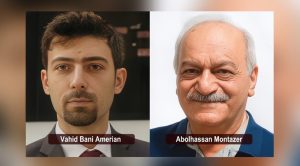
The clerical regime in Iran is rapidly accelerating its campaign of state-sanctioned terror against dissidents. In a heinous act of state murder, the regime has just executed two political prisoners and members of the People’s Mojahedin Organization of Iran (PMOI/MEK), Vahid Bani Amerian and Abolhassan Montazer. These executions come in the immediate aftermath of a bloody 48-hour period on March 30 and 31, 2026, when authorities hanged four other PMOI members: Mohammad Taghavi, Akbar Daneshvarkar, Babak Alipour, and Pouya Ghobadi. Driven by profound weakness and reeling from its weakening grasp on power following recent nationwide uprisings, the clerical establishment is desperately using the gallows to physically eliminate its organized opposition and terrorize a restless society.
In an attempt to justify these political executions, the regime’s state-run media unleashed a barrage of fabricated allegations.
Iranian Regime Hangs Two More Political Prisoners, NCRI Condemns

Maryam Rajavi, National Council of Resistance of Iran (NCRI), condemned the Iranian regime for hanging political prisoners in Iran. Vahid Bani Amerian and Abolhassan Montazer were hanged in Ghezel Hesar Prison, Karaj at dawn on Saturday. “The two heroic members of the People’s Mojahedin Organization of Iran (PMOI/MEK) have now joined their comrades who laid down their lives in the struggle for freedom, including Mohammad Taghavi, Akbar Daneshvar Kar, Babak Alipour, and Pouya Ghobadi,” Rajavi said.
“The ruling religious dictatorship in Iran has once again shed the blood of two of the Iranian people’s most courageous sons, exposing its fear and desperation in the face of organized opposition, the PMOI/MEK and the Liberation Army,” she added.
Continued Detention of Mother and Sister of Executed Political Prisoner Babak Alipour
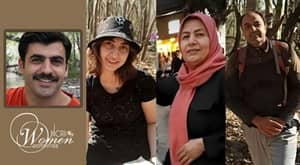
Two months after their arrest, the mother, sister, and brother of Babak Alipour, a political prisoner who was executed by the clerical regime in Iran on March 31, remain effectively held hostage by the regime’s authorities.
Omolbanin Dehghan, 63, the mother of Babak Alipour, was an active participant in the “No to Execution Tuesdays” campaign. She was arrested on January 26, 2026, in Tehran along with her daughter Maryam Alipour, 31, and her son Roozbeh Alipour, 40. Currently, Omolbanin Dehghan and Maryam Alipour are being held in Qarchak Prison in Varamin, while Roozbeh Alipour is under interrogation in Ward 209 of Evin Prison.
The family was denied the right to a final visit with Babak Alipour prior to his execution. Authorities also refused to return his body to the family for burial.
War as Strategy: How Tehran Weaponizes External Conflict to Contain Internal Dissent

As tensions and both direct and indirect confrontations between the United States, Israel, and Iran’s regime enter a new and volatile phase, understanding the true nature of this “war” — and its relationship to Iran’s internal dynamics — becomes critically important. While the conflict unfolding at the regional and international level carries real and destructive consequences, for Tehran it serves a function far beyond foreign confrontation: it is a strategic instrument to contain domestic uprisings and obscure deep internal crises.
Iranian society in recent years has been defined by sustained and accumulating discontent — a condition marked by explosive potential. Widespread protests, a widening chasm between state and society, and the steady erosion of political legitimacy have created a fragile structure in which even a minor spark could ignite a nationwide uprising. Within such a context, external conflict offers the regime an opportunity to recalibrate the internal environment in its favor.
Reactions to The Attack on the Tallest Bridge in the Middle East in Iran
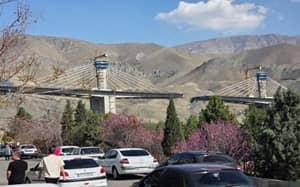
Karaj’s B-1 Bridge was supposed to hold the record as the tallest bridge in the Middle East; a massive and complex project whose construction took years and cost tens of trillions of rials. The bridge, with a length of 1,050 meters and a height of 136 meters, had been built in the city of Karaj in Alborz Province, and it was said that it would significantly reduce traffic congestion in the area.
On April 2, the B-1 Bridge was targeted twice in airstrikes, and parts of it collapsed. The bridge had been scheduled to become operational in the coming months.
According to reports, at the time of the attack, many people were in the green spaces beneath and around the elevated bridge, spending Sizdah Bedar, Iran’s traditional Nature Day outing.
Chinese Private Companies and the Exposure of U.S. Military Movements Amid Iran War
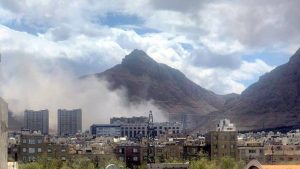
Chinese private companies, some of which are linked to military institutions, have begun offering information that exposes details of the movement of U.S. forces in the region. This comes while Beijing has officially tried to maintain its distance from developments in the Iran war. The Washington Post reported on Saturday, April 4, that since the start of the Iran war, users active on Western and Chinese social media platforms have encountered widely viewed posts containing information about U.S. military activities.
Among the information published in these posts are details about equipment deployed at U.S. bases, the movement of American aircraft carriers, and precise analyses of the process of preparing military aircraft for strikes against the Iranian regime.
MEK Resistance Units Protest Executions in Zahedan, Chant “Death to the Oppressor, Shah or Mullah”
On April 3, 2026, MEK Resistance Units carried out coordinated protest activities in Zahedan, Sistan and Baluchestan, condemning the regime’s recent wave of executions and reaffirming their commitment to overthrowing the ruling system.
#MEKResistanceUnits Protest Executions in Zahedan, Chant “Death to the Oppressor, Shah or Mullah” #StopExecutionsInIran #No2ShahNo2Mullahs https://t.co/BghkxMekda
— Iran Freedom (@4FreedominIran) April 4, 2026
Despite heavy security measures, activists displayed banners and slogans in public areas, honoring executed PMOI members and denouncing the regime’s use of executions as a tool of repression.
Iranian Resistance Supporters Rally in Geneva Against Execution of PMOI Political Prisoners

Geneva – April 2, 2026: Supporters of the Iranian Resistance gathered outside the United Nations headquarters in Geneva, Switzerland, to protest the Iranian regime’s execution of political prisoners and denounce the UN’s continued inaction. The demonstration followed the execution of four political prisoners affiliated with the People’s Mojahedin Organization of Iran (PMOI/MEK)—Mohammad Taghavi, Akbar Daneshvarkar, Babak Alipour, and Pouya Ghobad—who were put to death on March 30 and 31 in Ghezel Hesar Prison after reportedly enduring unfair trials, and torture.