

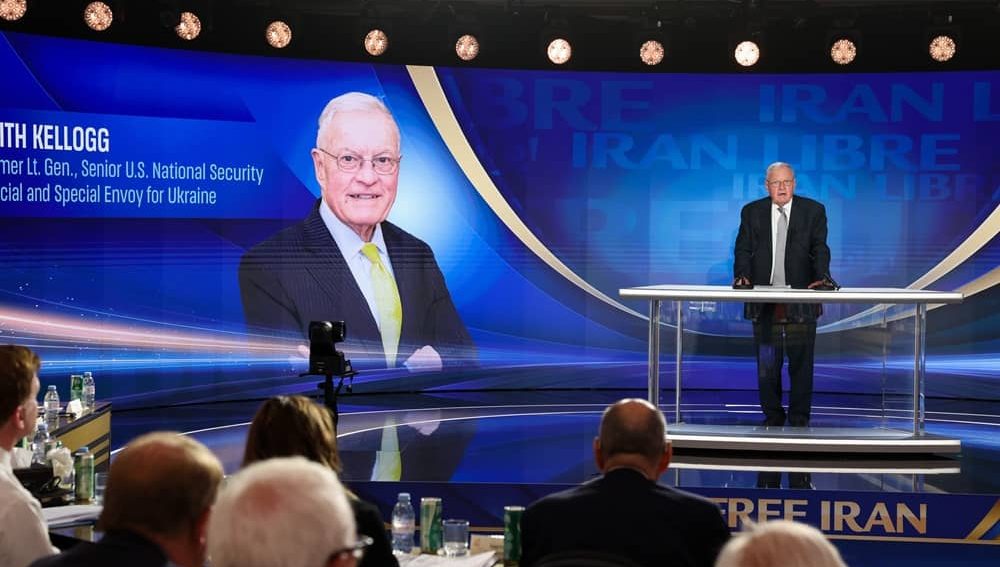
At the second day of the Free Iran 2026 World Summit in Paris, former United States Special Envoy to Ukraine and Russia General Joseph Keith Kellogg declared that the theocratic regime in Tehran has entered its most vulnerable state since 1979. Speaking on June 21, 2026, the general highlighted a rapidly shifting geopolitical landscape, noting the collapse of the Syrian regime, the fracturing of Hamas and Hezbollah, and the fall of the Maduro regime in Venezuela as clear signs that Iran’s regional architecture of influence is dismantling.
Gen. Kellogg noted that the regime has begun technical talks to surrender and down-blend its enriched uranium stockpile over a 60-day period. According to the general, stripping the regime of its nuclear ambitions does not instantly grant freedom, but it significantly weakens the ruling clerics, stripping away the “nuclear umbrella” that previously shielded their proxies and exposed the government to its own population.
Invoking Ronald Reagan’s famous proverb, “trust but verify,” General Kellogg praised the National Council of Resistance of Iran (NCRI) for its historic role in exposing the regime’s secret nuclear facilities at Natanz and Arak in 2002. He urged the council to serve as the international conscience ensuring absolute compliance. Ultimately, Gen. Kellogg called for aggressive, organized action to capitalize on this window of opportunity, framing disarmament as the foundational first step toward establishing the democratic future outlined in the Iranian Resistance’s Ten-Point Plan.
Excerpts of General Keith Kellogg‘s speech follow:

Mrs. Rajavi, Excellencies, distinguished guests, and friends of NCRI, thank you for having me again today.
When I stood before you in January of last year, I told you that the year ahead should be a year of hope, a year of action, and a year of change. I did not know how much change or how quickly it would occur.
I did not know that within months the region would be remade, that a war would be fought, that a ceasefire would be in place, and that the theocratic regime in Tehran, terrorizing their own people and the world for nearly half a century, would be forced to negotiate.
Let me begin where I began last year, because the truth has only grown stronger in the telling. For the people of Iran, for those who believe in her and in the promise of a freer future, this is the most promising hour since 1979.
The regime is weaker than it has been in decades. And this year, like the last, must be a year of hope, of action, and of change.
Consider how far we have come from a year ago. I told you that the beginning of the end of the Iranian regime’s primacy had already started.
And the principal backer of Hamas and Hezbollah would reap the whirlwind it had sown with the massacre of civilians on October 7th.
Then came the whirlwind. Hezbollah was weakened in Lebanon, the regime in Damascus fell, and Hamas was broken in Gaza.
Nor was the reckoning confined to the Middle East.
In my own hemisphere, the Venezuelan Maduro regime, Tehran’s partner in actions and sanctions evasion, and a haven for its operatives, found that it was time to go, that its time had run out too.
And the architecture of Iranian influence that took nearly 50 years was attacked in a matter of months.
A truly historic chance to change the Middle East, and in turn the world, for generations. If you want a free Iran, it must be freed. A window of opportunity is now, it needs to be taken. https://t.co/mRegMiA4rQ
— Keith Kellogg (@generalkellogg) June 23, 2026
Many of you in this room helped build the foundation for that brighter future. When the history of this period is written, you will again hold a bright page in it.
The first pillars to the future of a new Iran have been laid. An agreement has begun, a process towards the historic future and a future deal has begun. A nuclear arms race in the most volatile region on Earth has been prevented.
For 47 years, the effort by this tyrannical regime and its proxies, who destabilized the Middle East, has been its strategy of survival.
The chaos in Lebanon, the bloodshed in Syria, the terror in Gaza, the mines in the Strait of Hormuz, none of it was accidental.
Exporting violence abroad is how the terroristic clerics preserve their rule at home. A regime that cannot feed its own people, that crushes its own sons and daughters in the street, learned long ago they could only endure by setting the region on fire.
President Trump is closing the door to Iran ever having a nuclear weapon.
The regime has committed never to acquire a nuclear weapon, and its surrender and down-blending [of its] stockpile of enriched uranium over 60 days has begun with technical talks.
What does denuclearization mean for the region that has bled for half a century under the shadow of this regime’s ambitions?
It means the world’s foremost sponsor of terror will never build the single most destabilizing weapon in the Middle East and the world.
It means the nuclear umbrella in which Tehran has sheltered its proxies is gone. A regime that cannot extort its neighbors with the bomb has surrendered that bomb.
In Paris with the Free Iran caucus and Madam Rajavi. Great interaction with significant political personnel who understand the Region and “player nations” involved. The stakes for the U.S. in getting this “right” are enormous. pic.twitter.com/FShulpo5oE
— Keith Kellogg (@generalkellogg) June 22, 2026
It cannot blackmail the world from a program that has begun to diminish and dismantle.
The fear that hung over every capital, from Riyadh to Tel Aviv to Brussels, the fear of a nuclear-armed theocracy has begun to lift.
Iran dismantling its nuclear program is a doorway for the Iranian people to shape their future.
Stripping this regime of its ambition and ability to acquire this most catastrophic weapon does not make it free. It makes it weak. And a weak regime is one the Iranian people can finally confront on their own.
The bomb was never meant to defend Iran. It was meant to defend the dogmatic and abusive men who rule her. Taken away, and what remains is a government that stands exposed before the people it has oppressed for 47 years.
Here I want to invoke an old Russian proverb, one President Reagan made famous and one that should be carved above the door of every negotiation room from Geneva to Islamabad: trust but verify. Verify, verify. Trust but verify.
Few on this Earth have earned the authority to say those words like people in this room.
On the 14th of August 2002, drawing on the intelligence gathered by extraordinary risk by its network inside Iran, this Council stood up in Washington and revealed to the world its two hidden sites: the uranium enrichment plant at Natanz and the heavy water facility at Arak.
The regime had to disguise them as agricultural and desert eradication projects.
You exposed them for what they were: two parallel roads to the bomb. That single revelation forced open the doors to international inspection and set in motion six United Nations resolutions.
When I say trust but verify, understand that verification is not an abstraction to this Council.
It is your legacy, and you must be the conscience that ensures every barrel of uranium leaves, every centrifuge stops, and every promise on that page becomes a fact on the ground.
The regime has lied since its inception and it will again lie if it is permitted. They yearn to do so, and it is our duty, your duty, to not permit it.
That is why this hour belongs to the men and women of Iran, and why disarmament must be understood as the first step of something far larger, the foundation on which the Ten-Point Plan, the future of Iran, can be built.
The window is open wider than at any moment in a generation, and windows do not stay open forever. You must aggressively confront the regime. You must plant your flag, the people’s rule back in Iran.
A resistance movement cannot be in name alone. It will be hard. It will be costly. It must be done.
The theocratic regime in Tehran will not leave voluntarily. You must force it.
The hope is here. Now must come the action. Thank you for having me.