

Four-minute read
Iran’s economy is buckling under compounded pressures of inflation, corruption, and capital flight, deepening a crisis that is now overtly political. State media themselves acknowledge food prices among the highest in the world, while officials quietly prepare new fuel hikes and a currency overhaul. Beneath the statistics lies a deeper anxiety: a ruling system confronting the consequences of years of neglect—and the risk that economic collapse could turn into social upheaval.
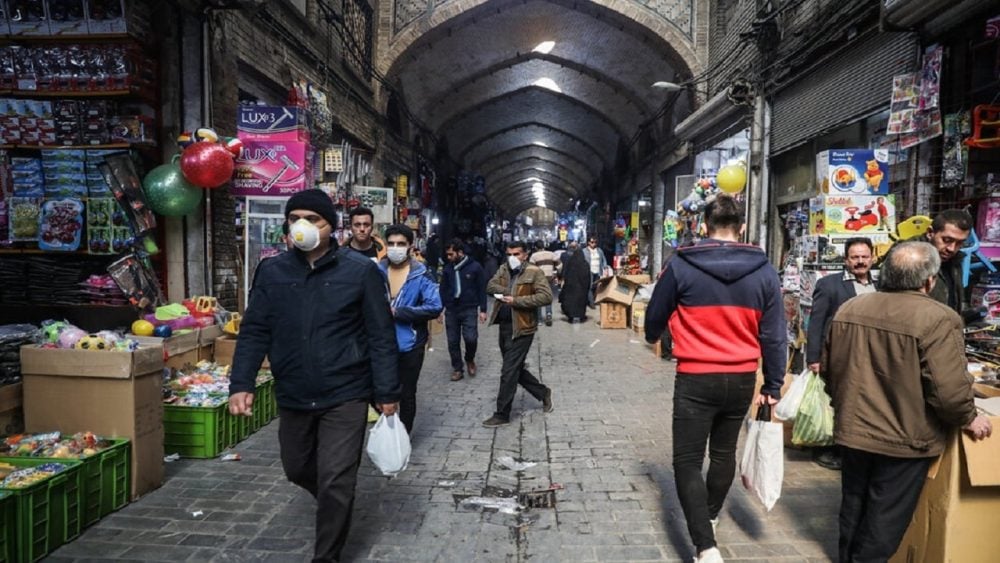
On November 9, 2025, state-run outlet Jahan-e San’at summarized new Center of Statistics figures: point-to-point inflation for food and beverages jumped to 64.3% in October 2025, up 17 percentage points in four months. By this measure, Iran ranks second globally for food inflation, after South Sudan. The paper concedes what households already know: “many experts believe official inflation figures are below lived reality.” The squeeze is visible in staples. In Mashhad, the bakers’ union confirmed on November 6, 2025, that bread prices rose up to 15%, with shops resorting to second card readers to add newly approved surcharges not yet programmed into the state’s “Nanino” system.
#Iran’s Poverty Line Exposed as Deception, Leaving Millions Below Survivalhttps://t.co/tC7yv7lDgJ
— NCRI-FAC (@iran_policy) October 25, 2025
Fuel-price triage and a de facto currency reset
Fuel is next. On November 7, 2025, MP Hossein Samsami said a three-tier gasoline plan at 1,500 / 3,000 / 5,000 tomans had been approved, adding that leaders also agreed to scrap the 28,500-toman preferential rate and unify the exchange rate near 100,000 tomans per dollar. A day earlier, Farhad Shahraki, first deputy of the Majles Energy Commission, said the import budget for fuel is already exhausted, the state has no foreign currency to keep importing gasoline, and “the government needs no new permit from parliament” to raise prices—signaling that price action can proceed under existing law. He also hinted that “free cards” at pumps could see price changes.
These steps, arriving amid 64% food inflation, point to another inflationary wave—and to the regime’s austerity by stealth: offloading fiscal shortfalls onto consumers while presenting the move as “reform.”
From Parliament to the Marketplace, Crisis Layers Converge Across #Iranhttps://t.co/AozMSSDCQJ
— NCRI-FAC (@iran_policy) October 28, 2025
Banking rot in plain sight
The crisis is not only at the checkout line. In a striking admission amid factional infighting, pro-government economist Farshad Mohammadpour said that Bank Iran Zamin has been “legally bankrupt for years,” but authorities have avoided a formal declaration. He cited 14,222 billion tomans in accumulated net losses, hemorrhaging roughly 2,370 billion tomans per month—about 76 billion per day and over 3 billion per hour—with depositors bearing the risk. “People think their deposits are earning profit,” he said, “but in reality their assets are evaporating.” The revelation is a window into a banking system hollowed out by political lending, opacity and impunity.
On November 8, 2025, a detailed review of Iran’s pharmaceutical market rebutted officials who blame shortages and price spikes on sanctions. It noted that medicines are not sanctioned and cited a 2019 WHO statement to that effect; the real drivers are domestic: sustained high inflation, removal of ultra-preferential rates (from 4,200 to 28,500 tomans and beyond), rising state arrears to producers and insurers, and distorting subsidies that invite leakage and smuggling.
The numbers are stark: $2.3 billion of drug imports in 2023/24; €11 billion mandated in the 2025/26 budget specifically for medicines, inputs and consumables (down from €13.6 billion the previous year); and a cut in drug import tariffs to 1%. Consumption is rising—28 billion doses distributed in the first half of 2025/26—while production sagged; enforcement reported a smuggling case on November 1, 2025, and sector experts estimate ~$450 million in outbound drug smuggling, including subsidized and special-disease items. The Supreme Audit Court also flagged “sedimentation” of health funds, with 20 trillion tomans of a $1 billion allocation diverted to university budgets rather than financing the drug supply chain. The pattern is classic: rents first, patients last.
#Iran’s Imploding Economy Exposes a Regime Beyond Preservationhttps://t.co/7N3OT7UFT2
— NCRI-FAC (@iran_policy) October 17, 2025
Record capital flight, falling oil revenue
The central bank’s latest quarterly shows an all-time record net capital outflow of nearly $9 billion in spring 2025, according to a November 9 analysis. Total capital flight in 2024 reached about $20.7 billion. Over 2018–2024, roughly $80 billion left the country; a chunk rides on trade channels dominated by state and quasi-state entities, including the IRGC’s economic arms. The same report notes a $3 billion year-on-year fall in oil-and-gas export revenue in spring 2025 (to $15 billion), a $1 billion drop in non-oil exports (to < $11 billion), and a services deficit of $2.8 billion—all while the economy still managed a $6 billion trade surplus that was effectively erased by the $9 billion capital outflow. Policymakers, meanwhile, publicly admit they are “haggling over $1 billion” for investment, a confession of shrinking fiscal room.
Meanwhile, officials tout a 7.4% unemployment rate in summer 2025, but employment actually fell by 171,000, labor-force participation slipped, youth joblessness stayed near 19%, and 40.3% of the unemployed hold university degrees, many stuck in unrelated, low-pay service jobs. Underemployment sits at 7.6%. In housing, the state oscillates between 500,000 and 2.8 million “empty homes,” an incoherence that neuters taxation policy. Even in power cuts, uptake of the “Bargh-e Man” app is spun as digital success when in reality people install it to track rolling blackouts. These are not technical errors; they are tools to manage perception.
#Iran’s Economic Collapse Is Fueled by the Regime’s Political Choices, Not Sanctionshttps://t.co/mfbZhzWp6a
— NCRI-FAC (@iran_policy) October 15, 2025
A state bracing for backlash
Put together, the story is not simply macroeconomic. Food at 64%, bread up, fuel hikes and FX unification pending, a bank effectively insolvent, drug rents and record capital flight form a feedback loop of pain and distrust. The two-language strategy is on display: promises of “reform” and external scapegoats for public consumption; quiet, coercive measures—price lifts, rationing, financial repression—for implementation. Officials know that sudden shocks can detonate. That is why the government now telegraphs austerity while denying its political character. The risk is clear: another price shock that collides with empty wallets and empty promises can translate economic crisis into a stability crisis.
The conclusion writes itself from the regime’s own data and declarations. A leadership that spent years monetizing scarcity and manipulating metrics is now preparing the public for more of both. It is not just the cost of living that is rising—it is the cost of rule.