

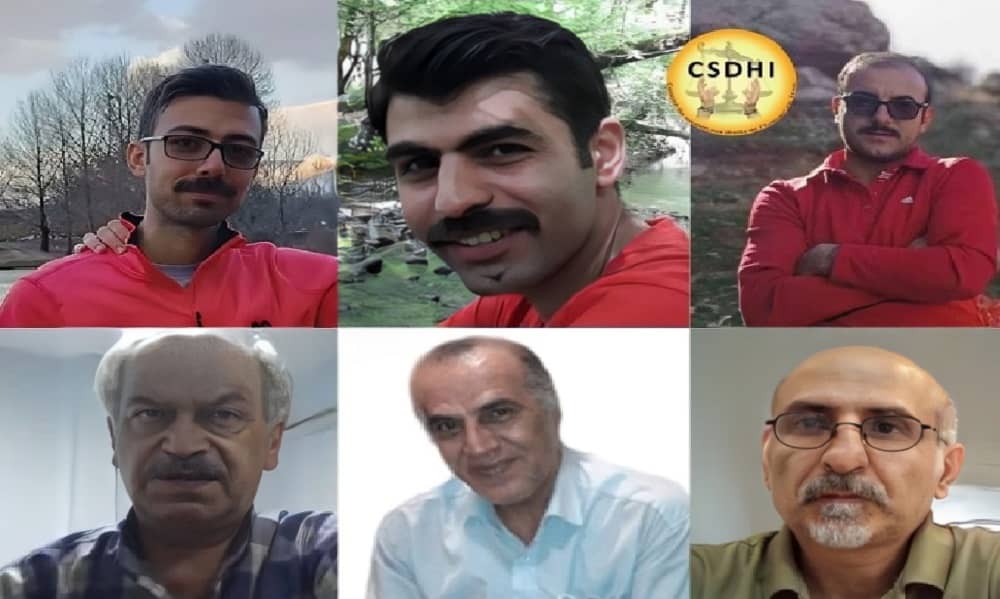
Six Iranian men—Abolhassan Montazer, Akbar (Shahrokh) Daneshvarkar, Babak Alipour, Mohammad Taghavi Sangdehi, Pouya Ghobadi, and Vahid Bani Amerian—are at immediate risk of execution following grossly unfair trials, Amnesty International Canada wrote on January 27. The organization has called for urgent intervention to prevent the executions, citing reports of torture, coerced confessions, and violations of international human rights law.
According to Amnesty International, the six men were sentenced to death in October 2024 by Tehran’s Revolutionary Court, Branch 26, for alleged “armed rebellion against the state” (baghi). The charges, which the men have consistently denied, stem from accusations of affiliation with opposition groups. Amnesty International has described the trial as deeply flawed, with the defendants subjected to torture and other ill-treatment during their detention.
Amnesty International detailed how Iranian authorities arrested the men under violent circumstances. For example, Vahid Bani Amerian and Abolhassan Montazer were arrested in Tehran on December 22, 2023. During his arrest, Vahid was severely beaten, sustaining eye injuries and bruising, before being held in solitary confinement for two months. Meanwhile, Abolhassan endured similar violence and was denied adequate medical care for severe chest and lung pain caused by the beatings.
Abolhassan Montazer, Akbar (Shahrokh) Daneshvarkar, Babak Alipour, Mohammad Taghavi Sangdehi, Pouya Ghobadi & Vahid Bani Amerian are at risk of execution in Iran following a grossly unfair trial. Their death sentences must be intermediately quashed! https://t.co/SIWHPu1xbi https://t.co/8wDgcqpDLY pic.twitter.com/dwtJU0XlHV
— Amnesty Iran (@AmnestyIran) January 24, 2025
Other detainees experienced equally harsh treatment. Babak Alipour was arrested on December 27, 2023, while Pouya Ghobadi and Mohammad Taghavi Sangdehi were apprehended on February 23, 2024, near the Iranian border in Chaldoran. Both men were later transferred to Evin Prison, where Pouya spent three months in solitary confinement, and Mohammad was denied essential medication for gout. Amnesty International also reported that Akbar (Shahrokh) Daneshvarkar was flogged during his detention.
The trial, presided over by Judge Iman Afshari, was riddled with procedural violations. Amnesty International highlighted that the court ignored multiple claims by the defendants and their lawyers that confessions had been extracted under torture. Despite these objections, six of the eight defendants received death sentences, while the others were sentenced to lengthy prison terms.
Amnesty International emphasized that these executions are part of a broader trend of increased repression in Iran, especially following the 2022 uprising. According to the NCRI, in 2023 alone, Iranian authorities executed at least 864 individuals, a 34% increase from the previous year. The NCRI also reported over 1,000 executions in 2024 in 86 prisons, including 34 women, 7 juvenile offenders, and 4 public hangings.
This pattern of using the death penalty as a tool to suppress dissent continued in 2024, with Revolutionary Courts imposing harsh sentences, often in secret trials influenced by intelligence agencies.
Behrouz Ehsani & Mehdi Hassani are at imminent risk of execution in Iran after the Supreme Court upheld their death sentences after a grossly unfair trial. Authorities must immediately halt any plans to execute them & quash their convictions & sentences. https://t.co/FyQ1IJSiqi pic.twitter.com/6hu0lCBD14
— Amnesty Iran (@AmnestyIran) January 27, 2025