

THIS PAGE WILL BE UPDATED WITH THE LATEST NEWS
UPDATE: 08:00 PM CET
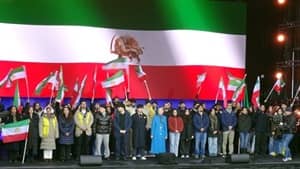
Message to Demonstrators Rallying Concurrently with the Munich Security Conference
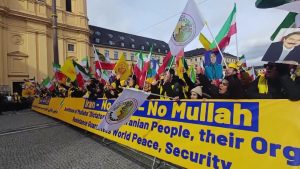
Mrs. Maryam Rajavi’s speech: “Fellow compatriots, defenders of the Iranian people’s uprising, I salute all of you who are the unquenchable voice of Iran’s uprising. Your gathering carries the message of the thousands who were slain in the blood-soaked days of January. It reflects that unbroken line of courageous young men and women whose sacrifice revealed the true magnitude of the army of uprising. It represents the immense offering made by the Iranian people at the altar of freedom. The ocean of blood spilled from the body of a nation yearning for liberty conveys three transformative messages. First, it once again proves the Iranian people’s unwavering and irreversible determination to overthrow the regime in its entirety. Second, it demonstrates that the path to this great change is organized uprising, in which rebellious youth and Resistance Units play a decisive role.”
Schools Under Security Siege: Ideological Scrutiny Follow Nationwide Protests

In the aftermath of the nationwide protests in January 2026, schools across Iran have reportedly become sites of heightened security presence and ideological scrutiny. Educational institutions are increasingly hosting individuals outside the formal teaching staff, tasked with interrogating students and exerting pressure on them regarding their political and social views. According to a report compiled by the Teachers’ Coordination Council, based on testimonies from teachers, parents, and students across multiple provinces, members of the Basij militia, plainclothes security agents, and religious preachers have entered schools under what appears to be a centrally coordinated and premeditated plan. These actors are reportedly conducting targeted question-and-answer sessions with students, designed to assess and monitor their beliefs and potential involvement in recent protests.
The Organized Pattern of Lethal Force in the 2026 Uprising in Iran; Urban Case File No. 1: Mashhad

The nationwide uprising of 2026 was met with a violent and coordinated response by the security and law enforcement forces of the ruling regime in Iran. Reports collected from various cities across the country indicate that the use of live ammunition against unarmed protesters, mass arrests, torture to extract forced confessions, and systematic pressure on the families of those killed were implemented simultaneously in multiple locations. A comparative review of events across different cities reveals recurring patterns in the management of the repression of protests by the security and law enforcement forces of the ruling regime in Iran. These include direct targeting of vital areas of the body, nighttime burials or restrictions on information regarding burial sites, the imposition of heavy financial demands for the release of bodies or detainees, and the transfer of detainees to detention facilities under inhumane conditions. These similarities go beyond isolated incidents and point to the existence of a coordinated operational policy.
Iran Admits Students Killed in Protests
In a rare and significant acknowledgment, Iranian authorities have officially admitted that students were killed during the January protests, marking one of the clearest public confirmations to date regarding campus-related casualties. The statement comes as universities across the country remain largely non-operational in person, with online classes continuing amid concerns over renewed student unrest. Government officials and university administrators confirmed that several students lost their lives during the January demonstrations. While precise figures were not detailed in the official remarks, the acknowledgment itself represents a notable shift from earlier ambiguity surrounding the fate of student protesters.
Bloomberg: Hilton Reviews Contract for Hotel Linked to Mojtaba Khamenei
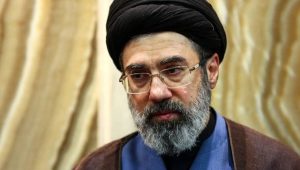
Following a Bloomberg investigation into the asset network linked to Mojtaba Khamenei, the American company Hilton has launched a review over whether to continue managing a hotel in Germany. Mojtaba Khamenei is the second son of Ali Khamenei, the supreme leader of Iran’s regime. Bloomberg reported on Thursday, February 12, 2026, citing informed sources, that Hilton Worldwide Holdings is evaluating whether continuing to operate the Hilton Frankfurt Gravenbruch hotel could expose the company to the risk of US sanctions. According to Bloomberg’s recent findings, the ultimate beneficiary of the property is Mojtaba Khamenei, the second son of Ali Khamenei, who has been under US sanctions since 2019.
Iran’s Regime and the 90 Percent: A Generation It Cannot Control
From 1979 to the January 2026 uprising, Iran’s ruling clerical system has remained locked in a relentless confrontation with its own youth. When a senior judiciary official in Iran publicly admits that “90 percent of newly arrested individuals had no prior criminal record,” it is more than a statistical detail. It is a political confession. The official, Hekmat-Ali Mozafari, deputy head of Iran regime’s judiciary, made this statement in reference to mass arrests during the January 2026 uprising. For observers unfamiliar with Iran’s political structure, the remark carries profound implications: the overwhelming majority of detainees were ordinary young citizens, not seasoned political activists or repeat offenders. This is not an anomaly. It is the continuation of a 47-year pattern.