

THIS PAGE WILL BE UPDATED WITH THE LATEST NEWS
UPDATE: 3:30 PM CEST
Advocating Insurgency, Vilifying the Insurgents

Michael Rubin’s Iran Needs an Insurgency is remarkable less for what it says than for how late it arrives. He has suddenly discovered that Iran needs an insurgency. Welcome to the debate.
The only problem is that the very movement Rubin has spent more than two decades disparaging has been waging precisely such a struggle since 1981. Long before Rubin concluded that organized resistance was indispensable, the Mujahedin-e Khalq (PMOI/MEK) had already built a nationwide resistance network, established Resistance Units across Iran, and paid an extraordinary price in blood for confronting the regime. Rubin is not advancing a new idea so much as catching up to a reality he has spent years denying.
To reconcile that contradiction, he resorts to a grotesque distortion of history, claiming that the MEK “supported Khomeini” and stood “against the Iranian people.” Rubin was just eight years old when the Shah fell in 1979. He was neither a participant in, nor a witness to the events, actors, and grievances that shaped revolutionary Iran. His account is therefore necessarily based on retrospective analysis rather than lived experience. Yet it is precisely his reading of the historical record that is at issue, as many of his claims are undermined by the available evidence.
Iranian Regime Member Deported from Canada, CBSA Confirms

A senior member of the Iranian regime has been deported from Canada after a judge dismissed his last-minute appeal, Global News has learned.
The Canada Border Services Agency said it had removed Syed Salman Samani, Iran’s former deputy interior minister and official spokesperson.
“As a matter of public interest, the CBSA can confirm that it has removed Syed Salman Samani from Canada,” the agency said in a statement.
He is the second regime official to be expelled under a 2022 policy that banned high-ranking members of Iran’s repressive government from Canada.
Before arriving in Canada in 2022, Samani was a “career politician” in the Islamic Republic from 2007 to 2021, according to the CBSA.
“The subject demonstrated his commitment and loyalty to the regime throughout his career,” the CBSA wrote in its report on Samani.
US Navy Blockade Has Caused Iran’s Oil Exports to Crater — And Could Finally Destabilize Regime: Expert

Iran’s oil exports have dropped to nearly zero under the renewed US naval blockade, according to analysis from a former senior US Treasury official — who predicts that the economic impacts could hit the elite and destabilize the regime within two to three months. Iran’s ability to ship oil out of the Strait of Hormuz to offset its current economic woes has hit a wall under the new blockade, with little to no activity seen at its Kharg Island hub, according to recent satellite images.
As Iran and the US attempt to use economic pressures to see who will blink first, Miad Maleki, who served in the Treasury under President Trump and Joe Biden, said Tehran’s regime will finally run out of room to maneuver this fall.
“The blockade has exposed Iran’s biggest economic vulnerability,” said Maleki, who now works at the Foundation for Defense of Democracies think tank.
“Iran’s oil clock is running down and the real fiscal shock is going to hit in the fall when all their payments come due,” he added.
UPDATE: 7:00 AM CEST
Iran’s Fuel Impasse: A Regime Caught Between Economic Bankruptcy and the Fear of Uprising
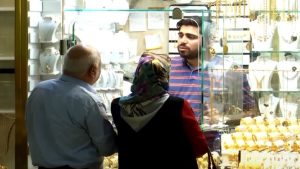
The Iranian regime is facing a paralyzing crisis that exposes the deep structural and economic bankruptcy of the ruling establishment. Recent remarks by government officials regarding a severe gasoline shortage are not merely technical reports; they are an admission of a complete economic and managerial deadlock.
The regime has reached what its own officials describe as a “point of compulsion,” trapping it between enforcing unbearable economic pressure on an already impoverished population and the terrifying prospect of sparking another nationwide uprising.
The regime’s inability to manage basic domestic needs is laid bare by its own statistics. Esmail Saghab Esfahani, head of the Energy Optimization Organization, confessed on August 15, 2026, that the government is no longer looking for “solutions” but is forced into “obligatory” decisions. According to Esfahani, Iran’s daily gasoline consumption has reached roughly 135 million liters, while domestic refinery and petrochemical production is only estimated at 121 million liters, resulting in a daily deficit of 14 to 15 million liters.
Iran’s Economy Faces Impasse With $127b Government Debt and Triple-Digit Inflation
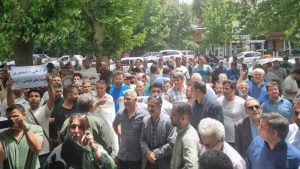
The Iranian economy has reached an unprecedented structural deadlock, characterized by systemic exhaustion and the depletion of the country’s strategic safety nets. This deep-seated crisis is distinctly marked by two converging disasters: an astronomical $127 billion debt owed by the government and the state oil company to the National Development Fund (NDF), and the uncontrolled descent into hyperinflation, officially manifesting in triple-digit rates across impoverished regions and eroding the nation’s fragile social contract.
Reza Mohammadi, the Investment Deputy of the National Development Fund, laid bare the catastrophic scope of public insolvency. He revealed that the NDF has accumulated outstanding claims totaling $127 billion, comprising over $110 billion from the government and more than $17 billion from the National Iranian Oil Company (NIOC).
Mohammadi noted that a settlement plan conceived under the administration of Ebrahim Raisi—which was meant to offset these debts through direct NDF investments in upstream oilfields—remains stalled as an unexecuted memorandum of understanding. Concurrently, the head of the NDF conceded that the NIOC cannot service its $17 billion liability through revenues from the flagship Azadegan oilfield, citing severe bureaucratic paralysis and administrative gridlock in project development.
“May Your Tongue Be Severed”: Family of Jina Mahsa Amini Fires Back at Iranian Official’s Misogynistic Attack

A member of the clerical regime’s parliament, in a recent interview with a state-run media outlet, insultingly used the phrase “went to hell” to refer to the state murder of Jina Mahsa Amini.
Jina Mahsa Amini is a young woman who was arrested on September 13, 2022, by the regime’s Guidance Patrol (Morality Police) and went into a coma due to severe beatings and blows to the head, passing away in the hospital on September 16. Her tragic death sparked an explosion of pent-up grief that shook all pillars of the ruling tyranny for six months.
The remarks by Ahmad Aryainejad in an interview with the state-run media outlet Hamshahri drew widespread outrage inside and outside Iran, eventually forcing him to apologize. He claimed that he had uttered this phrase subconsciously and apologized to Jina Mahsa Amini’s parents.
Iran’s Execution Machine Accelerates as Protesters Face the Gallows

The Iranian regime is accelerating its use of executions as an instrument of political repression, turning the death penalty into one of its principal tools for intimidating society and suppressing dissent. As protests, strikes, and acts of resistance continue across the country, the authorities are increasingly targeting protesters, political prisoners, and dissidents with death sentences designed not merely to punish individuals, but to terrorize an entire population.
The scale and secrecy of this campaign should alarm the international community. According to documented figures for 2025, at least 1,526 executions—more than 93 percent of the recorded total—were not officially announced by the authorities. Some were carried out secretly, without families or lawyers being informed. The true number is believed to be considerably higher.
This systematic secrecy is not simply a matter of incomplete statistics. It is part of a broader machinery of repression in which executions, arbitrary detention, torture, forced confessions, and closed judicial proceedings reinforce one another. The regime seeks to create an atmosphere in which every act of dissent carries the threat of the ultimate punishment.
Iran’s Internet Blackout Economy: Billions in Filter-Breaking Fees Fuel Repression and Profiteering
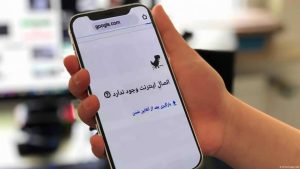
The Iranian regime’s system of internet censorship has produced a vast parallel economy in which millions of people are forced to pay simply to access websites and social media platforms that are freely available elsewhere.
A senior official in the administration of Masoud Pezeshkian has now acknowledged the extraordinary scale of this market, revealing that the annual financial turnover of VPN and filter-breaking services in Iran is estimated at between 7 and 12 trillion tomans. Mohammad-Jafar Ghaem-Panah also acknowledged that this enormous flow of money does not go to the Ministry of Communications or telecommunications operators. Instead, he admitted that authorities “do not know whose pockets it goes into.”
The admission raises a fundamental question: why does a system that imposes restrictions on the internet remain in place despite its enormous economic cost to the public and the absence of any transparent accounting of the money generated by those restrictions?
Iran’s Cost-of-Living Crisis Deepens as Workers Struggle to Afford Basic Necessities

Iran’s economic crisis is pushing the country’s working families into an unprecedented struggle to meet even the most basic costs of daily life. The gap between wages and living expenses has become so severe that a full month of work can no longer cover even half of the minimum cost of supporting a family.
Recent estimates put the minimum monthly cost of living for a working-class household at approximately 90 million tomans, while a married worker with one child and one year of experience earns only about 24.9 million tomans, even after receiving all benefits.
The figures expose the depth of Iran’s poverty crisis. A worker earning a full salary can cover only a fraction of the expenses required to maintain a basic standard of living.
Iran Regime Moves to Expand Repression Under the Pretext of “Countering Infiltration”
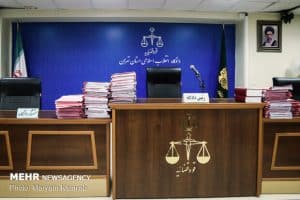
The Iranian regime is moving toward a new and potentially far-reaching instrument of repression that could give its security apparatus broader powers to criminalize ordinary contact with the outside world and suppress independent activity inside the country.
On August 16, the regime’s parliament approved the general framework of a bill officially described as a measure to “counter the infiltration of intelligence services and foreign governments or institutions.” The vote was overwhelmingly in favor, with 183 lawmakers supporting the measure, four opposing it, and five abstaining.
The bill has not yet become law. Its individual articles must still be debated and approved, and the legislation would subsequently have to pass the regime’s remaining legal procedures. However, the approval of its general framework is a significant warning: the regime’s parliament has endorsed the principle of creating a much broader legal framework for treating a wide range of social, professional, cultural, academic, and media activities as potential “infiltration.”
Ship Traffic Through the Strait of Hormuz Has Nearly Come to a Halt After Tanker Attacks

Reuters, citing data from maritime tracking company Kpler, reported that commercial ship traffic through the international Strait of Hormuz waterway dropped sharply over the weekend and has effectively come to the brink of a standstill following recent attacks on oil tankers.
According to the data, only five cargo-carrying vessels passed through the Strait of Hormuz on Saturday, and no crossings were recorded on Sunday, compared with 31 vessels during the previous weekend.
Among the vessels that crossed on Saturday were an empty very large crude carrier with its Automatic Identification System switched off and a very large gas carrier flying the Indian flag that was traveling via Iran’s route. A small tanker carrying Iranian regime fuel oil also exited the strait.
Iran’s Regime Plans Fuel Rationing, Higher Gasoline Prices Within Next 15 Days
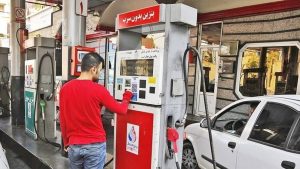
Esmail Saghab-Esfahani, a vice president of Iran’s regime, said on Saturday, August 15, that Iran’s daily gasoline consumption is about 135 million liters, while production by refineries and petrochemical plants is estimated at around 121 million liters. According to him, this has created a daily gasoline shortage of 14 to 15 million liters.
He emphasized that the proposed scenarios are no longer merely “solutions” but, in his words, have become a “necessity,” and the government is compelled to choose one of them.
According to the vice president of Masoud Pezeshkian, the president of Iran’s regime, one option is to distribute all domestically produced gasoline at fuel stations and halt supply once reserves are depleted. A second option is to allocate a fixed fuel quota to vehicles and charge any excess consumption at the market rate. Another scenario would allocate gasoline quotas directly to individuals, under which each person would receive 30 liters per month, with family members’ quotas placed under the control of the head of the household.
Iranian Regime Drone Attack on Office of Prime Minister of Kurdistan Region of Iraq

Masrour Barzani, Prime Minister of the Kurdistan Region of Iraq, announced that his private office and the residence of the head of Parastin, the Kurdistan Region’s intelligence agency, were targeted in drone attacks by the Iranian regime.
According to published reports, the Kurdistan Region’s Counter-Terrorism Directorate announced that early Monday morning, August 17, two Hadid-110 explosive drones, launched from Iranian territory, targeted the private office of Masrour Barzani, Prime Minister of the Kurdistan Region, and the residence of the head of Parastin, the region’s security and intelligence organization, in Pirmam, Erbil Governorate.
He strongly condemned the attacks, describing them as a dangerous escalation and a direct threat to the stability of the Kurdistan Region. According to the Kurdistan Region’s Counter-Terrorism Directorate’s investigation, the Iranian regime’s direct involvement in the drone attacks has been established. The military assault comes after the homes of other Kurdish regional leaders had previously been targeted in drone attacks by the regime’s proxy forces.
Iran’s Regime is Rebuilding the Security Circle Around Mojtaba Khamenei with New Security Figure
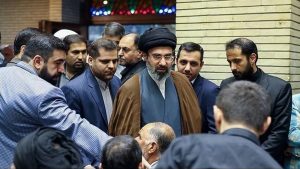
The return of Hossein Taeb to the Iranian regime’s security structures, at a time when the balance of power at the top of the government has shifted, has drawn the attention of political and security observers. Taeb is a veteran figure in the Islamic Revolutionary Guard Corps (IRGC) intelligence apparatus. Over the past four decades, he has been involved in some of the Iranian regime’s most significant security cases.
His position within the security network close to Ali Khamenei’s office, his longstanding relationship with Mojtaba Khamenei, and his experience managing security institutions raise the question of whether Tehran is rebuilding an old security circle around a new center of power.
Hossein Taeb is one of the figures whose career dates back to the Iran-Iraq War. His connections with the IRGC, the Basij paramilitary force, and intelligence institutions were established during those years and later expanded. Taeb became commander of the Basij and later served as deputy head of IRGC intelligence. He then became head of the IRGC Intelligence Organization, which in later years became one of the Iranian regime’s most important repressive security institutions.
Gross violation of Right to Life: Shahram Sadeghi, protester, executed without committing murder

The official news agency of the Islamic Republic (IRNA) reported on August 16, 2026: “Shahram Sadeghi, the driver of the ‘car of death’ at Golzar Intersection in Karaj, who ran over several law enforcement officers on January 8, 2026, was executed today, Sunday, August 16, following the confirmation of his sentence by the Supreme Court.”
In this report prepared by IRNA regarding this execution, the agency writes:
“On the night of January 8 of last year (1404 Persian calender), amidst the American-Zionist coup, Shahram Sadeghi, driving a Pride vehicle known as the ‘car of death,’ attacked officers near Golzar Intersection in Karaj and ran over several personnel. The deliberate running over of law enforcement officers, which caused shock and astonishment among bystanders, resulted in severe injuries to seven FARAJA (police) officers. Sadeghi’s brutal and violent act caused head, leg, hand, and eye injuries to seven police officers.”
Iranian Vice President admits state’s $170M anti-filtering VPN market goes to unknown pockets, while experts point to state-linked vendors
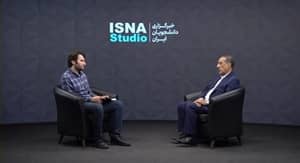
In a live television broadcast, Mohammad Jafar Ghaempanah, Iran’s Vice President for Executive Affairs, acknowledged that the domestic market for anti-filtering tools and VPNs generates between 7 trillion to 12 trillion tomans (roughly $100 million to $170 million) annually, adding that authorities “do not know whose pockets this money goes into.”
The admission highlights the economic paradox surrounding Iran’s strict internet censorship regime. While the government officially bans major social media platforms and foreign websites, tens of millions of citizens rely on circumvention tools to access the internet. Digital rights advocates and technical experts note that the infrastructure required to run high-bandwidth, bypass-capable VPN servers inside Iran requires direct access to state-controlled telecommunications architecture, pointing to state-affiliated involvement.
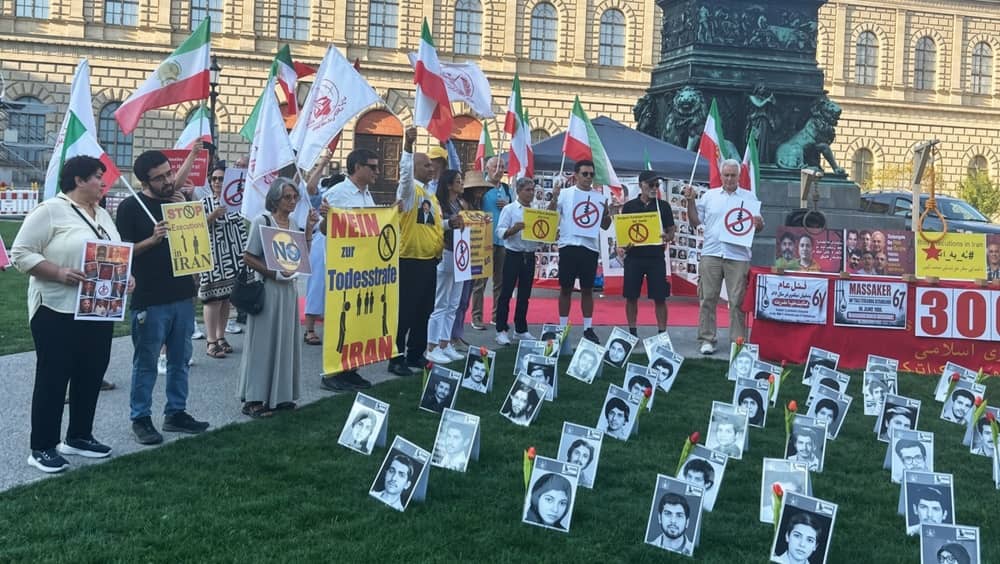
PMOI Supporters Hold Rally and Photo Exhibition in Munich to Commemorate 1988 Massacre
Munich, Germany – August 15, 2026 – Supporters of the People’s Mojahedin Organization of Iran (PMOI/MEK) held a rally and photo exhibition in Munich to commemorate the anniversary of the 1988 massacre of political prisoners in Iran.

The event called for justice for those killed during the 1988 massacre and for all victims who lost their lives in the Iranian people’s struggle for freedom. Participants also stressed the importance of preserving the memory of those who sacrificed their lives in the pursuit of freedom and human rights.
Paris Exhibition Calls for End to Executions and Death Penalty in Iran
Paris, August 15, 2026 – An exhibition calling for the abolition of the death penalty in Iran was held on Saturday, August 15, at Place Joachim-du-Bellay in Paris. Organized by supporters of the People’s Mojahedin Organization of Iran (PMOI/MEK) and the National Council of Resistance of Iran (NCRI), the event honored the memory of recently executed PMOI members and protesters who lost their lives during Iran’s nationwide uprising in January 2026.

Held under the slogan #StopExecutionsInIran, the exhibition attracted considerable public attention. Many Parisians expressed particular concern over mass executions, which have intensified in Iran since the beginning of 2026, particularly amid the war between Iran and the United States that began on February 28. Visitors stopped to view the displays, spoke with the organizers, and expressed solidarity with the Iranian people and opposition to the executions. Organizers also drew attention to the country’s alarming human rights situation, noting that thousands of prisoners are reportedly facing death sentences and calling for the abolition of capital punishment.
Iranian Resistance Supporters in Bern Commemorate the 1988 Massacre and Honor Martyrs of Freedom
Bern, Switzerland — August 15, 2026 — Supporters of the Iranian Resistance gathered in Bern to commemorate the anniversary of the 1988 massacre of political prisoners in Iran.
The event called for justice for those killed during the 1988 massacre and for all victims who lost their lives in the Iranian people’s struggle for freedom. Participants also stressed the importance of preserving the memory of those who sacrificed their lives in the pursuit of freedom and human rights.

At the dignified event, participants paid tribute to the victims’ ultimate sacrifice by laying flowers before photographs of the victims of the 1988 massacre, those who lost their lives during the uprisings, and political prisoners.
Gothenburg Rally Honors Martyrs of Iran’s 1988 Massacre and Democratic Struggle
Gothenburg, Sweden – August 8, 2026: Supporters of the People’s Mojahedin Organization of Iran (PMOI/MEK) gathered in Gothenburg to commemorate the anniversary of the 1988 massacre of political prisoners in Iran.

The event called for justice for those killed during the 1988 massacre and for all victims who lost their lives in the Iranian people’s struggle for freedom. Participants also stressed the importance of preserving the memory of those who sacrificed their lives in the pursuit of freedom and human rights.