

THIS PAGE WILL BE UPDATED WITH THE LATEST NEWS
UPDATE: 1:00 PM CEST
France Expels 2 Iranian Diplomats in Escalating Row with Tehran

France will expel two Iranian diplomats after Tehran’s security services detained and interrogated two French Embassy staffers last month, Foreign Minister Jean-Noël Barrot announced Tuesday evening.
The row dates back to July 19, when two French Embassy employees in Tehran — one of them the cultural attaché — were questioned for several hours and “beaten,” according to Barrot. Paris accused Iranian security services of carrying out a “premeditated and deliberate” act of intimidation in “flagrant violation” of diplomatic protections, summoning Iran’s chargé d’affaires two days later.
“It is precisely because France stands alongside the Iranian people” that the July 19 incident was especially outrageous, Barrot wrote on X Tuesday. The two French diplomats were “scandalously and deliberately assaulted,” he said, calling their treatment “intolerable.”
UAE Halts All Trade, Financial Dealings with Iran Over Alleged Missile Attack

DUBAI: The United Arab Emirates has said it is suspending all trade and financial dealings with Iran after reporting an Iranian missile attack directed at its ships.
The announcement comes after a period of relative calm in the UAE, with no Iranian missiles aimed at the country since May after it bore the brunt of attacks in the early weeks of the Middle East war.
Abu Dhabi has however accused Tehran of repeatedly targeting its tankers at sea in recent weeks.
“In light of regional escalations … all trade, commercial exchanges, and financial transactions with Iran have been halted until further notice,” said UAE foreign ministry communications director Afra Al Hameli.
17 Iranians Charged in US Cyber Theft Campaign, Federal Prosecutors Say

Federal prosecutors in New York on Tuesday charged 17 Iranians with conducting a “coordinated campaign of cyber intrusions” at United States-based universities, companies and government agencies.
The hackers from an Iran-based company allegedly wormed into 144 U.S.-based universities, 42 private-sector companies, five federal and state agencies and at least two non-governmental organizations since 2013, according to the indictment.
Federal prosecutors said they stole more than 31 terabytes of academic data and intellectual property as well as employees’ email accounts.
They allegedly “conducted many of these intrusions on behalf of the Islamic Republic of Iran’s (‘Iran’) Islamic Revolutionary Guard Corps,” federal prosecutors said.
Nine of the 17 defendants were previously charged with similar activity.
Iran’s 1988 Massacre Never Really Ended

Thirty-eight years after Iran’s mass execution of political prisoners, the gallows are still being used for the same political purpose: to intimidate a population that challenges the Islamic Republic.
On Sunday, Iran executed Shahram Sadeghi in Karaj. He had been convicted of deliberately driving into police officers during the January 2026 anti-government protests. Iran’s judiciary said the Supreme Court had upheld his death sentence.
His execution is not simply another case in Iran’s long record of capital punishment. It comes as the country marks the 38th anniversary of the 1988 massacre of political prisoners, when thousands were summarily executed after secret proceedings.
The Iranian opposition has documented the number of victims at more than 30,000, most of them members and supporters of the People’s Mojahedin Organization of Iran.
But the significance of 1988 is not only the scale of the killings. It is the fact that the perpetrators were never held accountable.
Iran’s Public Hangings Reflect a Regime Fearful of Renewed Unrest and Demand International Outrage

There are some things you never get used to hearing. As an Iranian American activist, I have spent years receiving news from Iran about political prisoners, dissidents, and young people whose lives have been destroyed for daring to speak out. Yet every execution still hits with the same force. Some stories, however, cut even deeper. I was born in Isfahan, one of Iran’s most beautiful and historic cities, a jewel of Persian culture renowned for its stunning architecture, vibrant streets, and warm-hearted people. It is a place filled with memories from my childhood and a source of immense pride. That is why the news I heard a short while ago left me devastated.
Two young Iranian dissidents, just 24 and 27 years old, were publicly hanged in Alikhani Square in Isfahan late last month. I remember the Alikhani neighborhood vividly. As a boy, I passed through its streets countless times. It was a working-class area filled with children playing in crowded alleyways. People looked out for one another. There was hardship, but there was also humanity. Learning that this familiar place had been transformed into a stage for public executions was heartbreaking. The square I remembered from my youth had become a site of intimidation and fear, where young men were executed by a regime increasingly fearful of the Iranian people’s growing demand for freedom.
UPDATE: 8:00 AM CEST
Iran’s Fuel Crisis Deepens as Long Lines, Price Fears and Regime Infighting Grow
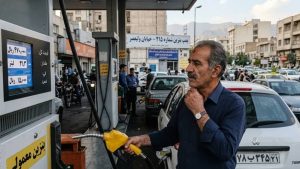
Simay Azadi – Iran’s gasoline crisis is adding another layer of pressure on households already struggling with severe inflation and declining purchasing power. Long lines have been reported in cities across the country, motorists are complaining about restrictions and deteriorating fuel quality, and new figures from within Iran’s oil industry show domestic gasoline production falling short of distribution.
The crisis has simultaneously intensified infighting within the ruling establishment. Regime MPs and state-run media are warning against transferring the cost of the fuel shortage to the population, while some outlets have gone considerably further—explicitly invoking the November 2019 uprising and warning that another gasoline price shock could produce a new “political and social crisis.”
The warnings come as state-run media have circulated reports about gasoline potentially being sold at 87,000 tomans per liter, while residents continue to report shortages and long lines at filling stations.
Iran’s Education Crisis Deepens as Millions Risk Falling Out of School
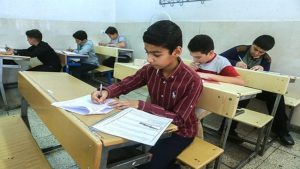
As the new school year approaches, growing numbers of Iranian students who have not yet finalized their enrollment are raising renewed concerns about the expansion of school exclusion and dropout rates across the country.
Reports indicate that around three million students have yet to complete their enrollment process. This figure cannot be equated with three million confirmed school dropouts, since many students will likely enroll before classes begin. Nevertheless, its sheer size is a serious warning sign, particularly amid worsening economic conditions and years of disruption to Iran’s education system.
The problem is no longer confined to a small number of children in deprived areas. Poverty, rising living costs, inadequate educational infrastructure, geographical isolation, gender-based barriers, child labor, and repeated interruptions to in-person schooling are combining to place more children and adolescents at risk of leaving education altogether.
Iran’s education crisis is not new. Data from the Parliament Research Center covering the period from 2015–16 to 2021–22 showed that the number of children and adolescents excluded from education increased from 777,862 to 911,272, representing an increase of roughly 17 percent in less than six years.
August 19 and the Mask of Reza Pahlavi’s “Democracy”: From Pride in the Legacy of Dictatorship to the Necessity of Rejecting All Forms of Tyranny
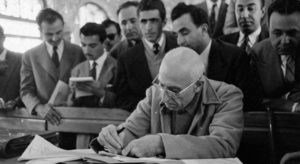
More than seven decades have passed since the sinister coup of 28 Mordad, 1332 (August 19, 1953); a black day on which the only national, independent, and democratically mandated government in Iran after the Constitutional Revolution—the government of Dr. Mohammad Mosaddegh—was overthrown. This bitter event severed Iran’s democratic evolution, rule of law, and national sovereignty. The direct consequence of this coup was decades of captivity and darkness for Iranian society under the boots of Pahlavi dictatorship, followed by the clerical reaction’s horseshoes up to the present day. Today, rereading this event in the context of Iran’s ongoing political and social developments is key to understanding why dictatorship persists and why a complete break from it is necessary.
The 28 Mordad coup was built on an unholy convergence of three anti-people forces: the court, religious reaction, and foreign imperialism. The illegitimate oil and geopolitical interests of Western powers—especially Britain and the United States—were threatened by the nationalization of Iran’s oil industry and its political independence. Thus, the think tanks of London and Washington devised the plan to overthrow Mosaddegh’s lawful government.
Iran’s Repair Poverty: Rising Costs Force Families to Live with Broken Appliances
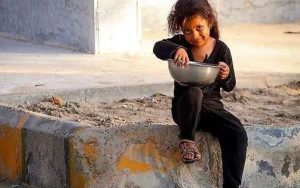
For millions of Iranian households, the economic crisis is no longer measured only by the price of food, housing, medicine, or household appliances. It is increasingly reflected in something more basic: the inability to repair the things they already own.
The soaring cost of spare parts and repair services has turned routine maintenance into a major financial burden. As household purchasing power continues to deteriorate, families are not only finding it increasingly difficult to buy new appliances; they are also struggling to keep existing ones functioning.
The result is a growing phenomenon that Iranian media have described as “repair poverty”—a situation in which broken appliances remain unrepaired because households simply cannot afford the cost.
Social media platforms are increasingly filled with videos showing people how to repair their own vacuum cleaners, juicers, and other household equipment. What might appear to be a trend toward do-it-yourself repairs is, in many cases, a reflection of economic necessity.
Middle Eastern Countries Seek Ways to Move Oil Through the Strait of Hormuz

An Iraqi government source told the Iraqi news outlet Shafagh News that Iraq’s State Oil Marketing Organization (SOMO) is holding intensive negotiations with foreign shipping companies to ensure the transport of the country’s oil through the Strait of Hormuz, and talks with a German company are close to reaching an agreement.
According to the report, the Iranian regime has agreed to allow oil tankers flying the Iraqi flag to pass through the strait, and Baghdad intends to use this authorization to transport its crude oil from southern Iraqi ports to global markets. SOMO has entered negotiations with two shipping companies, one American and one German. The American company has refused to place the Iraqi flag on its tankers, while the German company has expressed its willingness to use the Iraqi flag when transporting oil from Iraqi ports through the Strait of Hormuz.
According to the source, under the understanding reached with the Iranian regime, Iraqi oil tankers will pay no transit fees to pass through the Strait of Hormuz.
War-Damaged Iranian Businesses Still Await Loans as Workers’ Pay Covers Barely 8 Days of Living Costs
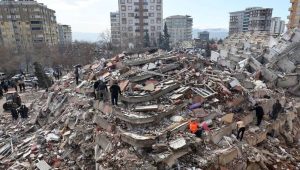
TEHRAN — The economic fallout from the war in Iran is now visible on both sides of the employment relationship: in factories that need money for repairs, raw materials and continued operations, and in working-class households whose incomes are falling further behind rising costs. A report by Jahan-e Sanat says around 1,400 businesses damaged in the war have yet to receive “even a single rial” in loans. At the same time, calculations by labor activist Faramarz Tofighi show that by the end of Tir, the monthly pay of a worker with one child, including all benefits, covered only 27.58 percent of minimum living costs — equivalent to 8.27 days of a month.
The two figures point to a common problem. Businesses need more liquidity simply to maintain existing operations, while workers need far higher incomes to buy the same goods they did before. Central Bank data reviewed by Jahan-e Sanat show that nearly 85 percent of credit extended to businesses in the first three months of the year went toward working capital, with the figure exceeding 91 percent in industry. Rather than expanding new capacity, bank credit is being used largely to keep existing capacity alive.
PMOI Supporters in Berlin Condemn Execution of January Uprising Protester Shahram Sadeghi
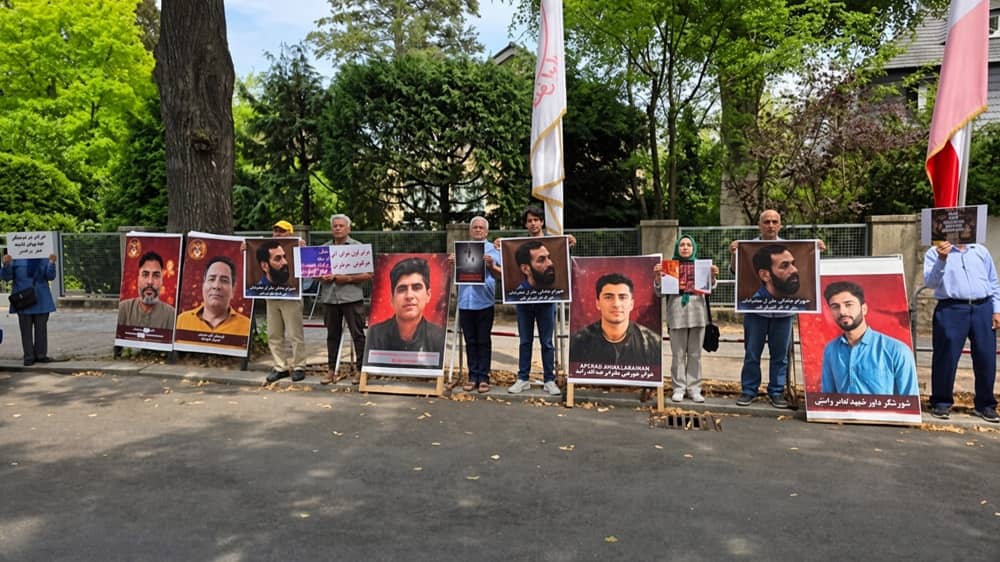
Berlin, Germany – On August 16, 2026, supporters of the People’s Mojahedin Organization of Iran (PMOI/MEK) gathered outside the Iranian regime’s embassy in Berlin to condemn the execution of Shahram Sadeghi, one of the protesters of the January 2026 uprising, who was executed in Iran on the same day. The demonstrators also called for an end to the executions of PMOI political prisoners and other activists detained during the January 2026 uprising.

For the 164th consecutive day, supporters of the PMOI/MEK have continued their sit-in protest outside the Iranian regime’s embassy in Berlin, which the protesters denounce as a hub of espionage and terrorism.
The protesters reaffirmed their opposition to executions, war, and the policy of appeasement toward the clerical regime, while rejecting both monarchical dictatorships and the clerical regime and calling for a democratic republic based on Maryam Rajavi’s Ten-Point Plan. They emphasized that the only viable solution is the establishment of such a democratic republic.
Stockholm: PMOI Supporters Protest Outside Swedish Foreign Ministry Over Execution in Iran
Stockholm, Sweden – August 16, 2026: Supporters of the People’s Mojahedin Organization of Iran (PMOI/MEK) gathered outside Sweden’s Foreign Ministry to condemn the execution of Shahram Sadeghi, one of the protesters involved in the January 2026 uprising, who was executed in Iran on the same day. The demonstrators also called for an end to the execution of PMOI political prisoners and other activists detained during the January 2026 uprising.

Protesters called on the Swedish government to take decisive action against the Iranian regime over criminal executions and terrorist activities. Their demands included the closure of the Iranian regime’s embassy in Stockholm, which they described as a hub for espionage and terrorism. They also called for the immediate and unconditional release of all political prisoners in Iran.
MEK Supporters in Copenhagen Condemn Execution of January Uprising Protester Shahram Sadeghi
Copenhagen, Denmark – July 30, 2026 – Supporters of the People’s Mojahedin Organization of Iran (PMOI/MEK) to condemn the execution of Shahram Sadeghi, one of the protesters of the January 2026 uprising, who was executed in Iran on the same day. The demonstrators also called for an end to the executions of PMOI political prisoners and other activists detained during the January 2026 uprising.

Holding photos of the victims, the protesters condemned the clerical regime’s actions as blatant violations of human rights. They said the executions reflected the regime’s growing desperation in the face of public dissent and vowed to continue their struggle until the overthrow of the mullahs’ rule and the establishment of a free, democratic, and just republic.