

THIS PAGE WILL BE UPDATED WITH THE LATEST NEWS
UPDATE: 3:00 PM CEST
US Hits Hezbollah with Fresh Sanctions, Emphasizing Ties to Iranian Government
WASHINGTON, Aug 20 (Reuters) – The United States on Thursday issued fresh sanctions targeting Lebanon’s Hezbollah, including re-designating it over actions on behalf of the Iranian government, according to a statement seen by Reuters.
The Treasury Department redesignated the group “for service to the Iranian regime under the command of Iran’s Islamic Revolutionary Guard Corps-Quds Force,” according to the statement.
The Reuters Iran Briefing newsletter keeps you informed with the latest developments and analysis of the Iran war. Sign up here.
A U.S. official, who spoke on condition of anonymity, said the redesignation was intended to show that Hezbollah is acting on behalf of the Iranian government, specifically Iran’s Islamic Revolutionary Guard Corps Quds Force.
Lebanon Says No Renewal for Iran Ambassador’s Visa, Deepening Rift

Lebanon’s refusal to renew the visa of Iran’s appointed ambassador is set to test already strained ties between Beirut and Tehran, with the Lebanese government insisting that its decision to declare Mohammad Reza Sheibani persona non grata is final and cannot be negotiated.
Sheibani’s visa expires on August 24, but he has remained in Lebanon since Beirut withdrew his accreditation in March and ordered him to leave. Iran has refused to implement the decision, keeping its ambassador at the embassy in Beirut.
Foreign Minister Youssef Raji has said Sheibani’s continued presence after the expiry of his visa would have no legal basis, arguing that the declaration of persona non grata automatically ends the legal effect of documents previously issued to the diplomat.
Raji said the decision “allows for no interpretation or ambiguity” and cannot be subject to settlement or negotiation.
UPDATE: 9:30 AM CEST
Bombs Failed, Deals Failed, Try Supporting the Iranian People

The Strait of Hormuz is closed. Then open. Then closed again. Confused? Welcome to 47 years of failed Western policy toward Iran.
For 47 years, Western leaders have played a high-stakes game of trial and error with the regime in Tehran, trying almost everything to keep the peace. The only problem? Nothing has worked.
For most of these five decades, Washington and European capitals defaulted to economic concessions and diplomatic indulgence, punctuated only by the occasional threat of force. When direct military strikes hit Iran’s state and military infrastructure over the past year, it merely proved what many of us have known all along: whether you sign treaties or drop bombs, neither will ever turn a religious dictatorship into a peaceful neighbor.
UPDATE: 7:00 AM CEST
The Unfinished Canvas Of 1953: How Mossadegh’s Legacy Drives Iran’s 2026 Democratic Revolution
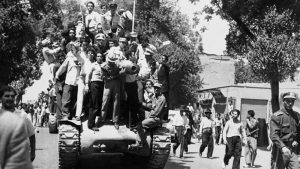
August 19, 2026, marks 73 years since the disastrous 1953 coup that overthrew Dr. Mohammad Mossadegh. This date is not merely a historical anniversary; Mossadegh has transformed from a political figure into an enduring “phenomenon,” a “thought,” and a recurring benchmark in Iran’s continuous struggle for freedom.
Mossadegh’s government was the only national, independent, and democratically willed government to emerge in Iran following the Constitutional Revolution. Today, understanding this bitter event in the context of Iran’s ongoing political and social developments is the master key to understanding why dictatorship has persisted in Iran for so long, and why Iran will not go back from one dictatorship to another.
The shah regime tried to frame the foreign-backed coup as a domestic uprising. But in reality, it was carried out by an unholy convergence of three anti-democratic forces: the royal court, religious reactionaries, and foreign colonial interests.
Iran Sentences Female Singer to 4 Years in Prison for Singing Poetry

An Iranian court has sentenced a classical female singer to four years in prison simply for performing poetry.
On Wednesday, August 19, 2026, Hiva Seyfizadeh announced in a video message that a preliminary court handed down the four-year sentence under the regime’s fabricated charge of “encouraging corruption and prostitution.” Protesting this oppressive verdict, the female singer emphasized that her sole action was singing a few lines of classical poems by Saadi.
This harsh sentence stems from a violent crackdown on women’s artistic activities. On the evening of Thursday, February 27, 2025, repressive security forces raided an event at the “Emarat-e Rooberoo” cultural venue in Tehran. During the raid, agents arrested Hiva Seyfizadeh, the venue manager, and several attendees, abruptly shutting down the performance. She was released on bail after two days, but the regime’s Public Security Police confiscated and blocked her Instagram page.
Iran: Donya Mohammadi, 20, Executed in Ilam Central Prison
At dawn on Wednesday, August 19, 2026, the death sentence of a 20-year-old woman named Donya Mohammadi, from Eyvan-e Gharb County, was carried out in Ilam Central Prison.
Donya Mohammadi was arrested two years ago, at age 18, on murder charges and ultimately sentenced to qisas (retribution in kind) by the judiciary.
At the time of reporting, state media and judiciary-affiliated outlets have not officially announced her execution.
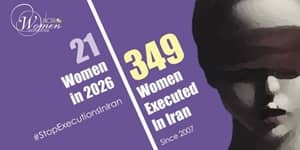
The execution of Donya Mohammadi brings the number of women executed in Iran to at least 21 since the start of 2026.
According to data recorded by the Women’s Committee of the National Council of Resistance of Iran, at least 349 women have been executed in Iran since 2007.
Iran’s Water and Power Crisis Deepens as Basic Services Become a Privilege
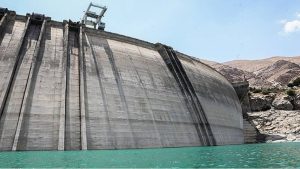
For millions of people across Iran, access to clean drinking water and reliable electricity—basic services that should be guaranteed in any functioning society—is becoming increasingly uncertain.
During the scorching summer of 2026, water shortages and power outages have spread across large parts of the country. Villages are being rationed to only a few hours of drinking water a day, residents of major cities are receiving polluted or muddy water from their taps, and businesses are repeatedly forced to close because of electricity cuts.
Even official and state-linked media can no longer conceal the scale of the crisis.
On August 15, the state-run IRNA news agency reported that 12 provinces, with a combined population of approximately 40 million people, are experiencing water stress.
The crisis is not confined to remote rural areas. It is reaching major urban centers, including Tehran, Ahvaz and Mashhad, while government officials openly acknowledge that critical water resources are being depleted.
Iran’s Workers Are Being Pushed Beyond the Poverty Line
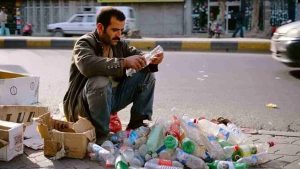
Iran’s economic crisis has reached a point where working families are no longer struggling simply to maintain a reasonable standard of living. For millions, the basic objective has become survival.
For more than four decades, the economic structure created under the regime has transformed national wealth into an instrument for preserving political power, expanding oligarchic networks, and financing the institutions responsible for repression. While the regime’s propaganda apparatus continues to promote narratives of “economic resistance” and attempt to conceal the depth of the crisis, figures published even by domestic semi-official and state-linked media increasingly reveal the scale of the disaster.
The latest calculations of workers’ living costs offer a particularly stark illustration. They show an economy in which wages are increasingly disconnected from the actual cost of survival, while inflation continues to erode household purchasing power.
The Pahlavi Legacy: A Monarchy That Looked Abroad for Its Survival
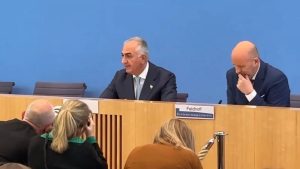
Political movements without genuine roots in society have historically sought survival through foreign patrons rather than through the consent of their own people. Iran’s modern history offers a particularly revealing example of this pattern in the Pahlavi monarchy and its contemporary advocates.
As the Iranian regime faces growing social discontent and the prospect of fundamental political change, efforts to revive the legacy of hereditary monarchy have become increasingly visible. Yet a closer look at the history of the Pahlavi dynasty raises a fundamental question: where did its political legitimacy come from?
A recently highlighted U.S. diplomatic document from May 21, 1953—just months before the overthrow of Prime Minister Mohammad Mosaddegh—provides a striking answer.
Economic Crisis: The Real Face of a Regime That Portrays Itself as Powerful
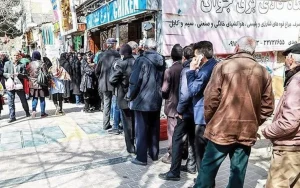
Following increased economic pressure on the Iranian regime and a naval blockade, its leaders fear that US President Donald Trump’s threat of further economic punishment could deepen hardship, reignite unrest, and further erode the regime’s legitimacy.
Despite the Iranian regime leaders’ warmongering after nearly six months of war and the closure of the Strait of Hormuz, a vital route for global oil supplies, they are facing growing pressure inside the country that could lead to nationwide unrest. The protests taking place across Iran over economic conditions are examples of this pressure.
On Friday, August 14, U.S. Treasury Secretary Scott Bessent said Washington would impose measures against Tehran by early the following week that had never been seen before. The remarks followed additional economic sanctions previously imposed on the Iranian regime. Washington did not specify what the new measures would include.
Ghaem Hosseini Executed in Dastgerd Prison, Crimes Against Humanity Continue in Alikhani Square Case

On the morning of Thursday, August 20, 2026, the government of the Islamic Republic of Iran hanged Ghaem Hosseini—the fifth detained protester in the “Alikhani Square” case—in Isfahan’s Dastgerd Prison. This execution took place in blatant defiance of international condemnations and repeated calls to halt political executions and the killing of protesters in Iran.
This execution was carried out despite a direct appeal on Tuesday, July 28, 2026, by Ms. Mai Sato, the UN Special Rapporteur on the situation of human rights in Iran following the public execution of two other defendants in the same case—Amirhossein Safari and Abolfazl Sepahi, who were hanged that morning in Isfahan’s Alikhani Square. Ms. Sato urged the Islamic Republic to halt all death sentences, explicitly describing public executions as an instance of “cruel, inhuman and degrading treatment.” Furthermore, on August 12, 2026, 32 countries—including France, the United Kingdom, and Canada—alongside the EU High Representative for Foreign Affairs, issued the strongest possible condemnation of the ongoing executions of protesters and the use of the death penalty in Iran.
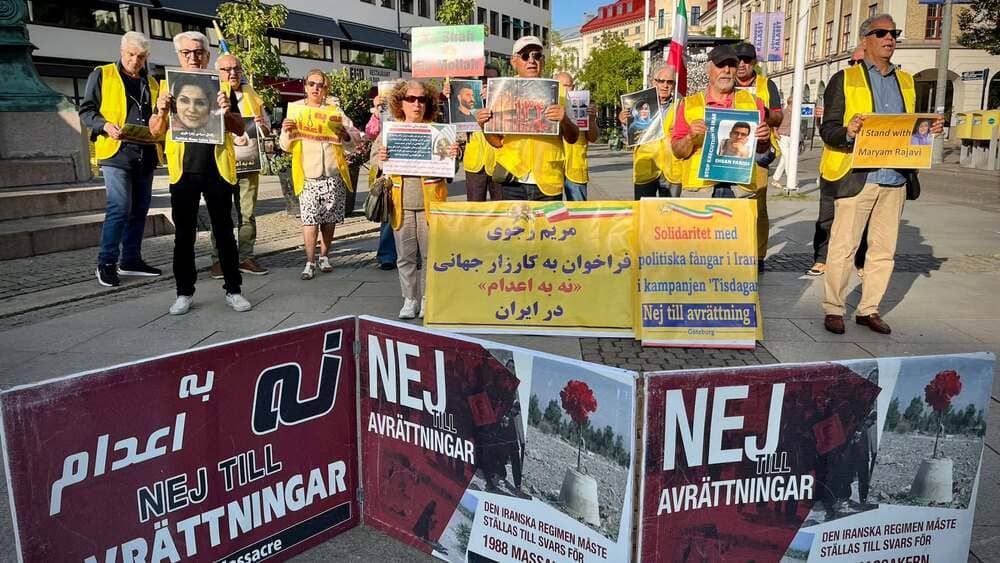
Gothenburg Rally Backing the 134th Week of “No to Execution Tuesdays” Across 60 Iranian Prisons
Gothenburg, Sweden — August 18, 2026: Supporters of the People’s Mojahedin Organization of Iran (PMOI/MEK) held a rally in solidarity with the 134th consecutive week of the “No to Execution Tuesdays” campaign, a movement protesting the Iranian regime’s escalating executions and systematic repression.
Participants also highlighted the regime’s intensifying crackdown, the rising number of executions, and broader repressive measures. They chanted slogans such as “Down with the executioner regime” and called for the immediate release of all political prisoners.

Freedom-loving Iranians in Gothenburg expressed support for Mrs. Maryam Rajavi, President-elect of the National Council of Resistance of Iran (NCRI), and her call to expand the “No to Executions” campaign globally.
Amsterdam Rally Supports “No to Execution Tuesdays” Campaign Against Iran Executions
Amsterdam, Netherlands – August 19, 2025 — Supporters of the People’s Mojahedin Organization of Iran (PMOI/MEK) gathered at Dam Square in Amsterdam to support the “No to Execution Tuesdays” campaign.
Demonstrators condemned the Iranian regime’s use of executions as a tool of repression and called for an end to state violence, regime change, and the establishment of a democratic republic in Iran. They demanded the immediate abolition of the death penalty and the release of all political prisoners.

Participants expressed solidarity with political prisoners and those facing execution, reaffirming their commitment to a democratic future for Iran. They rejected all forms of dictatorship—whether under the current theocratic regime or under monarchical rule.
Paris Exhibition Condemns Executions and Demands a Democratic Republic in Iran

Paris, France – August 19, 2026 – Supporters of the People’s Mojahedin Organization of Iran (PMOI/MEK) organized a book table and photo exhibition in Paris condemning the execution of political prisoners and the continued detention of protesters arrested during Iran’s January 2026 uprising.
The event highlighted the Iranian people’s call for a democratic republic and presented the Iranian Resistance as a path toward peace, freedom, and justice.
Organizers called on the French public and the international community to recognize the suffering of the Iranian people and their rejection of all forms of dictatorship, whether monarchical or theocratic.
Through photographs, personal testimonies, and other materials, the exhibition highlighted the courage and sacrifices of those who took part in the January 2026 uprising. It also drew attention to what organizers described as the Iranian regime’s continuing human rights violations, including the execution of political prisoners.