

THIS PAGE WILL BE UPDATED WITH THE LATEST NEWS
UPDATE: 7:30 PM CEST
Transfer of Five Death Row Prisoners, Supporters of PMOI, from Evin to Qezelhessar, Site of Executions

Three Others Previously Transferred; Four Baluch Political Prisoners at Risk of Execution Call for Urgent Action to Save the Lives of Political Prisoners on Death Row. This morning, Wednesday, April 16, 2025, the notorious Hedayatollah Farzadi, the criminal head of Evin Prison, announced that five political prisoners sentenced to death—Vahid Bani Amerian, Seyed Mohammad Taghavi, Babak Alipour, Pouya Ghobadi, and Shahrokh Daneshvarkar—must be transferred from Ward 4 of Evin Prison to Qezelhessar Prison by the end of the day, on orders from the criminal judge Iman Afshari. In response to prisoners’ objections to the transfer, Farzadi threatened that they would be forcibly moved using prison guards.
How Corruption and Greed Have Destroyed Iran

The Iranian economy has been in a nose dive since the mullahs hijacked the revolution in 1979 and seized control. Ayatollah Ruhollah Khomeini, the first Supreme Leader, created the Islamic Revolutionary Guard Corps (IRGC) – the regime’s Gestapo – and put them in charge not only of the military, but also over 70% of the economy, straddling key industries such as oil, gas, telecommunications, and infrastructure. It pays no tax and is answerable directly to the Supreme Leader. Its commanders and their families are now the wealthy elite in a country where the middle class has been destroyed, and more than half the population lives below the international poverty line, struggling to survive. Today, as tensions rise between Washington and Tehran, Iran’s national currency, the rial, has reached an all-time low against the US dollar, trading at over 1 million rials per greenback. Citizens now almost need a wheelbarrow to carry sufficient rials to buy a loaf of bread.
UPDATE: 10:30 AM CEST
U.S. Intensifies Airstrikes on Houthi Positions in Yemen, Destroys Strategic Oil Port

U.S. forces carried out a wave of intense airstrikes late Friday targeting multiple Houthi positions across Sanaa, Al-Jawf, and Saada provinces in Yemen, marking a sharp escalation in American military action against the Iran-backed group. According to Al Arabiya’s Yemen correspondent, the strikes focused on Houthi military camps in the Al-Hafa area and Bani Hashish district on the outskirts of the capital. Local media aligned with the Houthis reported at least 15 airstrikes, while additional attacks struck Bart Al Anan and Khub wa Al Sha’af in Al-Jawf.
The bombardment came just one day after U.S. Central Command confirmed the destruction of the Ras Isa oil terminal in Hudaydah Province, describing it as a key revenue hub for the Houthis. A CENTCOM statement said the strikes were aimed at cutting off “illicit revenues used to fund over a decade of regional terrorism.”
Houthi-run health authorities claim 80 people were killed and 150 injured in the Ras Isa attack, most of them workers at the port. Satellite images reviewed by international media, including Associated Press, revealed widespread destruction, damaged military equipment, and oil spillage into the Red Sea.
The U.S. air campaign follows recent threats by the Houthis to resume assaults on international maritime traffic. Washington has vowed to disrupt Houthi logistics and financing channels, which it accuses of prolonging instability across the region.
UPDATE: 8:30 AM CEST
Message to the Demonstration of Iranians Commemorating the Fallen Heroes of April 19, 1972, and 1975
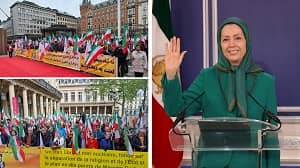
Maryam Rajavi’s message: “Rebellious friends and supporters of the Iranian Resistance,
I salute your passionate gatherings across various countries, held in honor of the fallen heroes of the highest stature and worth.
“On the anniversary of the martyrdom of four members of the central leadership of the People’s Mojahedin Organization of Iran in 1972, and the anniversary of the horrific crime of the Shah’s SAVAK in 1975—when nine Mojahedin and Fedayeen, hands tied, were executed by firing squad on the hills of Evin—we renew our pledge to fulfill the ideals for which they gave their lives: No to the Shah, no to the Mullahs — Victory to the Democratic Revolution of the Iranian People!”
Resistance Units Honor April 19 Martyrs Murdered by the Shah Regime
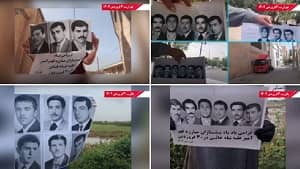
On the anniversary of the execution of the first members of the central committee of the People’s Mojahedin Organization of Iran (PMOI/MEK) and their fellow Fedayeen and PMOI comrades, Resistance Units carried out more than 60 revolutionary actions across Iranian cities. These activities commemorated the martyrs who ignited the first organized path of resistance against the Shah’s dictatorship—a path that continues to this day in the fight against the regime of the mullahs.
On April 19, 1972, the Shah’s regime executed four pioneering MEK leaders—Ali Bakeri, Nasser Sadegh, Ali Mihandoust, and Mohammad Bazargani—following trials in military courts under the oversight of notorious SAVAK police and the shah’s army. Exactly three years later, on April 19, 1975, nine political prisoners were massacred on the hills of Evin prison, including Bijan Jazani and several Fedayeen comrades, as well as PMOI members Kazem Zolanvar and activist Mostafa Javan Khoshdel.
The 1975 Evin Hills Massacre: Assassination of Nine Political Prisoners by The Shah’s Regime
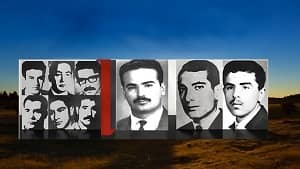
Fifty years ago, on April 19, 1975, by order of the Shah, Mohammad Reza Pahlavi, nine of Iran’s most prominent political prisoners were secretly gunned down and massacred. Bijan Jazani and six others from the People’s Fedaiyan organization, along with two members of the People’s Mojahedin Organization of Iran (PMOI/MEK)— Kazem Zolanvar and Mostafa Javan Khoshdel, both symbols of resistance under torture by SAVAK, the Shah’s notorious secret police—were killed in a plot orchestrated by the infamous SAVAK official Parviz Sabeti.
This crime was one of the most heinous and brutal acts of the Shah dictatorship, aimed at eliminating the pioneers who had raised the banner of revolutionary struggle against tyranny, paving the way for freedom, independence, and popular sovereignty in Iran, and shaking the foundations of the Shah’s corrupt and autocratic rule. After the 1953 coup that overthrew Prime Minister Mohammad Mossadegh, his regime systematically crushed dissent and committed any crime it deemed necessary.
Iranian Industry in Decline: A Crisis of Recession, Mismanagement, and Structural Corruption

A recent report by Iran’s Parliamentary Research Center on the performance of industrial companies listed on the Tehran Stock Exchange paints a stark picture of stagnation and decline in the country’s industrial sector. Echoing this assessment, the Purchasing Managers’ Index (PMI) also indicates a continued slowdown across Iran’s manufacturing landscape. Contrary to expectations, the industrial sector not only failed to grow in 2024, but it actually contracted compared to 2023. The output of companies listed on the Tehran Stock Exchange fell below last year’s levels, signaling a deepening crisis in the country’s industrial base.
Several interrelated factors have contributed to the downturn. Chief among them is a severe recession in both domestic and international demand, which has significantly weakened the sales outlook for Iranian manufacturers. Volatile currency fluctuations have compounded the problem, introducing further instability into an already fragile production environment. Additionally, imbalances in the supply of energy and raw materials have disrupted operations, forcing many industrial units to scale back or halt production altogether.
Woman Executed for Poverty: Marziyeh Esmaeili Hanged in Qazvin Prison
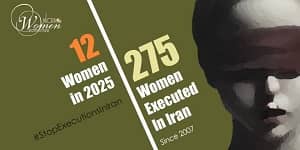
On April 15, 2025, Marziyeh Esmaeili, a 39-year-old woman and mother of a young daughter, was executed in Qazvin Central Prison on drug-related charges.
She had been convicted of carrying 600 grams of narcotics — a desperate act taken in exchange for just 10 million tomans (approximately $150 at current unofficial rates).
Marziyeh Esmaeili was living in extreme poverty and, with no financial or social support, agreed to transport the drugs out of sheer necessity. Following her arrest, she was denied access to legal representation, as she had no one to advocate for her and no means to afford a lawyer. She was ultimately sentenced to death and executed at the age of 39.
With no family to claim her, her body was handed over the following day, April 16, to her adopted daughter, Soda — the only person left in her life. Details about her burial and the location of her grave remain unknown.
Iranian Students Protest Dangerous Cafeteria Conditions Amid Official Indifference
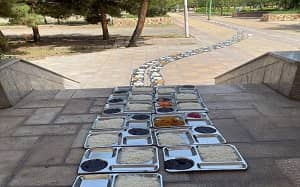
From cockroaches and lizards to flies and glass shards, in recent days, images of food served in university cafeterias across Iran have repeatedly made headlines and shocked students who rely on campus meals.
This report shares further details by interviewing students from universities in various cities across Iran. The incident began on February 24. The “Amirkabir” student newsletter reported that a used syringe tip was found in a meal served at the cafeteria of Iran University of Science and Technology.
Execution of Three Prisoners in Qom and Tabriz Prisons

In the ongoing surge of executions in Iran, two prisoners—Feyzollah Karami (from Varamin) and Sohrab Heydari (from Shahr-e Rey)—were executed at Qom Central Prison on the morning of Tuesday, April 15, 2025. Both had been arrested in recent years on drug-related charges and sentenced to death. Additionally, on the morning of Wednesday, April 9, 2025, a 27-year-old prisoner named Shamseddin Fazli was executed in Tabriz Prison. He had been arrested three years earlier on charges of murder.
According to reports, at least 79 prisoners have been executed in Iran since the beginning of the Persian month of Farvardin (starting March 21). This means that, on average, more than two people are executed every day—one every 12 hours. This alarming trend has sparked serious concern among human rights organizations both inside and outside the country.
Continued Sit-in by the Family of Hamid Hosseinnezhad Heydaranlou Outside Urmia Prison
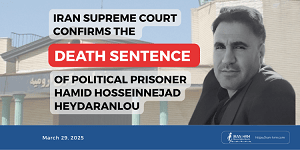
The family of Hamid Hosseinnezhad Heydaranlou, a political prisoner sentenced to death, has launched a sit-in in front of Urmia Central Prison since last night in protest against the imminent execution of his sentence. They are demanding an immediate halt to the execution and a thorough review of his case. According to received reports, on Friday, April 18, prison officials informed the family that the execution had been suspended by order of the Urmia prosecutor. However, Hamid’s family has stated they will continue their protest until they are able to have direct contact or a face-to-face meeting with him. So far, only a brief 50-second phone call has taken place between Hamid and his daughter and brother, which has not alleviated their concerns about his condition.
On Thursday, April 17, the family had their last in-person visit with Hamid under what they described as inhumane conditions. He was brought to the meeting area in shackles and chains, under heavy security, and shouted out his innocence during the visit. The day before, he had been transferred from the political ward to quarantine. According to his lawyer, the execution was scheduled to take place on Friday.
The Dire Condition of Female Political Prisoners in Iran Prisons – Part 3

Azar Korvandi Mousazadeh, a 60-year-old political prisoner, is slowly dying in the women’s ward of Tehran’s Evin Prison. She is not merely an inmate — she is a living testament to decades of resistance, a mother, a survivor of the 1980s prison purges in Iran, and now, a woman battling multiple life-threatening illnesses while being denied medical treatment.
Born in 1962, Azar Korvandi is a mother of two and a former political prisoner from the 1980s. During her previous imprisonment, she was pregnant and gave birth to her child while under interrogation. Her husband was executed during the 1988 prison massacre in Evin. Today, she continues to pay the price for her beliefs — this time with her health and possibly her life.