


THIS PAGE WILL BE UPDATED WITH THE LATEST NEWS
UPDATE: 6:30 PM CET
Unless We Act Now Iran Will Be A Nuclear Military Power In Months

Somewhere deep underground at a place called Fordow in Iran, you can be assured the gas centrifuges are whirring around the clock enriching Uranium isotopes into weapons-grade product. Atomic bombs for Iran. The lightning collapse of Bashar al-Assad’s filthy regime in Iran’s near neighbor Syria is just the latest in a series of catastrophes for the religio-fascist dictators in Tehran. They are on the back foot, weakened and humiliated in ways that would have been unthinkable just a few months ago. Nuclear capability – and fast – is seen as the only way out of the mess.
Many experts believe Ayatollah Ali Khamenei’s hated theocratic regime, which has ruled over the beleaguered people of Iran with a rod of iron since the revolution of 1979, will be the next Middle East dictatorship to fall. If it does, the downfall will be entirely of Khamenei’s own making.
Iran is not like Syria where an awful power vacuum with an awful lot of unknowns beckons – a second Iranian revolution has been quietly (and not so-quietly) building since the murder of Mahsa Amini in September 2022, killed by morality police for not wearing a hijab, and with it a legitimate alternative political (and democratic) infrastructure.
Young people – especially women – took to the streets in 2022 united under the banner “Women, Life, Freedom”, a slogan which, critically, later morphed into “Women, Resistance, Freedom”. Resistance Units grew and affiliated with the main Iranian resistance movement, the People’s Mojahedin Organization of Iran (PMOI/MEK).
Now, the word Mojahedin tends to make the hairs on the back of the neck of any westerner with a long memory stand up. But this Mojahedin is the key component of the National Council of Resistance of Iran, a fully-formed Government-in-waiting, with a female president, Maryam Rajavi, and a 10-point plan to bring democracy to Iran for the first time, which has the approval of huge swathes of the US and UK governments.
UPDATE: 11:30 AM CET
Bitcoin Mining Is One of The Suspected Causes of The Power Outages Disrupting Life in Iran
TEHRAN, Iran (AP) — Iran’s capital and outlying provinces have faced rolling power blackouts for weeks in October and November, with electricity cuts disrupting people’s lives and businesses. And while several factors are likely involved, some suspect cryptocurrency mining has played a role in the outages.
Iran’s economy has been hobbled for years by international sanctions over its advancing nuclear program. The country’s fuel reserves have plummeted, with the government selling off more to cover budget shortfalls as wars rage in the Middle East and Tehran grapples with mismanagement.
The demand on the grid has not let up, however — even as Iranians stopped using air conditioners as the weather cooled in the fall and before winter months set in when people fire up their gas heaters.
UPDATE: 9:30 AM CET
Are Iran’s Mullahs the Next Domino to Fall? A Robust West Might See it Happen

The events of August 2013 remain a stain on the moral reputation of the West. That summer, Bashar al-Assad used chemical weapons against his own people. This was despite the West’s warning that crossing this red line would be met with a decisive response. The decision by the House of Commons to vote against any retaliatory military strike gave cover for the risk-averse President Obama to abandon the red-line position.
Thankfully, the Assad regime has now fallen. We might have been here years ago and spared the Syrian people dreadful suffering if we had acted differently then. That is a burden those who refuse to act must carry.
The greatest political impact of the fall of Assad may be felt not in Damascus, but in Tehran. The vile regime of Ayatollah Khamenei and the Mullahs saw the 2013 decision as a sign of weakness from the West, following on from the failure to give even moral support to the 2009 Iranian uprising after the “stolen election”.
In Desperation over Syria, Khamenei Revisits the Bombing of Samarra Shrines by His Forces

Iranian regime supreme leader Ali Khamenei, in his speech following the fall of the despised Assad dictatorship and the loss of four decades of investment in Syria, attempted to justify this defeat by repeating his claim about “protecting the sanctity of holy shrines.” He said: “Our forces were present in both Iraq and Syria for two reasons: one was to protect the sanctity of the holy shrines. In Samarra, you witnessed that with the help of the Americans, they destroyed and demolished the sacred dome of Samarra.”
It is no secret that the bombing of the Shia Imams’ shrines in Samarra, which led to a horrific sectarian war across Iraq, was carried out under the direct orders of Khamenei. Today, even regime supporters acknowledge that the purpose of this bombing was to create religious divisions in Iraq and advance terrorist and war-mongering objectives. They also react to the claim of protecting holy sites.
Iran’s Oil Gamble in China: A Race Against Time Before Trump’s Return

The Iranian regime is racing against time to find buyers for the oil it has stored in Dalian, a port city in northeastern China. The looming of Donald Trump’s return to the White House has alarmed Tehran, as his presidency could once again tighten sanctions and block Iran’s access to these oil reserves, valued at approximately one billion dollars. Iran has directed the Islamic Revolutionary Guard Corps (IRGC) to sell this embargoed oil using intermediary companies. These intermediaries will leverage the financial credit of Iranian firms based in China to facilitate sales. However, this strategy is fraught with challenges as Beijing tightens its oversight of small refineries—the main buyers of Iran’s discounted oil.
Data from the real-time energy tracking firm Vortexa reveals that Iran’s floating oil reserves have grown significantly, increasing from 36 million barrels to 48 million barrels since September. This rise is attributed to a sharp drop in oil sales, with the additional inventory valued at about one billion dollars.
Alarming Rise in Student Addiction in Iran: A Crisis Ignored

A recent investigation by Iran’s state-run Shargh newspaper has revealed a troubling increase in the use of cigarettes, marijuana, hashish, and alcoholic beverages among students. This revelation comes amidst a persistent lack of transparency from regime-controlled organizations, which have refrained from publishing accurate statistics on youth and child addiction for the past eight years.
In May of this year, the Secretary General of Iran’s Anti-Tobacco Society confirmed that the smoking age in the country has decreased significantly. Warning against the influence of the “tobacco mafia” targeting teenage girls, he disclosed that the age of heavy drug addiction in Iran has alarmingly dropped to as low as 9 or 10 years.
Similarly, the Vice President of Iran’s Anti-Narcotics Headquarters referred to a 2016 government survey, which found that 2.1% of Iranian students were drug addicts. However, reports from cultural activists and experts in education suggest that this percentage has risen in recent years, indicating a worsening crisis.
Iran’s Energy Crisis: A Reflection of the Regime’s Mismanagement

The Iranian regime continues to demonstrate its inability to meet the basic needs of its citizens, as evidenced by the country’s ongoing energy crisis. On Thursday, the regime’s President, Massoud Pezeshkian, released a video on his social media accounts urging citizens to lower their home temperatures by at least two degrees to conserve energy. However, shortly after this appeal, large swaths of Iran, including the capital, experienced unannounced power outages lasting three to seven hours, leaving homes and public roads in darkness.
The situation worsened when Iran’s Tavanir Company announced a new schedule of planned power outages. This announcement highlighted the regime’s lack of commitment to improving energy infrastructure, such as building power plants or increasing gas production capacity. Instead, the regime appears focused on boosting military expenditures.
Detained Women’s Rights Activist Siran Khosravi Held in Uncertainty for Nearly a Month

Sanandaj, Western Iran – Siran Khosravi, a 37-year-old women’s rights activist from Sanandaj, has been in detention for nearly a month with no information about her current situation or whereabouts. She was arrested on November 19, 2024, when Iranian intelligence agents raided her home without a warrant. Eyewitnesses describe the early morning operation as one designed to instill fear, with agents forcing their way into Khosravi’s residence and taking her to an undisclosed location. Since then, she has been denied fundamental rights, including access to her family, legal counsel, and communication.
Despite continuous efforts by her family to find answers, authorities have not provided any information about the reasons for her arrest or the charges she may face. The lack of transparency has raised serious concerns about her safety and well-being.
Cyberattacks by the Iranian Regime on Critical Infrastructure in the U.S. and Israel

Reports indicate that cyber groups affiliated with the Iranian regime have used the IOCONTROL malware to attack critical water and fuel systems in the U.S. and Israel.
This malware, designed to infiltrate internet-connected devices, can control systems such as fuel pumps, routers, and security cameras. The Internet of Things (IoT) encompasses devices connected to the Internet that send and receive data, such as cameras, sensors, and household appliances. This technology is widely used across industries but can cause widespread disruptions in essential services if infiltrated by malware.
According to a report by the cybersecurity firm Claroty, this malware was discovered in a fuel management system targeted by a group linked to the IRGC. The attackers managed to disrupt fuel services and steal customers’ credit card information.
Escalating Executions in Iran: A Stark Reminder of the Human Rights Crisis

In a disturbing escalation of state violence, the Iranian authorities have executed at least 585 prisoners, including 21 women, since late July under Massoud Pezeshkian’s presidency. This alarming figure represents a 236-person increase compared to the same period last year, underscoring a grim human rights crisis in the country. The most recent wave of executions occurred between December 3 and December 11, during which at least 38 prisoners were hanged in various prisons across Iran.
On Wednesday, December 11, at least 13 individuals were executed. Among them were Ahmad Jahan Khani, Sirus Ahmadi, Meysam Karegar, Hassan Yousefi, Naser Nakhchi, Iman Moghadam, Rahman Saralak, Abdullah Tajik, and an unidentified prisoner, all hanged in Qezelhessar Prison. Additionally, Naser Shahouzehi was executed in Greater Tehran Prison, Sajad Azizi and Ebrahim Valizadeh in Miandoab, and Gholam Rousta in Shiraz.
The Collapse of the Assad Regime: A Devastating Defeat for Iran’s Regime
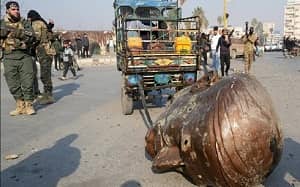
The rapid collapse of the Assad regime, which Iran’s government had backed, marks the latest in a series of defeats that have tarnished Iran’s image as a regional power. This event represents a serious challenge to Tehran’s military and proxy strategies. NBC published an analysis of this issue on December 9, 2024, under “The Collapse of the Assad Regime: A Devastating Defeat for Iran.”
For decades, Syria served as a vital bridge for Iran to transfer weapons to Hezbollah in Lebanon and other proxy forces in the region. After the 2011 uprising against Bashar al-Assad, Iran played a critical role in supporting the Syrian regime by providing weapons, and cash (amounting to $50 billion), and mobilizing proxy militias. However, the seizure of Aleppo by rebel forces has exposed the weakness of Syria’s army and highlighted the declining capabilities of Iran’s proxy forces.
Berlin Exhibition Stands with Iranian Political Prisoners, Protests Human Rights Violations

Berlin, Germany—December 12, 2024: Freedom-loving Iranians and supporters of the People’s Mojahedin Organization of Iran (PMOI/MEK) organized an exhibition to denounce human rights violations in Iran. The event highlighted the dire human rights situation in the country, particularly the plight of political prisoners facing death sentences. It called for the immediate release of all political detainees held by the mullahs’ regime and condemned the death sentences issued against six political prisoners affiliated with the PMOI.
MEK Supporters’ Exhibition in Hamburg Condemns Human Rights Violations, Supports ‘No to Execution’ Campaign Against Iran’s Regime

Hamburg, Germany—December 12, 2024: Supporters of the People’s Mojahedin Organization of Iran (PMOI/MEK) organized a book exhibition and protested against the rising wave of executions carried out by the Iranian regime, supporting the ‘No to Execution’ campaign against Iran’s regime. They called for the immediate release of all political prisoners held in the regime’s prisons in Iran and protested the sentencing of six political prisoners associated with the PMOI to death.