

THIS PAGE WILL BE UPDATED WITH THE LATEST NEWS
UPDATE: 08:00 AM CET
A Message for Christmas and the New Year 2026
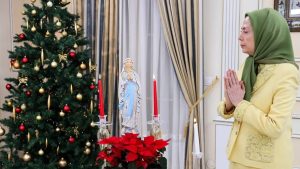
Maryam Rajavi’s message: “On the blessed day of the birth of Jesus Christ, we offer Him our boundless greetings and reverence and extend our heartfelt congratulations to His followers throughout the world, especially to our Christian compatriots, both within the country and across the diaspora.
“Salutations to the Virgin Mary, the embodiment of purity and a timeless symbol of liberation from exploitative bonds, who raised Jesus Christ in the sanctity of her immaculate embrace.
“Blessed indeed is the day of the birth of Jesus, son of Mary, a name whose remembrance signifies good news to the poor, freedom for the captives, sight for the blind, and liberation for the oppressed.”
400 Prominent Women Issue Appeal to Halt Execution of Iranian Political Prisoner Zahra Tabari
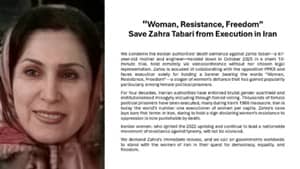
In a powerful display of international solidarity, more than 400 prominent women leaders from across the globe issued an urgent public statement on December 23, 2025, demanding the immediate release of Zahra Tabari, a political prisoner currently facing imminent execution in Iran. The signatories include Nobel Peace Prize laureates, former heads of state, United Nations officials, and human rights defenders who have united to condemn the Iranian regime’s use of the death penalty to silence political dissent.
The appeal, organized by Justice for the Victims of the 1988 Massacre in Iran (JVMI), highlights the regime’s brutal gender apartheid and its specific targeting of women who challenge the mullahs’ tyranny. Signatories include former Prime Minister of Ukraine Yulia Tymoshenko, former Swiss President Micheline Calmy-Rey, and 2022 Nobel Peace Prize Laureate Oleksandra Matviichuk. They warn that in Iran today, “daring to hold a sign declaring women’s resistance to oppression is now punishable by death.”
PMOI Resistance Units Mark 100 Weeks Of ‘No to Executions Tuesdays’ Campaign Across Iran
On December 23, 2025, the nationwide movement against the Iranian regime’s use of capital punishment reached a historic milestone. Marking the 100th consecutive week of the “No to Executions Tuesdays” campaign, Resistance Units affiliated with the People’s Mojahedin Organization of Iran (PMOI/MEK) launched a massive, coordinated wave of anti-regime activities. Across the country, brave activists carried out 116 protest actions in 80 cities, signaling that the regime’s strategy of intimidation through the gallows has failed to silence the call for freedom.
December 23—Iran
PMOI Resistance Units mark the 100th week of the "No to Executions Tuesdays" campaign with anti-regime activities across Iran. pic.twitter.com/0K4pgikXYW— People's Mojahedin Organization of Iran (PMOI/MEK) (@Mojahedineng) December 24, 2025
In their latest activities, Resistance Units honored the perseverance of these prisoners. In Tehran, placards appeared in public spaces declaring, “We stand with political prisoners and will be your voices,” and “One hundred weeks of protest, one hundred weeks of crying out against executions and tyranny.” In Shahriar, banners saluted the prisoners who have endured 100 weeks of hunger strikes, demanding the release of all political detainees.
Zahra Khanzadeh Executed in Vakilabad Prison, Mashhad
At dawn on Wednesday, December 24, 2025, the death sentence of a female prisoner identified as Zahra Khanzadeh was carried out in Vakilabad Prison in Mashhad.
Zahra Khanzadeh had been sentenced to death on drug-related charges.
As of the time of this report, the execution of Zahra Khanzadeh has not been covered by state-run media, particularly outlets affiliated with Iran’s judiciary.
With the execution of Zahra Khanzadeh in Vakilabad Prison in Mashhad, the number of women executed in Iran in 2025 has reached 64, marking at least an 88% increase compared to 2024.
Regime Infighting Amid Economic Collapse: Iran’s Power Struggle Exposes a Crisis of Survival

As Iran sinks into one of the most severe economic and livelihood crises in its modern history, open confrontations at the highest levels of power have become increasingly visible.
Unprecedented attacks by Mohammad Bagher Ghalibaf, Speaker of the regime’s Parliament, against the government of Masoud Pezeshkian—alongside explicit threats to impeach ministers and parallel calls by hardline figures such as Hamid Rasaei to remove Mohammad Reza Aref—are not routine political disagreements. They raise fundamental questions about power balance, governance failure, and the future of the regime’s economic management.
The core question is no longer whether internal disagreements exist, but whether these clashes signal an erosion of authority at the very top of the system.
Iran’s Roads of Death: How the Regime’s Priorities Turn Daily Travel into Mass Killing

For years, road accidents in Iran have constituted one of the country’s deadliest yet most normalized disasters—a silent massacre that claims dozens of lives every day and leaves countless families shattered. Now, even the regime’s president has inadvertently exposed the scale of this ongoing catastrophe.
Masoud Pezeshkian, stated in remarks published by state-affiliated outlets including Eghtesad Online and Mehr News Agency on December 20, 2025, that “seventeen thousand deaths from road accidents are unacceptable; it is like a passenger plane crashing every day.”
This comparison is not an expression of compassion. It is an unambiguous confession of the magnitude of a disaster that the regime itself has created, sustained, and normalized. If a passenger plane truly crashed every day, the world would demand accountability. In Iran, however, daily death on the roads is treated as routine.
Manufacturing the Past to Block the Future: How Fake Monarchist Networks Serve Authoritarian Power in Iran

The recent exposure of a vast, coordinated network of fake X media accounts after X activated its new location feature promoting the restoration of monarchy while attacking democratic forces was not merely a media scandal. It constituted the unmasking of one of the most sophisticated and organized efforts at public opinion engineering in Iran’s contemporary history. The findings revealed a coherent security-oriented structure, equipped with advanced technological tools and a cyber army, working to artificially revive a political past that has long lost its social legitimacy. This project did not aim to build a genuine political alternative. Rather, it sought to present a fabricated substitute against a movement grounded in popular sovereignty, the separation of religion from the state, and democratic governance.
The defining feature of this operation was its timing. It became fully active at the height of nationwide protests following the 2022 uprising, precisely when Iranian society was transitioning from political passivity to active resistance. The objective was not to strengthen monarchism as a viable political current, but to divert social energy away from fundamental transformation and channel it toward a “safe” and controllable option—one that would ultimately preserve the core architecture of authoritarian power.
Hezbollah Turns to Drug Trafficking in Venezuela as Support from Tehran Dries Up
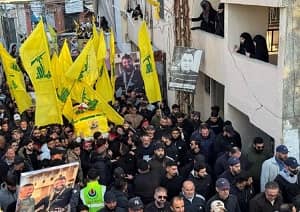
The Washington Free Beacon, reported citing informed sources that Hezbollah, following a reduction in support from the Iranian regime, has turned to drug trafficking in Venezuela to finance itself and has expanded its presence in the country.
The outlet wrote, citing informed sources, that following the failures of the Iranian regime and its proxy groups, Hezbollah forces have increasingly traveled to Venezuela and are relying on drug trafficking for revenue more than ever before.
Marshall Billingslea, the former U.S. Treasury Department assistant secretary for terrorist financing, said in October during a hearing of the “International Narcotics Control Committee” in the U.S. Senate that more than 400 Hezbollah field commanders had been ordered to relocate to Latin America, specifically Venezuela. These commanders have joined approximately 11,000 Hezbollah-affiliated operatives who entered Venezuela between 2010 and 2019.
Head Of Atomic Energy Organization of Iranian Regime: Grossi Is ‘Part of the Enemy’

Mohammad Eslami, head of the Atomic Energy Organization of the Iranian regime, criticized the positions of the Director General of the International Atomic Energy Agency (IAEA) regarding the need to inspect nuclear sites bombed in Iran and described Rafael Grossi as “part of the enemy.”
On Wednesday, December 24, Eslami reacted to Grossi’s recent remarks about the IAEA’s lack of access to the Natanz, Fordow, and Isfahan sites and said: “If there is a protocol for [inspecting] attacked facilities, he should announce it. Such a thing is not provisioned in the safeguards.”
He added that the method of the Agency’s inspections of sites that were targeted during the twelve-day war “must be defined.”
Earthquake In Tehran Would Be Deadlier Than War

Ali Nassiri, head of Tehran’s Disaster Prevention and Management Organization, warned about the consequences of a major earthquake in the capital, saying that an earthquake with a magnitude above six could cause human losses far heavier than war. Nassiri, head of Tehran’s Disaster Prevention and Management Organization, said in an interview on Wednesday, December 24, with ISNA, a state-run news agency, that earthquakes are “the most important and most destructive threat facing Tehran.” He added that an earthquake would be even more devastating for the capital than war, because if a severe earthquake occurs, the scale of human casualties could exceed the total victims of past wars and major disasters.
Rejecting rumors about the “man-made creation of earthquakes,” Nassiri stressed that major earthquakes have no human origin whatsoever and that claims about triggering earthquakes through military or nuclear tests lack any scientific basis.
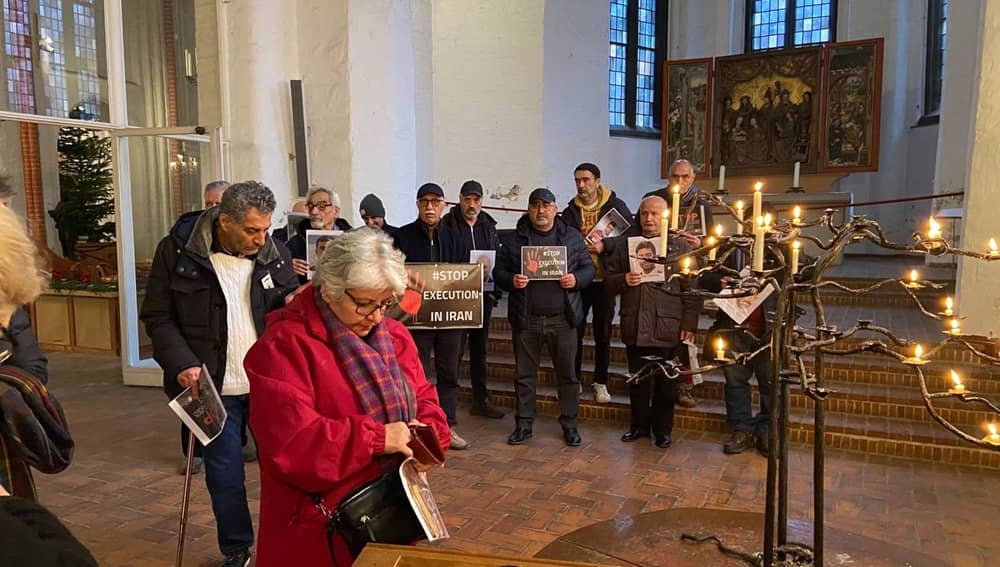
Hamburg Rally Supports “No to Execution Tuesdays,” Calls to End Executions and Free Political Prisoners

Hamburg, Germany – December 23, 2025 – Supporters of the People’s Mojahedin Organization of Iran (PMOI/MEK) gathered outside St. James’ Church (Hauptkirche St. Jacobi) to condemn the Iranian regime’s widespread use of the death penalty as a grave violation of human rights, particularly its execution of political prisoners. The event also voiced strong support for the “No to Execution” campaign. Participants expressed solidarity with the 100th week of the “No to Execution Tuesdays” campaign, held across 55 prisons in Iran, and called for the abolition of all death sentences against prisoners.
Zurich Exhibition Backs “No to Execution Tuesdays,” Urges End to Executions and Freedom for Political Prisoners

Zurich, Switzerland – December 22, 2025 – Supporters of the People’s Mojahedin Organization of Iran (PMOI/MEK) held a photo exhibition to protest the Iranian regime’s escalating use of the death penalty, particularly against political prisoners. The event also voiced solidarity with the growing “No to Execution” campaign. They also expressed their solidarity with the 100th week of the “No to Execution Tuesdays” campaign held across 55 prisons in Iran and called for the abolition of all death sentences against prisoners.
Heidelberg Rally Supports “No to Execution Tuesdays,” Calls to End Executions and Free Political Prisoners

Heidelberg, Germany – December 23, 2025 – Supporters of the People’s Mojahedin Organization of Iran (PMOI/MEK) held a rally and photo exhibition to condemn the Iranian regime’s widespread use of the death penalty as a grave violation of human rights, particularly its execution of political prisoners. The event also voiced strong support for the “No to Execution” campaign. They further expressed their solidarity with the 100th week of the “No to Execution Tuesdays” campaign, held across 55 prisons in Iran, and called for the abolition of all death sentences against prisoners.