

THIS PAGE WILL BE UPDATED WITH THE LATEST NEWS
UPDATE: 10:00 AM CEST
Iran Inmates Sew Lips Shut in Mass Hunger Strike at Notorious US-Sanctioned Jail: Report

More than 1,000 inmates death-row inmates held in a unit of Iran’s Ghezel Hesar Prison have entered a third week of a mass hunger strike to protest regime executions, with some prisoners sewing their lips shut in protest, according to reports.
The escalating demonstration at the U.S.-sanctioned Ghezel Hesar Prison in Karaj near Tehran, also highlights growing international concern over the Islamic Republic’s reliance on capital punishment, particularly for drug-related offenses.
According to the Human Rights Activists News Agency (HRANA), the hunger strike started on July 13, after six inmates were transferred to solitary confinement ahead of possible executions. Other Iranian human rights groups said the prisoners had been convicted of drug-related offenses.
In a statement released on July 27, the exiled Iranian opposition group, the National Council of Resistance of Iran (NCRI), reported that prisoners in Unit 2 of Ghezel Hesar Prison were in “deteriorating physical condition” because of the hunger strike.
UPDATE: 8:00 AM CEST
Iran Regime Publicly Executes Two January Uprising Protesters in Isfahan Amid Public Protests

As the religious fascism ruling Iran struggles to contain the fallout from the massive nationwide uprisings of January 2026, it has increasingly resorted to its most macabre tool of terror: public executions.
On the morning of Tuesday, July 28, 2026, the henchmen of the mullahs’ regime publicly hanged two brave young protesters, Abolfazl Sepahi Badjani, 24, and Amirhossein Safari Hosseinabadi, 27. The executions took place at Alikhani Square in Isfahan. Rather than projecting strength, these brutal public displays expose the deep vulnerability of a desperate regime completely incapable of quelling a rebellious society that no longer fears its apparatus of repression.
The two executed youths were prosecuted for their participation in the January 2026 uprising. According to the regime’s judiciary, as cited by the Mizan news agency, they were leveled with fabricated and draconian charges, including “Moharebeh” (enmity against God), “corruption on Earth,” and alleged involvement in the deaths of four State Security Force (SSF) officers. The regime also accused them of possessing firearms and Molotov cocktails, setting fire to a police station, and blocking streets.
Iran Hangs 2 Protesters in Public, Crowd Cries ‘Dishonorable’ As Security Fires Tear Gas
Iran publicly hanged two young men Tuesday over their alleged roles in January’s nationwide anti-government protests, as onlookers chanted “Dishonorable, dishonorable!” before security forces fired tear gas to disperse the crowd, according to the National Council of Resistance of Iran (NCRI), an exiled Iranian opposition group.
Abolfazl Sepahi Badjani and Amirhossein Safari Hosseinabadi were hanged Tuesday in Isfahan’s Shahid Alikhani Square — where authorities alleged they committed offenses connected to the Jan. 8 protests, according to the NCRI and Iranian state media.
The NCRI said onlookers condemned the executions before security forces fired tear gas to disperse the crowd. The opposition group also said security personnel had been deployed on rooftops and surrounding streets.
Iranian state media also reported the public executions, Reuters said, with Iran’s semi-official news agency Mehr saying they were carried out in Alikhani Square “in the presence of a group of people.”
Iran Holds Public Hanging for 2 Protesters at Site of Anti-Regime Rally: ‘Dishonorable!’

Iran escalated its barbaric executions of anti-regime protesters Tuesday, holding public hangings for two men at the same spot where they demanded change in January. Harrowing video captured the moment scores of Iranians yelled in defiance as the regime carried out the public execution of Abolfazl Sepahi Badjani and Amir Hossein Safari Hosseinabadi in Isfahan’s Shahid Alikhani Square.
“Dishonorable, dishonorable!” the crowd chanted at the security forces for executing the men, according to the National Council of Resistance of Iran (NCRI) group.
Badjani and Hosseinabadi were last together at the same square during the January protests that erupted across Iran against the brutal regime and its handling of the country’s economy.
The protests turned chaotic on Jan. 8 and 9 when Tehran’s security forces cracked down on dissent, with the two men being among 12 accused of killing four security guards during one of the demonstrations in Alikhani Square.
The 1988 Massacre: The Greatest Unpunished Crime Against Humanity
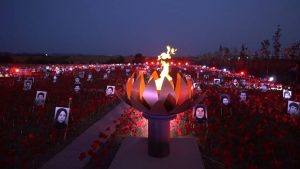
The massacre of over 30,000 political prisoners in the summer of 1988 is recorded as the largest crime against humanity since World War II and the most heinous genocide in modern Iranian history. This horrific tragedy can be termed “the greatest unpunished crime against humanity.” With the massacre decree, Khomeini sought to eradicate an entire generation of PMOI members to guarantee his regime’s survival.
The murderous clerical regime began preparations for this nationwide genocide in the winter and spring of 1988 by segregating, reshuffling, and transferring prisoners between facilities. The machinery of slaughter and crime was set in motion on July 19, 1988, when the infamous Khomeini issued a secret and ruthless edict (fatwa) ordering the execution of all prisoners who remained steadfast in their commitment to resistance and allegiance to the PMOI. In this fatwa, he decreed that all steadfast PMOI members were deemed “mohareb” (at war with God) and must be executed immediately.
Following this fatwa, “Death Commissions”—comprising a Sharia judge, a prosecutor, and a representative of the Ministry of Intelligence (including executioners such as Ebrahim Raisi and Mostafa Pourmohammadi)—were stationed in Evin, Gohardasht, and prisons across the country, commencing their summary trials.
Resistance Units Mark Ashraf Martyrs Anniversary and Reject Hereditary Rule with Nationwide Campaign
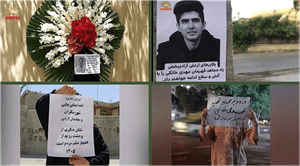
Resistance Units across Iran carried out two coordinated nationwide campaigns in recent days: one commemorating the martyrs of the July 2009 attack on Camp Ashraf in Iraq, and another denouncing what they described as the Iranian regime’s attempt to legitimize Mojtaba Khamenei’s hereditary succession as Supreme Leader through religious propaganda.
The activities, which spanned dozens of cities, combined memorial events, anti-regime slogans, posters, banners, and acts targeting symbols and institutions of the regime. Together, the campaigns underscored the Resistance’s message that the struggle against the clerical dictatorship continues despite leadership changes following the death of Ali Khamenei.
The first campaign marked the anniversary of the July 28–29, 2009 attack on Camp Ashraf, when Iraqi security forces under then-Prime Minister Nouri al-Maliki, acting after the transfer of camp security from U.S. forces, launched a deadly assault on residents of the camp.
Camp Ashraf, located in Iraq’s Diyala Province, housed thousands of members of the People’s Mojahedin Organization of Iran (PMOI/MEK). During the raid, Iraqi forces used live ammunition, armored vehicles, and batons against unarmed residents. At least nine residents were killed, hundreds were injured, and dozens were detained, prompting widespread condemnation from international human rights organizations.
Ali Khamenei’s 37-Year Rule: The Legacy of Repression, Corruption, and Absolute Power
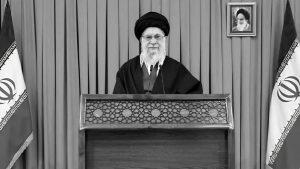
For nearly 37 years, from June 1989 until his death in February 2026, Ali Khamenei stood at the apex of Iran’s clerical dictatorship, transforming the office of Supreme Leader into the center of an extensive system of political repression, economic domination, and institutionalized impunity.
His rule shaped nearly every aspect of the Iranian regime’s domestic and foreign policies. Under his leadership, the country witnessed repeated massacres of protesters, widespread executions, systematic human rights abuses, economic decline, and growing international isolation. His death during the 2026 war created the most serious leadership crisis in the history of the doctrine of Velayat-e Faqih, with his son, Mojtaba Khamenei, assuming control of the regime amid deepening political instability.
Ali Khamenei rose through the ranks of the revolutionary establishment following the 1979 anti-monarchical revolution. Although he lacked the senior religious credentials traditionally associated with the position of Supreme Leader, he steadily accumulated influence through key appointments.
UN Experts Urge Iran to Halt Executions of Protesters After Mass Death Sentences
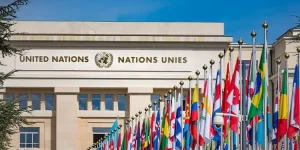
GENEVA – United Nations human rights experts have called on the Iranian regime to immediately halt executions and overturn the death sentences imposed on 12 young protesters arrested during the January 2026 nationwide uprising. In a statement released on July 27, the experts condemned what they described as grave violations of international human rights standards, warning that the regime is using capital punishment as a tool to intimidate society and silence dissent. The statement follows the execution of two protesters on July 19 and growing fears that the remaining defendants could face imminent execution after being sentenced in secret proceedings before the Revolutionary Court.
The UN experts criticized the sentencing of 12 defendants in a single closed hearing, arguing that the proceedings failed to meet even the most basic standards of a fair trial.
“Sentencing 12 people to death in one hearing, in a closed courtroom and without clarity as to each defendant’s individual responsibility violates established fair trial standards,” the experts said.
Iran Regime’s Deepening Internal Feuds Expose Fear of Resistance and Structural Collapse
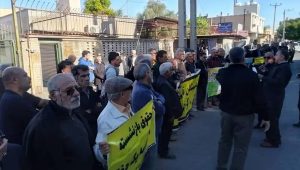
The Iranian regime’s escalating internal factional warfare, accompanied by increasingly desperate statements from the IRGC, has once again exposed the depth of its political deadlock, institutional fragmentation, and mounting fear of the organized Resistance and its expanding network of Resistance Units.
Far from projecting confidence, recent official statements and media exchanges reveal a leadership struggling to contain both internal divisions and external pressure. As the regime attempts to rally its supporters through familiar propaganda, its own officials and state-controlled media continue to acknowledge a system suffering from profound structural decay.
In a statement marking the 38th anniversary of Operation Eternal Light (Forough Javidan), the IRGC once again devoted significant attention to the role of the PMOI/MEK in anti-regime protests, highlighting what it described as the organization’s “prominent role” in nationwide uprisings.
Iranian Regime Proxy Forces Face Decline After War with United States
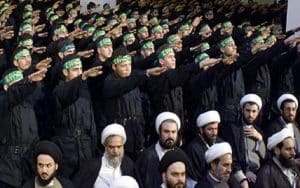
For years, one of the favorite expressions used by officials of the Iranian regime was “strategic depth.” The argument was straightforward: if the Iranian regime was to be defended, it was better to do so not at Iran’s borders but hundreds or even thousands of kilometers away.
The result of this policy was the creation of a network stretching from Hezbollah in Lebanon and the Palestinian Islamic Jihad to Iran-backed militias in Iraq, the government of Syrian President Bashar al-Assad, and the Houthis in Yemen. The Iranian regime called this network the “Axis of Resistance” and presented it as one of the most important symbols of its regional power.
But the map that once stretched from Tehran to the Mediterranean is no longer what it used to be.
Developments following October 7, the Gaza war, the blows inflicted on Hezbollah, the fall of Bashar al-Assad, and mounting pressure on armed groups in Iraq have, one after another, placed every link of this chain under strain.
How the Bab al-Mandeb Strait Became a Critical Chokepoint for Global Energy and Trade
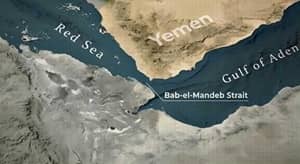
A narrow corridor between Yemen and the Horn of Africa, and how insecurity there is altering the cost of living across the globe.
On a world map, the Bab al-Mandeb Strait might look like a narrow, insignificant gap between the coast of Yemen and the African continent. In reality, this 32-kilometer (20-mile) waterway is one of the most vital arteries of the international economy.
As regional conflicts expand alongside a fragile ceasefire between Iran and the United States, global market attention has once again turned to this critical location—a point where international shipping lines grapple with drone and missile threats from Yemen’s Houthis, an Iranian-backed proxy force. Understanding why a tiny strait at the southern tip of the Red Sea can send shockwaves through the global economy requires a closer look at its geographical and commercial scale.
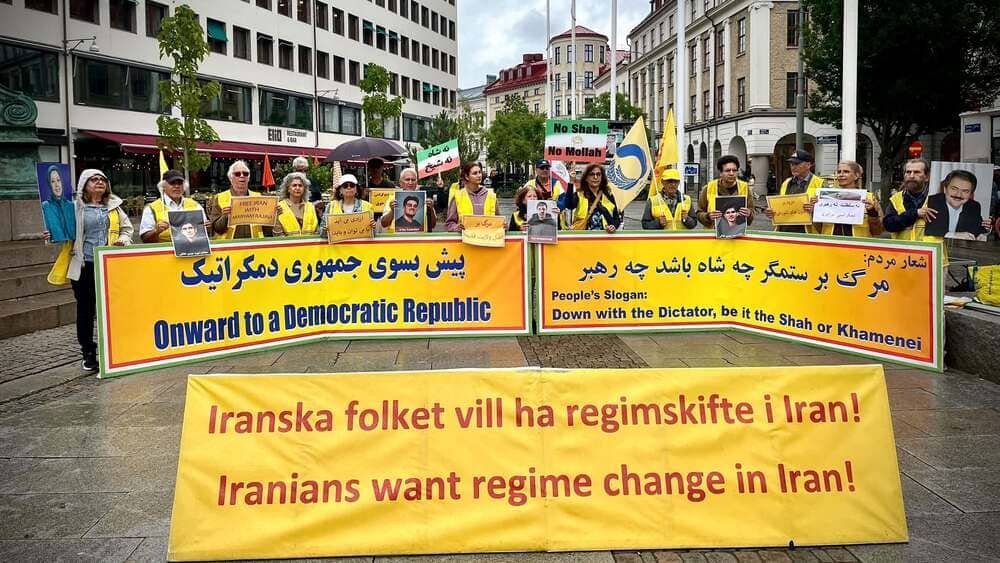
Gothenburg Rally Condemns Execution of PMOI Member Mehdi Khanaki, Calls for Urgent Action
Gothenburg, Sweden – July 25, 2026: Supporters of the People’s Mojahedin Organization of Iran (PMOI/MEK) gathered o protest the execution of political prisoner and PMOI member Mehdi Khanaki, carried out over his involvement in Iran’s January uprising.

The rally also honored members of the organization and protesters killed during the uprising, while commemorating the first anniversary of the executions of PMOI members Mehdi Hassani and Behrouz Ehsani, paying tribute to their sacrifice and resistance against the Iranian regime. Participants issued an urgent call to halt the imminent execution of 22-year-old Amirhassan Akbari Monfared.
Washington DC Rally Condemns Execution of PMOI Member Mehdi Khanaki, Urges Firm Action on Iran
Washington, DC – July 25, 2026: Iranian American supporters of the Iranian Resistance gathered at the Lincoln Memorial to protest the execution of political prisoner and PMOI member Mehdi Khanaki, who was executed for his alleged involvement in Iran’s January uprising. Demonstrators condemned the rising use of the death penalty and called for international accountability for the regime’s human rights violations. They also demanded the immediate and unconditional release of all political prisoners in Iran.

Chants of “Executions in Iran must end! must end!”, “Down with terrorist regime of Iran”, “Stop executions in Iran now now now!”, and “Down with dictator, long live freedom”, echoed throughout the rally, underscoring support for democratic change led by the Iranian people and their organized resistance.
Malmö Rally Condemns Execution of PMOI Member Mehdi Khanaki, Calls for Urgent Action
Malmö, Sweden – July 25, 2026: Supporters of the People’s Mojahedin Organization of Iran (PMOI/MEK) gathered to protest the execution of political prisoner and PMOI member Mehdi Khanaki, carried out over his involvement in Iran’s January uprising.

The rally also honored members of the organization and protesters killed during the uprising, while commemorating the first anniversary of the executions of PMOI members Mehdi Hassani and Behrouz Ehsani, paying tribute to their sacrifice and resistance against the Iranian regime. Participants issued an urgent call to halt the imminent execution of 22-year-old Amirhassan Akbari Monfared.