

THIS PAGE WILL BE UPDATED WITH THE LATEST NEWS
UPDATE: 7:30 PM CEST
Britain Asks Cyprus to Extradite Man Suspected of Spying for Iran
LONDON/NICOSIA, July 31 (Reuters) – Britain has asked Cyprus to extradite a dual British-Azerbaijani national suspected of spying on a British air base on the Mediterranean island and passing his findings to Iran’s Revolutionary Guards, London police said on Friday.
Rashad Sultanov, 44, from Islington in north London, is being held in custody by Cypriot authorities as extradition proceedings progress, the Metropolitan Police said in a statement.
The case marks Britain’s first overseas National Security Act investigation, led by counter-terrorism police into incidents at Britain’s RAF Akrotiri base in Cyprus between May 11 and June 22 last year, the statement said.
Police in Cyprus, where Britain has two military bases, said the suspect was first arrested in 2025 and had been in custody since then. An Israeli minister at the time said Cypriot authorities had thwarted an attack on Israeli citizens.
He was formally rearrested on July 17 following Britain’s extradition request, a Cypriot police spokesperson said.
Illicit Iranian Gambling Network Helped Pull Off A $4 Billion Sanctions Dodge
LONDON – One of the world’s largest illegal gambling networks sends millions of dollars worth of crypto through an office in Dubai, part of a $4 billion Iranian sanctions evasion operation.
The office, above a budget hotel in an unfashionable neighbourhood, is the listed address of Shelbit, an unlicensed crypto exchange run by an expatriate Iranian, according to data shared by two crypto investigative firms and an independent analyst, and reviewed by Reuters.
Among Shelbit’s main customers is a Farsi-language gambling network of more than 2,000 websites, fronted by two flashy Iranian influencers with high-level government connections – one operating from an expensive villa in Madrid and the other, until recently, from a luxury hotel in Hong Kong.
The two men and the Iranian running Shelbit were convicted as partners in crime in an illegal gambling case in Iran in 2023.
U.S. Sees Iran as Likely Behind Cyberattack on Minnesota Water Systems

Investigators believe a cyberattack this week on dozens of municipal water systems in Minnesota was probably the work of Iranian hackers, according to U.S. and state officials and others familiar with the matter, a potential act of aggression that comes at a precarious moment in the U.S. war against Iran.
Officials cautioned that they had not definitively determined who was responsible for the attack and that the preliminary assessment could change as the authorities collected more technical data.
They also warned that the hackers could be attempting to pose as Iran-based in an effort to ratchet up tensions between the two countries, though former intelligence officials said such a scenario was unlikely.
Local officials reported that the well and treatment plant in at least one city was temporarily offline on Monday, while other cities in the state had to use manual workarounds to cope with attempted attacks on automated operations.
UPDATE: 12:30 PM CEST
Treasury Cracks Down on Global Networks Enabling Iran’s Mahan Air and IRGC
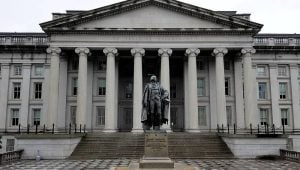
WASHINGTON—Today, the U.S. Department of the Treasury’s Office of Foreign Assets Control (OFAC) is designating six entities and individuals in China, India, Russia, and Iran, including multiple companies serving as general sales agents for the U.S.- and European Union‑sanctioned Iranian airline Mahan Air. Although Mahan Air presents itself as a civilian carrier, it has long played a central role in enabling the Islamic Revolutionary Guard Corps (IRGC), providing travel services for IRGC‑Qods Force personnel, facilitating military training, and supporting Iran’s procurement and transport of unmanned aerial vehicle (UAV) systems and weapons.
“Those who provide financial services, logistics, or commercial support to the IRGC or Mahan Air are helping sustain a terrorist enterprise,” said Secretary of the Treasury Scott Bessent. “Treasury will continue to identify them, expose them, and cut them off from the U.S. financial system.”
By sanctioning entities that help sustain Mahan Air’s global operations, today’s action further disrupts the network underpinning Iran’s destabilizing activities across the region.
Qatar Condemns Iranian Attacks on Jordan, Urges De-Escalation

Qatar has strongly condemned the Iranian attacks targeting Jordan, describing them as a “flagrant violation” of Jordan’s sovereignty and territorial integrity, as well as a “brazen breach” of international law and the United Nations Charter.
In a statement, the Ministry of Foreign Affairs stressed on Wednesday that the continuation of such attacks represents a dangerous escalation that could hinder ongoing de-escalation efforts and undermine diplomatic initiatives aimed at restoring security and stability in the region.
The ministry called for “the immediate and complete cessation of all military actions and assaults” that threaten regional security, urging all parties to avoid steps that could widen the cycle of escalation and to return to dialogue and negotiations while respecting understandings reached through diplomatic efforts.
Qatar also reiterated its “full solidarity with the Hashemite Kingdom of Jordan” and affirmed its support for all measures taken by Amman to protect its sovereignty and security.
UPDATE: 7:00 AM CEST
Victory Behind Bars: 1,500 Death-Row Prisoners Force Iran’s Regime to Retreat

On Tuesday, July 28, 2026, a historic victory for human rights and defiance was recorded within the dark walls of Iran’s dungeons. In an inevitable retreat, the Iranian regime’s ruthless judiciary and prison guards were forced to bow to the demands of 1,500 death-row prisoners in Unit 2 of Ghezel Hesar Prison in Karaj. Breaking the regime’s will through an unyielding 16-day hunger strike, the inmates proved that unity and steadfastness can overcome the clerical regime’s machinery of suppression.
As the strike gained momentum, a panicked high-level delegation of the regime’s judiciary and prison security agents rushed to the site to prevent the protest from spreading. The delegation included Jamshidi (Director General of the Tehran Province Prisons Organization), Azizi (Warden of Ghezel Hesar), Tarhani (Head of the Pardon and Clemency Commission), and several intelligence protection heads.
In a meeting with four prisoner representatives from each of the four halls of Unit 2, the delegation initially attempted to end the hunger strike by sowing division among the inmates. However, the prisoners’ vigilance thwarted this deceitful plot.
Public Executions Will Not Save Iran’s Regime from Its Deepening Crisis
When governments resort to public executions, they intend to send a message of strength. More often, however, they reveal something entirely different: fear.
The Iranian regime’s public execution of two young protesters, Amirhossein Safari and Abolfazl Sepahi, in Isfahan on July 28 marks another grim chapter in Tehran’s escalating campaign of political repression. Rather than demonstrating confidence, the executions expose a leadership increasingly convinced that only terror can preserve its grip on power. Far from restoring authority, these spectacles of violence reveal a regime confronting a society it no longer knows how to govern except through intimidation.
The judiciary justified the executions by accusing the two young men of involvement in the deaths of four security personnel during the nationwide uprising of January 2026. Authorities also highlighted allegations that they possessed firearms, Molotov cocktails, and other weapons and participated in attacks on police facilities.
Whether viewed through the regime’s legal narrative or by its critics as politically motivated prosecutions, one fact is unmistakable: the authorities are intent on portraying organized resistance as an existential security threat.
The 1988 Massacre Was No Sudden Crime: How Iran’s Regime Planned the Elimination of Political Prisoners
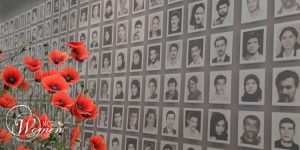
For nearly four decades, the 1988 massacre of political prisoners has remained one of the darkest chapters in Iran’s modern history. While much attention has focused on the executions carried out during the summer of 1988, growing evidence indicates that the killings were not an improvised response to wartime events but the culmination of a carefully orchestrated plan developed months in advance. The gradual release of survivor testimonies, documentary evidence, and accounts from victims’ families has strengthened the case that the regime’s campaign was systematically prepared, involving coordinated prisoner transfers, renewed interrogations, and administrative measures designed to facilitate one of the largest mass executions of political prisoners in contemporary history.
Contrary to official narratives portraying the massacre as a wartime necessity, numerous accounts indicate that preparations began as early as the autumn and winter of 1987.
Across Iran’s prisons, inmates were quietly transferred between wards, separated into different groups, and subjected to renewed reviews of their case files. Prison authorities offered no clear explanations for these changes, responding to prisoners’ questions with silence or intimidation. At the time, few detainees imagined these administrative changes were laying the groundwork for a mass execution campaign.
From “Surrender” to “Honorable Agreement”: The IRGC’s Latest Narrative Cannot Hide the Regime’s Weakness
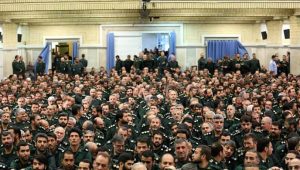
One question still lingers among many members of the Basij and the regime’s loyalists: What happened to the cries of “Revenge! Revenge!” that echoed so loudly only weeks ago? Why has what was once denounced as a humiliating capitulation suddenly become an “honorable agreement” worthy of praise?
The latest remarks by Yadollah Javani, deputy political chief of the IRGC, are less an explanation of Tehran’s agreement with Washington than an attempt to rewrite the story of the regime’s retreat. Javani now insists that the memorandum of understanding with the United States was negotiated “from a position of dignity and strength” and enjoyed the approval of Mojtaba Khamenei from the outset. The problem is that the regime’s own propaganda from only weeks earlier tells a very different story.
When details of the agreement first emerged, media outlets affiliated with the IRGC and hardline factions attacked it as an act of surrender. Commentators described it as a betrayal of those killed in recent conflicts, while protesters burned copies of the document during organized demonstrations. Government negotiators were accused of capitulating to Washington, and hardliners demanded resistance rather than compromise.
Iran’s Consumer Spending Slumps as 103 Million Fewer Purchases Reveal Deepening Cost-of-Living Crisis

New economic data has revealed a dramatic decline in consumer spending across Iran, providing fresh evidence of the severe financial pressure confronting households. According to official statistics, the number of retail purchase transactions fell by 103 million in the Iranian month of Khordad 1405 (May–June 2026) compared with the previous month, while the total value of consumer purchases dropped by approximately 44 trillion tomans.
The figures paint a stark picture of shrinking purchasing power as inflation, declining real incomes, and persistent economic instability continue to force families to cut back on both discretionary and essential spending.
Even regime-affiliated media have begun acknowledging the seriousness of the downturn. In an article published on July 26 (4 Mordad 1405) titled “103 Million Missing Purchases,” the state-run newspaper Siasat-e Rooz argued that the decline represents far more than a routine statistical fluctuation.
Retirees Keep the Flame of Civil Protest Alive in Iran
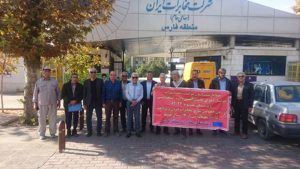
Retirees in Iran are now forced to take to the streets in the scorching heat of summer and the freezing cold of winter. They stand in front of Social Security offices and government buildings, risking insults, beatings, arrest, and fabricated legal cases—not for special privileges, but for their most basic rights: a dignified livelihood, accessible healthcare, and the respect earned through a lifetime of work. For weeks, Sundays have become the day of retirees’ protests in cities across Iran. The significance of these protests extends beyond their economic demands or the number of participants each week. The “Protest Sundays” have become a recurring public gathering, gradually taking on a meaning that goes beyond a labor-related protest.
What gives these protests political and social weight is their persistence. Through their repeated presence, retirees prevent government promises, waves of repression, or new crises from pushing their demands aside.
United States Launches Major Attack on Iranian Regime Targets
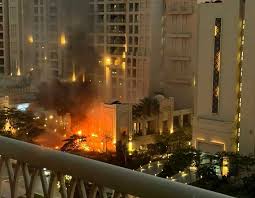
U.S. Central Command (CENTCOM) says the latest strikes were a response to missile attacks by the Islamic Revolutionary Guard Corps (IRGC) against American forces in the region.
The Wall Street Journal reported that a proposal for a 10-to-14-day air campaign to weaken the Iranian regime’s missile capabilities is under consideration.
U.S. Central Command (CENTCOM) announced early Thursday, July 30, the completion of a new round of military operations against targets in Iran. According to CENTCOM, the operation, which began at 8:00 p.m. Eastern Time, was carried out in response to missile attacks by the Islamic Revolutionary Guard Corps (IRGC) against U.S. forces and bases in the Middle East, particularly in Jordan.
CENTCOM described the operation as “a powerful response” to attacks by the Iranian regime. At the same time, a U.S. official told The Wall Street Journal that the latest strikes were broader in scope than previous operations, targeting multiple locations across Iran. Axios also quoted a U.S. official as saying that the United States had launched a new wave of airstrikes against targets in Iran.
Execution Crisis in Isfahan: An Urgent Call for International Action

The new wave of executions, particularly public executions in Isfahan Province, demonstrates a clear and structural violation of human rights and international standards. According to legal documentation, at dawn on July 28, 2026, two detainees from the January 2026 nationwide protests—Abolfazl Sepahi Badjani (24 years old) and Amirhossein Safari Hosseinabadi (27 years old, with a disability)—were hanged in public at Alikhani Square in Isfahan. These two individuals are part of the 12 protesters who were sentenced to death in the case known as the “Isfahan Alikhani Square Case” by Judge Mohammad-Reza Tavakoli, Head of Branch 1 of the Isfahan Revolutionary Court.
The judiciary listed their charges as “enmity against God”, “corruption on Earth”, “involvement in the death of four law enforcement officers,” “possession of firearms and Molotov cocktails,” “arson at a police station,” and “blocking streets.” This comes after two other defendants in the same case, Erfan Esfandiari and Gol-Mohammad Mohammadi, were previously executed on July 19, 2026.
Justice in Words, Torture in Action: Judicial Hypocrisy in the Islamic Republic of Iran

In recent years, the Judiciary of the Islamic Republic of Iran has repeatedly emphasized “adherence to citizenship rights,” “guaranteeing the rights of defendants,” “prohibition of torture,” and “fair trial standards” in official state media and affiliated publications—including IRNA, Iran Newspaper, Mizan News Agency, the Human Rights and Citizenship Journal of Imam Sadiq University, and the Research Institute for Islamic Culture and Thought.
However, extensive and documented evidence demonstrates the systematic violation of these very rights in practice. The escalation of executions, particularly political executions such as the public hanging of two protesters arrested during the January 2026 (1404) protests—whose sentences were issued based on forced confessions under torture and without the right to due process—serves as the most recent example of “Justice in Words, Torture in Action: Judicial Hypocrisy in the Islamic Republic of Iran.”
Citing the Constitution of Iran, domestic legislation, international human rights instruments, and credible international reports, this report examines the fundamental contradiction between the official rhetoric and the actual conduct of the Iranian judicial system.
Calls for Unity in Iran Amid Disputes Across State Institutions
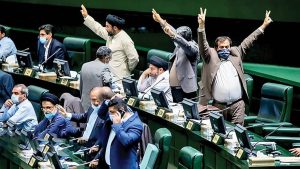
TEHRAN — The burning of portraits of former President Hassan Rouhani and former Foreign Minister Mohammad Javad Zarif during a nighttime gathering, the state newspaper’s criticism of how state television covered remarks by senior government officials, the sidelining of hundreds of lawmakers from a newly established parliamentary body, and Kayhan newspaper’s attack on the government’s new body for managing cyberspace together reveal four manifestations of a single conflict: post-war political divisions have moved beyond ordinary factional competition and now extend to the legitimacy of decision-making, the limits of institutional authority, and control over the state’s official narrative.
Images circulated from one of the nighttime gatherings showed portraits of Rouhani and Zarif set on fire. Sazandegi placed the incident alongside statements by senior officials and religious authorities calling for calm, highlighting a contrast between the return of the rhetoric of political exclusion and efforts by parts of the ruling establishment to preserve the unity that had been emphasized during the war.
On the same day, President Masoud Pezeshkian instructed government institutions to activate their information network down to the lowest administrative levels. He wrote: “Unity and cohesion are the central pillar of the government’s communications. The government’s network, which extends to villages across the country, must be activated.”
PMOI Supporters in Munich Condemn Iran’s Executions, Vow to Continue Resistance Against the Regime
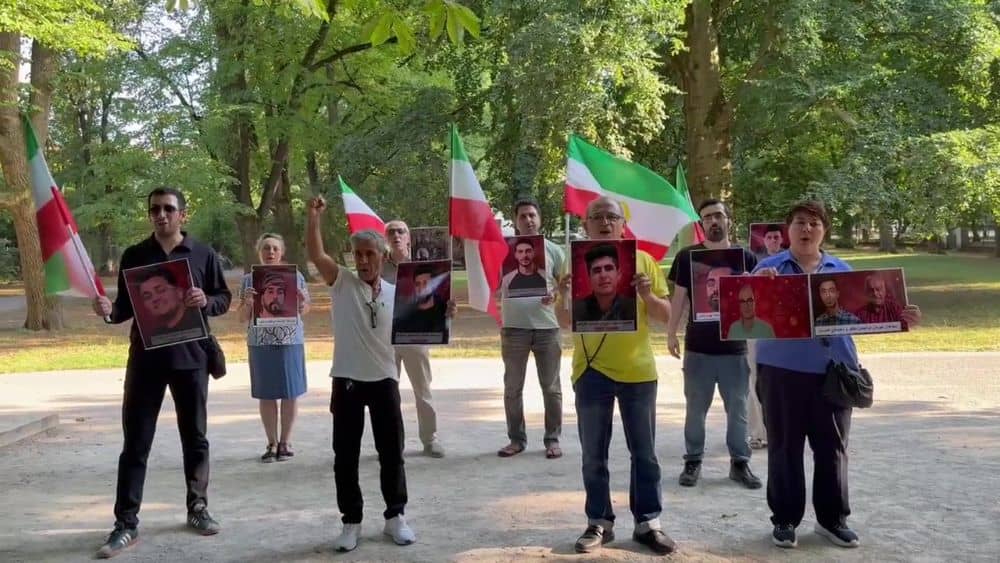
Munich, Germany – July 29, 2026 – Supporters of the People’s Mojahedin Organization of Iran (PMOI/MEK) held a rally in Munich to protest the Iranian regime’s ongoing executions of political prisoners and protesters, including PMOI member Mehdi Khanaki.
The demonstrators also condemned the public execution of two protesters in Isfahan, who had been arrested during the January uprising. They called on the international community to adopt a firm policy toward the Iranian regime and take urgent action to stop its escalating campaign of executions and repression.

The demonstrators stressed that the regime continues to target political prisoners, protesters, and dissidents in a desperate attempt to suppress the growing nationwide movement for freedom.
Berlin Protest Condemns Iran Executions, Calls for Accountability for the Mullahs’ Regime
Berlin, Germany — July 28, 2026 — Supporters of the People’s Mojahedin Organization of Iran (PMOI/MEK) gathered outside the Iranian regime’s embassy in Berlin to protest the execution of political prisoners and protesters in Iran, including PMOI member Mehdi Khanaki. The demonstrators also denounced the public execution of two protesters in Isfahan, who had been arrested during the January uprising, and urged the German government to take a firm stance against the Iranian regime’s escalating wave of executions and repression.

They said the executions are continuing and are targeting protesters and political prisoners across the country. The event was also held in solidarity with the “No to Execution Tuesdays” campaign in Iran’s prisons.
St. Gallen Event Condemns Political Prisoner Executions, Backs Iran’s “No to Execution Tuesdays”
St. Gallen, Switzerland – July 28, 2026: Supporters of the People’s Mojahedin Organization of Iran (PMOI/MEK) held a book table and photo exhibition in St. Gallen to protest the executions of political prisoners, including PMOI member Mehdi Khanaki, as well as the public execution of two protesters in Isfahan, who had been arrested during the January uprising.

They said the executions are continuing and are targeting protesters and political prisoners across the country. The event was also held in solidarity with the “No to Execution Tuesdays” campaign in Iran’s prisons.
Gothenburg Rally Backing the 131st Week of “No to Execution Tuesdays” Across 59 Iranian Prisons
Gothenburg, Sweden — July 28, 2026: Supporters of the People’s Mojahedin Organization of Iran (PMOI/MEK) held a rally in solidarity with the 131st consecutive week of the “No to Execution Tuesdays” campaign, a movement protesting the Iranian regime’s escalating executions and systemic repression.

Protesters condemned the recent execution of political prisoners, including PMOI member Mehdi Khanaki, as well as the public execution of two protesters in Isfahan, who had been arrested during the January uprising, saying the executions are continuing and targeting protesters and political prisoners across the country.