


THIS PAGE WILL BE UPDATED WITH THE LATEST NEWS
UPDATE: 9:30 AM CEST
FBI Shifts Some Agents Back to Counter-Terrorism Following Iran Strike, People Familiar Say
WASHINGTON, June 24 (Reuters) – The FBI has ramped up its efforts to monitor potential threats to the U.S. from Iran following President Donald Trump’s decision to attack the country’s nuclear facilities, two people briefed on the matter told Reuters on Tuesday.
FBI officials have informed some agents in recent days that they will be exempt from a mandate to focus part of their time on immigration enforcement given the elevated threat level from Iran, the people said.
The directive related to counter-terrorism, counterintelligence and cyber security agents who work on issues connected to Iran. FBI field offices in Chicago, Los Angeles, San Francisco, New York and Philadelphia have canceled rotations for agents to work on immigration issues, one of the sources said.
Behzad Naziri, Former Evin Prison Detainee: “With My Cellmates, We Counted 74 Methods of Torture”

Behzad Naziri is one of the voices of the Iranian Resistance. Now 65 years old, he was imprisoned as a political detainee by the mullahs in 1982 at the age of 23 and held in Tehran’s Evin Prison. Speaking to Marianne, he recounts his arrest and the physical and psychological torture he endured during his three years of imprisonment until his escape in 1985.
“I was working at AFP in Tehran as an interpreter and journalist. At the time, I translated Iranian newspapers for foreign reporters. Every day, I saw pages of lists of people executed in prisons printed in Tehran’s newspapers — like the lists of university or high school exam results.
The first time I went to Evin wasn’t as a prisoner but as a journalist. To silence international criticism over the mass executions, the mullahs’ regime decided to open Evin Prison to French journalists from TF1 and AFP, whom I accompanied. But we only saw what the authorities allowed us to see.”
UPDATE: 8:00 AM CEST
Beyond War and Appeasement: Why the World Must Embrace Iran’s ‘Third Option’

The recent ceasefire announced on June 24 has brought a pause to the direct military conflict, but it has not resolved the fundamental crisis. For years, the international community has oscillated between two failed policies toward Tehran: aggressive military threats and futile diplomatic appeasement. Both have proven to be dead ends. The ceasefire serves as a stark reminder that a genuine solution lies elsewhere—in a “Third Option” championed for decades by the Iranian Resistance, which calls for regime change driven by the Iranian people themselves.
As Maryam Rajavi, the President-elect of the National Council of Resistance of Iran (NCRI), stated following the ceasefire, “The proposal for a ceasefire and ending the war is a step forward for the third option: neither war nor appeasement. Let the people of Iran themselves, in the battle of destiny, bring down Khamenei and the dictatorship of velayat-e faqih.”
Defying The Regime’s War on Dissent, PMOI Resistance Units Rise Across Iran to Defend Prisoners and Demand Freedom
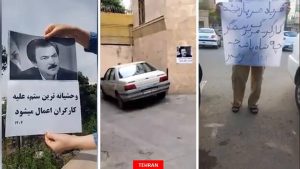
As the clerical regime in Tehran exploits the fog of foreign conflict to wage a hidden war against its own people, a nationwide campaign of courage is pushing back. On June 24, PMOI Resistance Units launched a coordinated campaign of defiance in cities across Iran, making it clear that the principal battle for the nation’s future is being fought on its own streets. In a powerful display of organizational strength, these activists are risking their lives to expose the regime’s brutality and amplify the Iranian people’s unyielding demand for a democratic revolution that will, as one placard in Tehran declared, “put an end to religious tyranny.”
Hossniyeh Kolkoli, Baloch Teacher and Mother of 4, Dies After Being Shot by Plainclothes Agents

Hossniyeh Kolkoli, a 41-year-old Baloch teacher and mother of four, has died after being critically wounded by gunfire from plainclothes agents in the southeastern city of Iranshahr. After six days in a coma in the intensive care unit of Khatam-ol-Anbia Hospital, she succumbed to her injuries. The incident occurred on the evening of Thursday, June 19, 2025, near the Army Town roundabout in Iranshahr. Plainclothes agents, reportedly pursuing a Peugeot Pars vehicle, opened fire without warning or justification, fatally striking Hossniyeh Kolkoli, who was uninvolved.
The bullets caused severe internal damage, leading to the immediate removal of her kidney and spleen in emergency surgery. A second operation followed to control internal bleeding, involving extensive abdominal sutures.
In Mullahs’ Iran, Torture Is a Tool of Governance

June 26, the International Day in Support of Victims of Torture, marks the global commitment to ending one of the most brutal and inhumane forms of human rights violations. This prohibition is not only enshrined in the United Nations Convention against Torture (CAT, adopted in 1984), but also in the International Covenant on Civil and Political Rights (ICCPR) and customary international law. It stands as a definitive and non-derivable norm.
According to the UN Convention against Torture: “Torture means any act by which severe pain or suffering, whether physical or mental, is intentionally inflicted on a person for purposes such as obtaining a confession, punishment, intimidation or coercion, by or at the instigation of or with the consent or acquiescence of a public official.”
In Iran under the rule of the mullahs, torture is not only tolerated—it is structurally embedded as a tool for repression, control, and silencing dissent in society.
Suspicious Death of Fouad Alikhani in IRGC Intelligence Detention Center in Kermanshah

In a continuation of the troubling trend of suspicious deaths of detainees in Iran’s security detention centers, reports indicate that Fouad Alikhani, a 41-year-old resident of Kermanshah, has died in the IRGC Intelligence Detention Center of the province. According to local sources, Alikhani died as a result of severe torture during his detention, and security authorities have so far provided no clear explanation regarding the incident.
Fouad Alikhani was arrested on Sunday, June22, 2025, at a security checkpoint in Kermanshah by security forces. His relatives state that the arrest took place without a judicial warrant or prior notice. Such actions are a clear violation of the Code of Criminal Procedure of the Islamic Republic of Iran and run counter to fundamental principles of human rights. According to his family, Fouad was taken directly to the IRGC Intelligence Detention Center, and from that moment onward, no information about his condition was available.
Total Communication Cut-Off at Vakilabad Prison: Escalating Crackdown Amid Attack on Evin Prison

As Iran reels from the unprecedented bombing of Tehran’s Evin Prison, reports indicate a simultaneous intensification of repression against political prisoners in Vakilabad Prison, Mashhad—raising alarms over a systematic clampdown under the guise of security. Since Friday, June 20, 2025, all phone communications for political prisoners held in Vakilabad Prison have been completely and abruptly cut off. The move came without prior notice or legal justification, leaving families in a state of distress and complete uncertainty about the fate of their loved ones. In tandem, in-person visitations have been canceled and replaced with restricted glass-partitioned (non-contact) visits.
Just days earlier, on Tuesday, June 16, 2025, Tehran’s Evin Prison was subjected to an unprecedented military-style bombing. The assault caused significant damage to key areas, including Ward 4, the women’s section, the gymnasium, library, and infirmary. Eyewitnesses reported several inmates injured and widespread destruction, including shattered windows.
Crisis at Evin Prison: Forced Transfers After Bombing Amid Institutional Silence

In the aftermath of a suspicious bombing at Evin Prison—an incident whose nature and scope have yet to be officially clarified—credible reports point to a dramatic escalation in security measures and the mass, involuntary transfer of detainees, particularly political prisoners. These unprecedented developments have sparked alarm among families, civil society actors, and international human rights organizations.
Verified citizen-captured footage and reliable sources indicate that, under the cover of night, heavily armed security forces surrounded Evin Prison, deploying buses and specialized vehicles to forcibly relocate inmates. Witnesses report that since the evening of June 23, 2025, the prison and its surrounding areas have been under intense military lockdown, with dozens of special forces vehicles stationed on-site.
IAEA Inspectors Blocked Under New Law Passed by Iranian Parliament

On Wednesday, June 25, 2025, Iran’s parliament passed a bill that significantly limits the regime’s cooperation with the International Atomic Energy Agency (IAEA). The bill, previously approved by the Parliament’s National Security and Foreign Policy Committee, mandates the suspension of both safeguards and non-safeguards cooperation with the International Atomic Energy Agency. Alireza Salimi, a member of the parliamentary presidium, explained that from now on, IAEA inspectors will only be allowed to access nuclear sites if the Supreme National Security Council issues security clearance for the nuclear facilities and so-called peaceful projects.
He added that the bill includes punitive measures against any individual who grants IAEA personnel access to the country without proper security authorization. Under this legislation, the installation of surveillance cameras, submission of periodic reports, and routine inspections will also be suspended unless expressly permitted by the regime’s security agencies.
Day 13 – Ceasefire Holds Amid Fallout, Arrests, and Diplomatic Maneuvers

Following the ceasefire between Israel and Iran, reports have emerged of a widespread wave of arrests and internal repression within the Islamic Republic. According to the state-affiliated Tasnim News Agency, authorities in Kermanshah province have detained at least 115 individuals accused of “disturbing security” during recent days. Additional arrests were reported by the Revolutionary Guard Corps in Hamedan and Hormozgan, with local police in Fars province reporting 53 detainees and Gilan province 36. In Zarand, 11 people were arrested for “propaganda against the system.”
A report from the regime-linked outlet Farda News highlighted a growing wave of desertion and disobedience within the ranks of the military and security forces. Many soldiers and officers are reportedly refusing to report for duty, declining to follow orders, or going into hiding. In response, Iran’s General Staff has issued new directives permitting commanders to use “the harshest possible measures” to suppress desertion and reassert control.
Israel-Iran 12-Day War Ends: Trump Announces Ceasefire, Iranian Resistance Welcomes Peace Deal – OpEd

On June 23, 2025, U.S. President Donald Trump made a surprise announcement declaring the end of the 12-day war between Iran and Israel. He confirmed that a “complete and final” ceasefire agreement had been reached. Trump stated that both parties approached him, and through Qatari mediation and negotiations with Israeli Prime Minister Benjamin Netanyahu, a ceasefire was initiated.
Maryam Rajavi, the president-elect of the National Council of Resistance of Iran (NCRI), welcomed the ceasefire and the end of foreign conflict. She emphasized that the real battle remains the Iranian people’s fight for freedom and victory over the ruling religious fascism.
Rajavi said that the proposal for a ceasefire and end to the war represents progress toward the “Third Option”: No to war, no to appeasement. Instead, let the Iranian people themselves overthrow the regime of Supreme Leader Ali Khamenei and the dictatorship of Velayat-e Faqih.