

THIS PAGE WILL BE UPDATED WITH THE LATEST NEWS
UPDATE: 11:00 PM CET
Preparing for Iran’s Democratic Transition

ith Operation Epic Fury underway in Iran, the question of the Islamic Republic’s future is no longer confined to academic speculation or the rhetoric of dissidents abroad. It has become an urgent strategic matter for the United States and its allies. After years of domestic unrest, economic collapse, and growing popular resistance, the durability of the ruling system in Iran is increasingly uncertain. What matters now is not merely whether the current system crumbles, but whether a credible democratic alternative is ready to assume responsibility when it does.
A crucial development occurred on February 28, 2026, when Maryam Rajavi – president-elect of the National Council of Resistance of Iran – announced the formation of a provisional governing framework designed to guide Iran through the crucial period following the collapse of the ruling establishment.
Her announcement deserves serious attention in Washington because it addresses the central strategic question that has long haunted discussions about Iran: What comes next?
UPDATE: 08:30 PM CET
Iran War Enters Third Week with Kharg Strike, Tehran Blasts, and Widening Gulf Spillover
The war entered its third week on Saturday with one of the sharpest regional escalations in days. The United States said it struck more than 90 military targets on Kharg Island overnight while sparing the island’s oil infrastructure, and Iran responded by threatening U.S.-linked ports, docks and economic sites in the UAE. At the same time, missiles and drones reached Qatar, the UAE and Saudi Arabia, while a missile hit the U.S. Embassy compound in Baghdad.
Inside Iran, the past 24 hours were marked by some of the heaviest strikes yet reported in Tehran, Kharg and southern Bushehr. Overnight explosions were heard around Nobonyad, Azadi Square and other parts of the capital, while the Iran Space Research Center in Tehran was hit. In southern Bushehr province, Deir came under sustained attack, with IRGC naval facilities, command buildings and local broadcasting infrastructure among the reported targets. On Kharg Island, repeated overnight explosions were reported for about an hour, with ammunition depots and IRGC naval positions hit while oil and passenger terminals remained standing.
B-2 stealth bombers takeoff to conduct a mission during Operation Epic Fury, delivering long-range fire to not only eliminate the threat from the Iranian regime today, but also eliminate their ability to rebuild in the future. pic.twitter.com/ebyUYNnOLo
— U.S. Central Command (@CENTCOM) March 13, 2026
The casualty picture also worsened. In Isfahan, at least 15 people were killed in a strike on a factory, according to Fars. In Tehran, Tasnim reported that Morteza Darbari, commander of the Muslim Ibn Aqil Basij base at Aman Zaman Mosque, was killed in an attack on a checkpoint in Hashemabad in District 15.
In Iraq, Reuters reported that three members of the Popular Mobilisation Forces were killed in a strike on PMF headquarters in Baghdad, adding to the sense that the war’s Iraq front is heating up again.
Iranian official and state-linked messaging on Saturday reflected a broader war footing. IRNA carried remarks from armed forces spokesman Abolfazl Shekarchi urging neighboring countries not to trust what he called America’s “hollow power,” while official coverage emphasized Quds Day mobilization and wartime unity. That public line coincided with the intensified strikes and with growing signs that Tehran is trying to project internal control while under sustained bombardment.
⚠️ Update: Two full weeks have now passed since #Iran fell into digital darkness amid a regime-imposed internet blackout.
The public remain isolated from the outside world with only a limited domestic intranet after 336 hours while state-approved accounts get whitelisted access. pic.twitter.com/NY0oTuHg3f
— NetBlocks (@netblocks) March 14, 2026
Across the Gulf, the conflict widened visibly. Qatar said its armed forces intercepted missile attacks over Doha, and key parts of the capital were evacuated, including Education City and central Msheireb. The UAE said its air defenses intercepted nine ballistic missiles and 33 drones on Saturday, and debris from an intercepted drone caused a fire in Fujairah. Saudi Arabia said it destroyed a ballistic missile aimed at Al-Kharj and 20 drones over the Eastern Province, the Empty Quarter and Al-Jouf.
Iraq remained another major flashpoint. A missile struck a helipad inside the U.S. Embassy compound in Baghdad, and the embassy urged Americans to leave Iraq immediately. Separately, Washington moved to reinforce its regional posture, with reports that about 2,500 Marines and the amphibious assault ship USS Tripoli were being sent to the Middle East.
BREAKING: Two Iraqi security officials say a missile struck a helipad inside the U.S. Embassy compound in Baghdad. https://t.co/bPUMsa7fPE
— The Associated Press (@AP) March 14, 2026
The broader diplomatic picture also hardened over the last 24 hours. Reuters reported that U.S. President Donald Trump rejected fresh ceasefire efforts, signaling that Washington is still prioritizing military pressure over negotiations. Taken together, the last day’s developments point to a war that is widening on three fronts at once: deeper strikes inside Iran, heavier retaliation across the Gulf, and a renewed rise in attacks on U.S. positions in Iraq.
UPDATE: 08:30 AM CET
Maryam Rajavi Meets with Senior U.S. Senator Thom Tillis
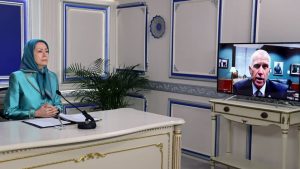
Maryam Rajavi held an online meeting with U.S. Senator Thom Tillis, a senior member of the Senate from North Carolina, to discuss developments in Iran, the prospects for change, and the appropriate policy toward Iran. During the discussion, Senator Tillis expressed support for the Iranian people in their quest for freedom and the work carried out by the NCRI toward that goal. He added that the Shah’s dictatorship had paved the way for the establishment of Islamic fundamentalist rule in Iran. Maryam Rajavi said, “The slogan of the provisional government is peace and freedom. Regime change can only be achieved by the Iranian people and their organized resistance. Just as the Iranian people rejected the monarchical dictatorship, they have risen up to end the rule of the velayat-e faqih regime and remain committed to that goal.
Why Iran’s Regime Fears the People More Than Foreign Missiles

As the geography of Iran is overshadowed by the fog of a foreign war, a climate of tension and anxiety has taken hold. Yet, amidst the external turmoil, the most fundamental question is where the real war is actually taking place. The true battlefield does not lie on Iran’s borders, but in its streets. Even if the regime eventually strikes a deal with foreign adversaries to preserve its power, there is no compromise to be made with an Iranian society that demands freedom and dignity. The only possible outcome to this domestic conflict is the definitive end of the mullahs’ 47-year occupation of the country.
The regime’s top security officials have explicitly shifted their crosshairs onto ordinary citizens, revealing the ruling establishment’s true fears. In a blatant admission of the regime’s war on its people, Ahmad-Reza Radan, the commander of the State Security Forces, told state television on the evening of March 10, 2026: “If anyone comes to the streets at the enemy’s request, we do not view them as a protester. We view them as an enemy and will deal with them as we deal with an enemy. All our forces have their fingers on the trigger.” By defining protesting citizens as enemy combatants, the regime has made it clear that its primary adversaries are the Iranian people themselves.
Four Women among PMOI Fighters Missing or Detained Since February 23
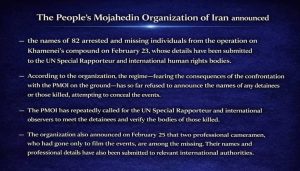
The People’s Mojahedin Organization of Iran (PMOI/MEK) has released the names of PMOI fighters who were arrested or remain missing following an attack on the headquarters of the mullahs’ Supreme Leader, Ali Khamenei, on February 23, 2026.
To safeguard those involved and prevent further abuses, the PMOI has formally submitted the list to the United Nations Special Rapporteur and other relevant international authorities.
The first four names belong to women in the list of those whose names have been announced as being detained or missing since February 23:
Iran Prepares Another Mass Killing and Political Purge under the Pretext of a Foreign War

As of today, March 13, 2026, the nationwide internet blackout in Iran has exceeded 13 days. This marks the second-longest shutdown in Iran’s history (following the January 2026 protests). Based on the experience of recent bloody crackdowns, an “absolute information blackout” in the security lexicon of the Islamic Republic has consistently served as a strategic prerequisite for creating a safe environment to commit large-scale massacres. This communication blockade, coupled with explicit threats from high-ranking officials, indicates deliberate preparation for a new political massacre under the guise of “war conditions” in the event of any protests.
Statements from officials—for which audio and visual records exist as evidence of human rights violations—demonstrate an organized will for lethal suppression.
Mojtaba Khamenei and the Financial Power Network in Iran – Part 2

In the first part of this report, Mojtaba Khamenei’s role in the security structure of power in Iran and his connections with a network of commanders within the Islamic Revolutionary Guard Corps (IRGC) and intelligence institutions were examined; networks that have played a decisive role in suppressing popular protests in recent years. However, the power structure of the ruling regime in Iran has not been formed solely on the basis of security and military influence. Alongside this security network, a complex system of economic foundations, quasi-state companies, and financial channels has developed over the past decades, placing significant portions of the country’s economic resources in the hands of circles close to the Office of the Supreme Leader.
Amnesty Warns on Energy Infrastructure Attacks as Iran Threatens Harsh Penalties

Amnesty International is urging all parties in the regional conflict to avoid unlawful attacks on energy infrastructure. At the same time, Iran’s judiciary says those accused of “assisting the enemy” could face harsh penalties, including possible execution. As fears grow over escalating conflict in the Middle East, Amnesty International has warned that attacks on energy infrastructure could have devastating consequences for civilians. The warning comes as Iran’s judiciary spokesperson signaled a tougher domestic stance, saying individuals accused of “cooperating with the enemy” during wartime could face severe punishments — including the death penalty.
Iranian Resistance Supporters Hold Ongoing Rally in Berlin Backing NCRI Plan for a Provisional Government

Berlin, Germany — March 11, 2026 — Supporters of the Iranian Resistance demonstrated outside the Iranian regime’s embassy for several consecutive day, calling for the overthrow of the clerical establishment and endorsing the National Council of Resistance of Iran’s (NCRI) announcement of a Provisional Government. The NCRI, a coalition of democratic Iranian opposition forces, presented the initiative as a viable democratic alternative for Iran following the death of Ali Khamenei.