


THIS PAGE WILL BE UPDATED WITH THE LATEST NEWS
UPDATE: 10:00 PM CET
Iran War Enters New Phase as Trump Delays Energy Strikes, Israel Keeps Hitting Tehran, and Tehran Denies Talks
U.S. President Donald Trump said the United States and Iran had made “major points of agreement” in recent contacts and said he was postponing threatened U.S. strikes on Iranian power and energy infrastructure for five days. On the other, the regime in Iran denied that any such talks had taken place, Israel said it was still conducting strikes in Tehran, and reports from inside Iran described more attacks on military, naval and defense-linked sites from the capital to the Gulf coast.
The diplomatic shift was real enough to move markets, but not solid enough to count as a breakthrough. Trump said his aides Steve Witkoff and Jared Kushner had spoken with Iranian interlocutors and suggested a deal could come soon; the regime’s parliament speaker, Mohammad Baqer Qalibaf, dismissed that account as “fake news” aimed at influencing oil and financial markets. Reuters reported that Brent crude dropped below $100 a barrel after Trump’s announcement, reversing part of the panic from the weekend’s threats around the Strait of Hormuz.
Oil prices sank around 10 percent after US President Donald Trump suddenly ordered a halt to strikes on Iranian energy infrastructure after citing "very good" talks with Tehran. Iran denied talks were underway. Still, Trump's statement offered relief to crude prices, which have…
— AFP News Agency (@AFP) March 23, 2026
Inside Iran, the reported military picture was still one of pressure and attrition. Local and social-media reporting compiled in the file described strikes or blast damage in Tehran, Tabriz, Isfahan, Bushehr, Bandar Lengeh, Konarak, Qeshm, Bandar Anzali and possibly Khorramabad, with specific reported hits on a defense-electronics building on Tehran’s Sayyad Shirazi highway, the air force staff headquarters in Tehran, the 100-kilowatt AM transmitter of the Gulf broadcasting center, the Bushehr provincial meteorology building, the Bandar Lengeh traffic-control tower and marine-operations building, a naval armory in Konarak, and the Salakh maritime border post on Qeshm. The Israeli military separately said on Monday that it was conducting strikes in Tehran, while CENTCOM released material saying it had hit a military facility in Qom that produced gas-turbine engines for attack drones and aircraft parts used by the Revolutionary Guards.
Targeted strike in Tehran’s Chizar district killed Saeid Shamghadari, described as an academic in electrical engineering who was active in the regime’s missile sector, along with his daughter and son. Local claims suggested that Hamid Mirzadeh, described as an aerospace commander in Tabriz, was killed in a targeted strike in the Abrisham residential towers, alongside other reported attacks in the city around Marzdaran, Rabe Rashidi and Shahid Merathi Square. Another local report said a residential tower in Tabriz’s Shahrak-e Nasr was hit, with at least six deaths reported internally. A separate claim from Varamin said a point strike in Kheyrabad destroyed a house used by regime-linked figures and killed a local Friday prayer leader along with Basij personnel. Because wartime media restrictions and the internet blackout continue to choke verification inside Iran, the broad pattern of fresh strikes is clearer than the exact casualty ledger attached to each site.
Trump says US has 'major points of agreement' in talks with Iran https://t.co/2NeL8zdKAM https://t.co/2NeL8zdKAM
— Reuters (@Reuters) March 23, 2026
Reuters reported that two Iranian ballistic missiles got through Israeli air defenses overnight into Sunday, injuring scores of civilians in Arad and Dimona, with 31 people hospitalized in Arad, including 18 children and at least nine serious cases, and five hospitalized in Dimona, including a 12-year-old boy in serious condition. Reuters also reported that at least 15 more people were hospitalized on Sunday in fresh Iranian attacks, including after a cluster munition hit Tel Aviv. Its March 23 running tally said Iranian attacks have killed 16 people in Israel, alongside four Palestinian women in the occupied West Bank, while 13 U.S. service members have been killed in the wider war.
The State Department issued a fresh worldwide caution telling Americans, especially in the Middle East, to exercise increased caution, warning that periodic airspace closures could disrupt travel, that U.S. diplomatic facilities — including some outside the Middle East — had been targeted, and that groups supportive of Iran could target U.S. interests or locations associated with Americans around the world.
🚫 FALSE: Rumors are again circulating about a U.S. F-15 being shot down over Kuwait. They are NOT TRUE.
✅ TRUE: The disinformation campaign from the Iranian regime is rampant. Lies about U.S. aircraft being shot down by Iran have been circulated multiple times on different… pic.twitter.com/Cmj013XGqd
— U.S. Central Command (@CENTCOM) March 23, 2026
The Iranian regime’s defense council threatened to mine Gulf sea lanes if Iranian coasts or islands were attacked, while London and Washington spoke about the need to reopen the Strait of Hormuz. China, in contrast, publicly urged the U.S. and Israel to stop military operations and warned that continued force would create a “vicious cycle.” AP reported that the International Energy Agency’s Fatih Birol called the war a “major, major threat” to the global economy and said the loss of oil supply had already exceeded the two big oil shocks of the 1970s combined. At the same time, Saudi Arabia leaning harder on its East-West pipeline to Yanbu has suggested an emergency workaround to Hormuz.
⚠️ Update: It's now day 24 of #Iran's internet blackout, with the measure passing 552 hours among the most severe registered in any country.
International connectivity remains unavailable to the general public while authorities maintain a selective whitelist for global access. pic.twitter.com/sTLpMHabDY
— NetBlocks (@netblocks) March 23, 2026
UPDATE: 08:00 PM CET
Iran’s IRGC Commanding Hezbollah Operations in Lebanon, PM Salam Tells Al Arabiya

Lebanese Prime Minister Nawaf Salam said in an interview with Al Arabiya on Sunday that members of Iran’s Islamic Revolutionary Guard Corps (IRGC) are directing Hezbollah’s operations in its ongoing war with Israel.
Salam criticized Hezbollah for dragging Lebanon into the conflict by launching rockets at Israel.
“It was declared that this war was in retaliation for the assassination of Khamenei, so this means this war was imposed upon us,” he said. Lebanon was drawn into the war after Hezbollah began firing rockets into Israel on March 2, saying it was acting in response to the killing of Iran’s supreme leader, Ali Khamenei, in Israeli-US strikes on February 28.
Referring to an incident earlier this month in which an Iranian-made drone struck a British base in Cyprus, Salam said the attack was carried out by the IRGC, “which is present and, unfortunately, is managing the military operation in Lebanon.”
UK Summons Iranian Ambassador Over Charges Against Men Accused of Spying
LONDON, March 23 (Reuters) – Britain said on Monday the Iranian ambassador to the UK had been summoned after an Iranian national and one British-Iranian dual national were charged last week on suspicion of helping Iran’s intelligence services.
The two men appeared in a London court last week accused of being involved in gathering information and undertaking reconnaissance of Jewish targets in Britain given to them by Iranian spy services over five weeks last summer.
“National security remains our top priority, and we take threats posed by Iran and those who do its bidding extremely seriously,” Britain’s foreign office said in a statement.
UPDATE: 05:30 PM CET
Iran: An External War Masks Another Battle — That of the People Against the Regime

As military escalation in the Middle East continues, external strikes have not led to the collapse of the Iranian regime. This reality highlights a frequently underestimated fact: Iran’s political evolution depends on its internal dynamics.
After several weeks of conflict, the hypothesis of a rapid collapse of the Iranian regime has not materialized. Despite nearly 8,000 targets reportedly struck according to CENTCOM, and the elimination of Ali Khamenei in the early hours of the conflict followed by that of numerous high ranking military and security officials, the ruling system remains in place.
On March 12, Reuters, citing three sources familiar with U.S. intelligence assessments, reported that the Islamic Republic was not facing an imminent risk of collapse. This situation underscores the limits of a strictly military approach to what is прежде a political crisis.
UPDATE: 01:00 PM CET
Daily Sad News from Iran

Sara Ebrahimi, a 14-year-old student from Cologne, could spend her free time doing what other teenagers do: playing sports, going to parties, enjoying life. But in reality, the daughter of Iranian parents neither can nor wants to fully engage in such things.
“I have many wishes and dreams for my future that I hope to fulfill in Germany,” she said in an interview with the Rundschau. “My peers in Iran don’t have that. Their desire for a better life is met with gunfire from the regime.” Many of her friends, whose families also come from Iran, are currently deeply shaken by the events in the country.
Sara therefore spends a large part of her free time advocating for peace and democracy in Iran. She regularly meets like-minded people online and in person and sometimes travels long distances to attend demonstrations.
“Every day I receive sad news from Iran through messages, social media, and personal contacts,” Ebrahimi told the Rundschau even before the attacks on the country by the United States and Israel. The demonstrations had been brutally suppressed by those in power.
“I can’t really do anything about what is happening there,” the student said. “But here, where I was born, I can protest and raise awareness about the terrible situation. The more voices there are, the better.”
At that time, people had already taken to the streets in more than 210 cities—more than half of Iran’s population. It pains her that this had long gone largely unnoticed by the German public.
UPDATE: 08:00 AM CET
Freedom-loving Iranians Rally in Amsterdam, the Netherlands
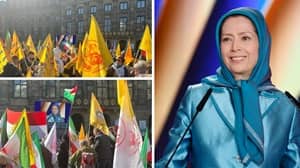
Mrs. Maryam Rajavi’s speech: “I salute all of you who have risen in defense of the people of Iran, carrying the banner of peace and freedom. Happy Nowruz and Happy Eid al-Fitr to all dear Iranian compatriots! You have begun the (Persian) year 1405 with demonstrations and a powerful spirit of freedom.
“May this year become the year of victory for the brave people of Iran, a people who have fought for liberty for 120 years, and who now stand once again in the midst of another revolution: Iran’s democratic revolution. As Massoud Rajavi, the Leader of the Iranian Resistance, said: ‘This is a decisive moment, a night of destiny for the people and the homeland. At the same time, it is a test of all individuals and groups within the people’s front.’ May the dark era of tyranny, war, and destruction give way to an era of freedom, to the sovereignty of the people, and to a future defined by peace and liberty.”
Psychological Warfare Is Tehran’s Last Line of Defense

When regimes begin to fear their own people, the battlefield changes. It is no longer defined by streets, protests, or even prisons—it moves into the minds of citizens. In today’s Iran, where the ruling establishment faces mounting internal unrest and external pressure, psychological warfare has become not just a tactic, but a central pillar of survival. This form of warfare does not rely on conventional weapons. Its tools are narratives, selective imagery, and carefully engineered language. Its goal is not to convince everyone, but to destabilize enough people—by creating doubt, spreading fear, and eroding trust—so that collective action becomes difficult, if not impossible. The Iranian regime understands that it does not need to win the loyalty of the population; it only needs to weaken their confidence in change.
One of the most visible elements of this strategy is the constant projection of strength. Even in moments of clear vulnerability, state-controlled media insists that everything is under control. This messaging continues regardless of setbacks, losses, or visible signs of crisis. The purpose is straightforward: if people believe the system is unshakable, they are less likely to challenge it. Perception, in this sense, becomes more important than reality.
Iran’s 2025–2026 Repression Record: Over 2,600 Executions and Tens of Thousands Arrested in a Single Year

The human rights record of Iran during the Persian year 1404 (March 21, 2025 – March 20, 2026) stands among the darkest in recent history. Facing an acute crisis of survival, the ruling establishment intensified its reliance on repression, resulting in a dramatic surge in executions, arrests, and systemic violence. From the outset of the year, the rate of executions increased significantly and continued to rise in an exponential pattern over subsequent months.
This escalation coincided with mounting social unrest and culminated in a nationwide uprising on December 28, 2025. In response, regime authorities imposed internet shutdowns and ordered a vast crackdown, further amplifying the scale of human rights violations.
At least 2,657 executions were recorded during the year, more than doubling the 1,155 executions documented in 2024. Given the prevalence of secret executions and limited transparency—especially during periods of conflict—the actual figure is likely higher.
Children of Iranian Regime Officials Enjoy Luxury Lives in Dubai and Europe

The Organized Crime and Corruption Reporting Project (OCCRP) reported that Hossein and Abolfazl Shamkhani, sons of Ali Shamkhani—a senior Iranian regime official—used aliases and Dominican passports to purchase a portfolio of high-value properties worth $29 million in Dubai, and that their activities have also extended to Europe. Hossein Shamkhani was placed under sanctions by the United States, the United Kingdom, and the European Union in July 2025 for generating billions of dollars in oil revenue for Iran’s regime and Russia.
The U.S. Department of the Treasury identified him as “Hugo Hayek,” a citizen of Dominica.
The OCCRP announced on Thursday, March 19, that Abolfazl Shamkhani also holds a Dominican passport under the alias “Sami Hayek.” However, he has not been sanctioned so far.
From Evin to Chabahar; Prisoners Caught Between the Flames of War and Guards’ Volleys
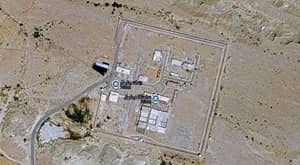
As the 22nd day of the nationwide internet blackout in Iran unfolds, verified reports have revealed a horrific crime within the walls of Chabahar Prison. In the early hours of Wednesday, March 18, 2026 (27 Esfand 1404), security forces responded to prisoners’ protests over the deprivation of food rations by firing live ammunition directly at them, resulting in the death of several and the wounding of dozens of Baluch prisoners.
The protests began on Tuesday evening after prisoners had been deprived of any food rations for four consecutive days. Prisoners exited their wards to demand basic necessities and a transfer to safe locations in the face of ongoing airstrikes. Special Units (Yegan-e Vizheh) surrounded the courtyard and opened fire on the protesting prisoners instantly.
Strait of Hormuz Crisis Reshapes Oil Markets and Global Power Dynamics

The Strait of Hormuz crisis has re-emerged over the past week as a defining force in global energy markets, disrupting oil flows, driving prices higher, and exposing deep geopolitical fault lines. As tensions escalate, the waterway—through which roughly one-fifth of the world’s oil supply passes—is no longer operating under normal conditions. Instead, selective transit, rising insurance costs, and political signaling are reshaping how energy moves across the Gulf.
According to a Reuters report published on March 21, disruptions linked to tensions in the Strait of Hormuz have pushed global oil prices toward multi-year highs. Benchmark crude rose above $110 per barrel, while European gas markets also experienced sharp increases.
Nowruz Gathering in Heidelberg Expresses Support for NCRI and Provisional Government of Maryam Rajavi
Heidelberg, Germany – March 21, 2026 – Freedom-loving Iranians and supporters of the People’s Mojahedin Organization of Iran (PMOI/MEK) in Heidelberg held a gathering on the occasion of the Iranian New Year, Nowruz. The event, which marked the first day of the new year, also included expressions of support for the National Council of Resistance of Iran (NCRI) and the provisional government announced by Mrs. Maryam Rajavi, the President-elect of the NCRI, as well as endorsement of her Ten-Point Plan for the future of Iran.
Nowruz Gathering in #Heidelberg Expresses Support for NCRI and Provisional Government of @Maryam_Rajavi#NCRIAlternative #No2ShahNo2Mullahshttps://t.co/NKeJPYN5Eg
— Iran Freedom (@4FreedominIran) March 22, 2026
Participants reiterated their rejection of both the former monarchical dictatorship and the current religious dictatorship, stressing that Iran’s future must be determined by its people through democratic governance and free elections.