

Four-minute read
As foreign military strikes and the regime’s own wartime rhetoric darkened the atmosphere in Iran, Chaharshanbe Suri — the ancient fire festival held on the eve of the last Wednesday before Nowruz — became something far bigger than a family celebration this year: a nationwide act of defiance. What the clerical establishment tried to suffocate through threats, surveillance and street deployments instead became a vivid display of public anger, cultural resilience and organized resistance.
Chaharshanbe Suri is one of Iran’s oldest national traditions, rooted in the Persian culture and centered on bonfires, fireworks, street gatherings and the symbolic act of jumping over flames to leave behind sickness, sorrow and misfortune before the new year. For generations, it has been a communal and family occasion, associated with renewal and joy. But in recent years, and especially under a regime that views independent public gatherings with suspicion, the celebration has steadily evolved into a political arena. Its spontaneous street presence, its deeply Iranian cultural character, and its ability to draw young people into public spaces have made it an increasingly potent occasion for anti-regime protest.
This year, that transformation was sharpened by the wider wartime climate. The ruling establishment entered Chaharshanbe Suri under visible strain, projecting belligerence outward while showing anxiety at home. Even as senior figures issued threats linked to the regional conflict, contradictions inside the system became harder to hide.
#Breaking 🧵
March 15—Iran
PMOI Resistance Units across carry out 15 operations across Iran, targeting the regime's centers of repression and corruption as part of the Charshanbe Suri (Fire Festival) campaign against the regime. #NCRIAlternative #No2ShahNo2Mullahs pic.twitter.com/S4D4iUGNfx— People's Mojahedin Organization of Iran (PMOI/MEK) (@Mojahedineng) March 18, 2026
On March 16, 2026, Ahmadreza Radan, the regime’s police chief, warned loyalist forces not to “leave the field,” calling the eve of Chaharshanbe Suri a “decisive night.” The Ministry of Intelligence warned against what it called the “misuse” of the occasion. The judiciary reportedly sent text messages urging citizens not to celebrate. On March 13, the IRGC Intelligence Organization issued a threatening statement invoking the bloody street crackdown of the previous uprising and warning that anyone seeking to stir “fear and street unrest” would face a hard blow. Radan had earlier declared that anyone taking to the streets in protest would be treated as an “enemy,” with the fingers of the security forces “on the trigger.”
The government’s message was clear: in a period it was framing as wartime, even a traditional celebration would be treated as a national security threat. Officials close to the state also attempted to turn the moment into a show of regime cohesion, with the Pezeshkian cabinet declaring the coming days a “week of unity” and urging a conscious street presence to display support for the system under Mojtaba Khamenei’s leadership. The clerical state was not merely trying to regulate a festival; it was trying to preempt the possibility that any gathering, however cultural in form, could become political in substance.
That is precisely what happened.
Nationwide defiance
Rather than retreat, people and the organized resistance network inside the country used Chaharshanbe Suri to reclaim the streets. PMOI Resistance Units launched coordinated actions on March 16 and 17 across Tehran, Karaj, Mashhad, Shiraz, Kerman, Qazvin, Sari, Zahedan, Ilam and other cities, hanging banners from overpasses, posting flyers, painting slogans and turning public spaces into platforms for political messaging. Their campaign placed the festival in the context of a broader national struggle, presenting Chaharshanbe Suri, Nowruz and Sizdah Bedar as part of a “national campaign” for peace and freedom.
PMOI Resistance units mark Fire Festival by lighting the path to a democratic republic https://t.co/h7gIJSycfV
— People's Mojahedin Organization of Iran (PMOI/MEK) (@Mojahedineng) March 17, 2026
The slogans carried a pointed and deliberate message. In city after city, activists rejected both the ruling theocracy and any return to monarchical dictatorship. “Death to the oppressor, whether Shah or Leader” and “Neither monarchy nor leadership, but a democratic republic” appeared in Tehran, Sari and elsewhere, drawing a hard line against both past and present forms of autocracy. Other banners promoted a democratic republic and backed the National Council of Resistance of Iran’s provisional-government framework and Maryam Rajavi’s Ten-Point Plan. In Tehran, some signs openly mocked the hereditary character of the current power structure, declaring that “King Mojtaba Khamenei” had mounted the throne of velayat-e faqih.
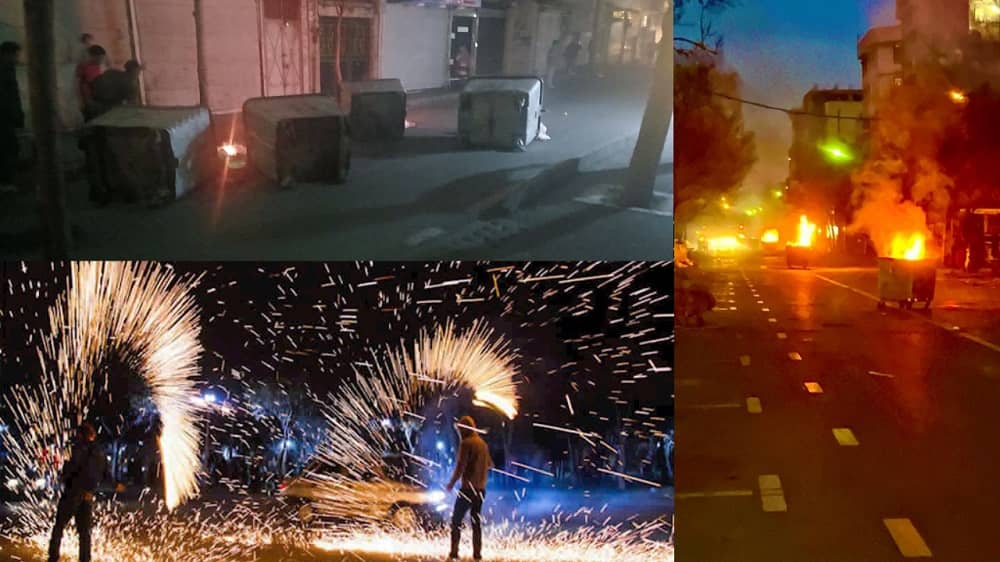
By the night of Chaharshanbe Suri itself, the campaign had moved from messaging to direct action. In Tehran and at least 15 other cities, rebellious youths reportedly turned the festival fires into signals of uprising. Images of regime leaders and symbols of the state were set ablaze. Slogans for overthrow rang out in the streets. The cry of “Atesh javab atesh” — “Fire answered with fire” — captured both the mood and the method: a regime that had tried to rule through intimidation was met with visible, public contempt. In cities stretching from Tehran and Arak to Mashhad, Zahedan, Iranshahr, Sarbaz, Baneh, Ravansar, Kermanshah, Eslamabad-e Gharb, Abhar, Yasuj and Ahar, the ancient ritual of fire became the language of political refusal.
What made the response especially significant was its timing. The resistance insisted that while foreign strikes may shake the regime, Iran’s future must be decided by the Iranian people themselves. That was the political argument underneath the fire, the banners and the slogans: the solution does not come from foreign bombs, nor from accommodation with the ruling order, nor from restoration of a former dictatorship. It comes from organized resistance and a population willing to defy fear in the streets.
Tabriz
PMOI Resistance Units set fire to signpost of IRGC Basij Base pic.twitter.com/aYYUBTgOBB— People's Mojahedin Organization of Iran (PMOI/MEK) (@Mojahedineng) March 18, 2026
In that sense, this year’s Chaharshanbe Suri was not only a festival under pressure. It was a measure of the regime’s weakness. The clerical establishment treated bonfires, fireworks and family gatherings as a security emergency because it understood what they had become: a cover for dissent, a test of public courage, and a recurring opening for coordinated resistance. The more the state tried to criminalize celebration, the more the celebration revealed the public mood.