

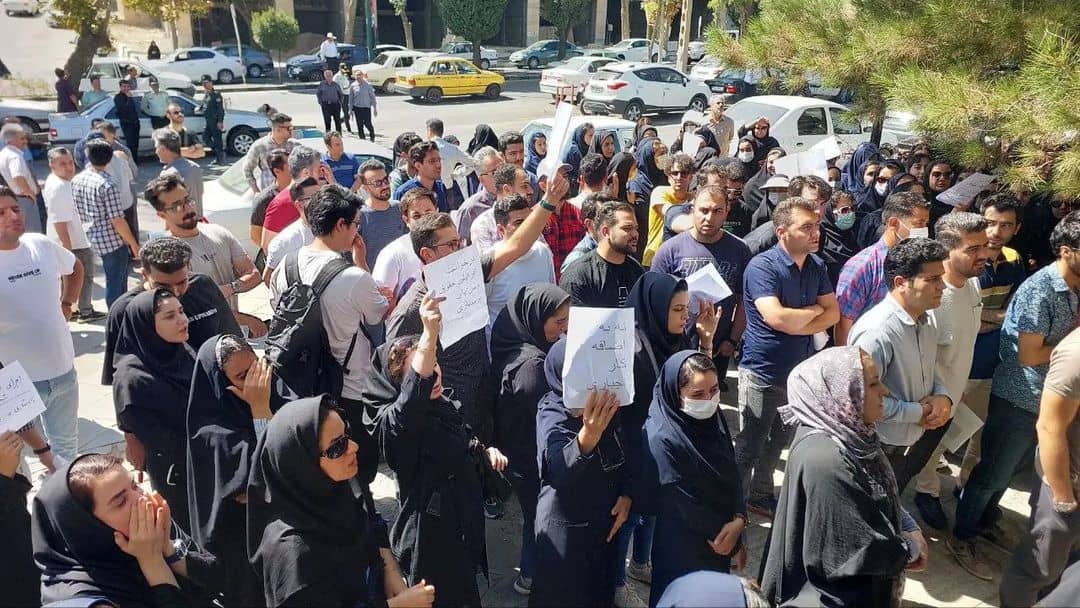
Protests erupted across Iran today, with demonstrators from various sectors—nurses, retirees, and farmers—taking to the streets in cities nationwide to demand better living conditions, fair wages, and an end to systemic corruption. The Iranian regime’s response has been marked by both repression and denial, even as state media acknowledge the unprecedented scale of these protests.
In Arak, two nurses were arrested by security forces during peaceful protests outside Amir al-Momenin Hospital. The healthcare workers, part of a broader national movement, were demanding higher pay, better working conditions, and an end to mandatory overtime. In Mashhad, nurses from hospitals including Imam Reza, Hasheminejad, Shariati, and Ibn Sina continued their protests, despite violent crackdowns by security forces. Videos show guards attacking protesters, yet the nurses remain defiant, chanting slogans like “From Shiraz to Mashhad, strike, strike!” and “Nurses die, but they do not accept humiliation.”
More images of the large protest rally of nurses in Hamedan.#Iran #IranProtests pic.twitter.com/QZjvr87S6s
— People's Mojahedin Organization of Iran (PMOI/MEK) (@Mojahedineng) August 20, 2024
The regime’s reaction has been both repressive and dismissive. However, Abbas Ebadi, Deputy Minister of Health, acknowledged the severity of the situation on Tuesday, telling state media, “The reality is that we are facing serious challenges in the nursing sector that are on the brink of boiling over into a crisis.”
Despite this, government officials have largely ignored the nurses’ demands, with security forces resorting to violence to quell the protests. Setareh Sobh newspaper reported that nurses across 50 hospitals are involved in the strikes, reflecting a significant and widespread challenge to the regime’s authority.
Midwives in Mashhad join the strikes and protests that began by nurses across the country.#Iran #IranProtests pic.twitter.com/5PddU2ersr
— People's Mojahedin Organization of Iran (PMOI/MEK) (@Mojahedineng) August 20, 2024
In Hamedan, nurses from local hospitals continued their protests, echoing the demands seen in other cities. The unrest has disrupted hospital operations nationwide, with many nurses threatening to resign en masse if their demands are not met.
Retirees protested in Kermanshah today, where they gathered to demand higher pensions and better living conditions. These protests, primarily involving former employees of the Telecommunications Company of Iran and the Social Security Organization, highlighted the growing economic strain on retirees, who expressed their frustrations with chants that criticized the regime’s economic policies.
Security forces in Arak arrested two of the nurses who were protesting yesterday. The peaceful protesters are demanding basic needs, including higher pay and better working conditions.#Iran #IranProtests pic.twitter.com/jgAU3NggzN
— People's Mojahedin Organization of Iran (PMOI/MEK) (@Mojahedineng) August 20, 2024
The ongoing economic crisis in Iran has also severely impacted the agricultural sector. Sadif Badri, a member of the regime’s parliament, revealed that the government has not only failed to pay its debts to wheat farmers but has also doubled the price of fertilizer. He noted, “More than fifty percent of the payments owed to farmers who delivered their wheat to the government remain unpaid. This is creating serious problems for maintaining self-sufficiency in wheat production in the coming years.” Farmers are now struggling to meet their financial obligations to banks and secure the necessary inputs for their upcoming planting season, further exacerbated by the recent sharp increase in fertilizer prices.
Also on Tuesday, political prisoners in 18 prisons across Iran joined the protest movement by launching a hunger strike in opposition to the regime’s increasing use of the death penalty. The prisoners, part of the “No to Executions” campaign, are protesting the execution of over 310 individuals this year, including 16 women. Their Tuesday strike, which has now reached its 30th week, calls for an end to the regime’s violent crackdowns on dissent.
Mashhad
Images of some of the martyrs of the 1988 massacre pic.twitter.com/FH2dQVqZPJ— People's Mojahedin Organization of Iran (PMOI/MEK) (@Mojahedineng) August 20, 2024