

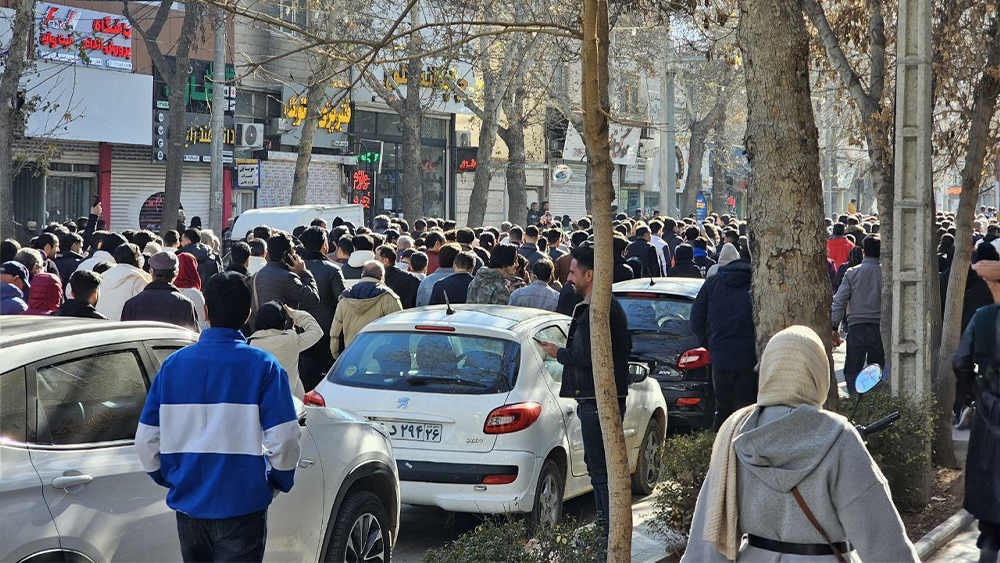
On Wednesday, January 7, 2026, the nationwide uprising in Iran entered its eleventh consecutive day, marking a significant escalation in the struggle against the ruling dictatorship. As the sun set on Wednesday, the regime’s suppression apparatus appeared overstretched, with reports emerging from multiple provinces of security forces retreating in the face of fearless, unarmed crowds.

Economic Paralysis: South Pars and the Bazaars
The most critical development on Day 11 was the expansion of strikes into the country’s vital energy sector. Workers at the South Pars refineries, the heartbeat of Iran’s natural gas production and a primary source of revenue for the state, downed tools and joined the nationwide movement. This strategic escalation coincides with a continued commercial paralysis in the capital and major provincial centers.
In Tehran, the historic Grand Bazaar remained a focal point of resistance. Merchants in the ‘Bein-ol-Haramein,’ ‘Pachenar,’ and ‘Hammamchal’ districts, as well as the specialized Gold and Jewelry Bazaar and the ‘Kaffashha’ (Shoemakers) Bazaar, kept their shutters down. The strikes were not passive; merchants gathered to chant, “Iranians will die but never accept humiliation.” The regime’s response indicated a fear of gathering crowds: authorities ordered the closure of the 15 Khordad metro station, a key transport hub serving the market district, in an attempt to prevent protesters from coalescing.
January 7, 2026 — Across Iran
Workers at the South Pars refineries have joined the nationwide strikes.
In Qazvin’s main bazaar, shopkeepers are closing their stores while chanting “Death to the dictator.”
In Tehran’s bazaar, merchants in the Hammam Chal alley and the… pic.twitter.com/HjjuPYA8lx— People's Mojahedin Organization of Iran (PMOI/MEK) (@Mojahedineng) January 7, 2026
This commercial defiance was mirrored nationwide. In Rasht, the Gold Market remained closed, and in Tabriz, the main Bazaar struck. Similar shutdowns were observed in Shiraz, Qazvin, Ahvaz, Kerman, and Bandar Abbas. In Neyshabur, northeast Iran, the youth initiated street protests that effectively shut down local commerce, leading to direct skirmishes in the city streets.
Confrontation and the Retreat of Forces
While the strikes squeezed the regime economically, the streets witnessed a shifting balance of power. In several cities, the sheer density of the crowds forced heavily armed security forces to abandon their positions.
In Abadan, southwest Iran, security units fled their posts after failing to disperse demonstrators with tear gas. In Bojnurd, the crowds were reportedly so massive that security agents retreated to rooftops to avoid being overrun. A similar scene unfolded in Borujerd, western Iran, where youths armed only with stones clashed with Revolutionary Guard (IRGC) forces, compelling the agents to retreat into their bases.
January 7—Borujerd, western Iran
Large crowd gathered for anti-regime protests on the 11th night of the nationwide uprising.#IranProtests pic.twitter.com/J1pB06Jos8— People's Mojahedin Organization of Iran (PMOI/MEK) (@Mojahedineng) January 7, 2026
However, the regime’s response in other areas was lethal. In Lordegan, within the Chaharmahal and Bakhtiari province, security forces opened fire with live ammunition. Despite the use of deadly force, the residents did not disperse. The fierce clashes resulted in casualties on both sides; reports indicate that four regime agents were killed during the confrontation. The IRGC-affiliated Fars News Agency confirmed the intensity of the fighting, admitting that two police officers were killed, 30 were injured, and both the governor’s office and several administrative buildings sustained damage.
In Shiraz, the urban landscape was transformed into a zone of resistance. As authorities deployed water cannons to clear the streets, protesters countered by constructing barricades. Footage from the city showed a truck dumping a load of stones onto the street to assist youths in reinforcing their defensive lines against plainclothes agents and suppressive units.
January 7—Shiraz, southern Iran
The people are using all the means at their disposal to counter the regime's suppressive forces. Video shows a truck dumping stones to help protesters set up barricades and fight back against the regime.#IranProtests #IranRevolution pic.twitter.com/1BiIyWPbpE— People's Mojahedin Organization of Iran (PMOI/MEK) (@Mojahedineng) January 7, 2026
A defining feature of Day 11 was the breakdown of the wall of fear. In Kerman and Kermanshah, citizens physically intervened to prevent the arrest of protesters. In one instance in Kermanshah, demonstrators braved tear gas to rescue a woman who had been injured by security forces, pulling her to safety rather than fleeing.
A Unified Front: From Universities to Dungeon Cells
The uprising has forged a unified voice across disparate sectors of society, linking university campuses with political prisoners.
Despite the late hour on Wednesday, students at Tehran’s Soore University held rallies, chanting a poignant new slogan: “Evin [Prison] has become a university, Tehran has become a prison,” highlighting the mass arrests of their peers. This sentiment was echoed in Zahedan, Urmia, and at the Azad University of Kermanshah, where students confronted Basij militia members while chanting, “The student dies but accepts no humiliation.”
January 7—Zahedan, southeast Iran
Students at University of Sistan & Baluchestan held nightly protest rally chanting anti-regime slogans:
"Students will die but won't accept humiliation"
"We have neither water nor bread, high prices be damned"#IranProtests #IranRevoIution pic.twitter.com/1il8jfdaQZ— People's Mojahedin Organization of Iran (PMOI/MEK) (@Mojahedineng) January 7, 2026
In a rare and defiant act, political prisoners in two of the regime’s most notorious detention centers joined the protests from behind bars. In the women’s ward of Evin Prison, prisoners gathered to sing the national anthem and chant, “Freedom comes with ‘we can and we must’.” Simultaneously, male political prisoners in Ghezel Hesar Prison issued a collective statement in the form of chants, vowing, “We swear by the blood of our comrades, we stand until the end,” and calling for the overthrow of the “execution republic.”
The political nature of the uprising was further clarified by slogans rejecting all forms of dictatorship. In Tabriz, youths burning trash bins to block reinforcement routes chanted, “Death to the oppressor, be it the Shah or the Leader,” signaling a demand for a democratic republic rather than a return to past monarchies or the continuation of the current theocracy.
Regime Tactics and the Call for Perseverance
Faced with a losing battle on the streets and in the markets, the regime has resorted to information warfare and threats of lethal violence. Internet speeds have been drastically throttled across the country, particularly in Tehran, Fars, and Alborz provinces. Operators like Hamrah-e Avval and Irancell have disrupted access to foreign websites and messaging apps like Telegram to prevent the coordination of protests and the dissemination of footage.
Tehran’s governor, Motamedian, issued an explicit threat on Wednesday, stating to state media that police have the legal authority to use weapons against those attacking public facilities. “If the gatherings turn to destruction… the police, according to the law, have the authority to use weapons,” he told the Asr-e Iran outlet.
Salute to the courageous people of Kermanshah, Ahvaz, Ilam, Shiraz, Fasa, Isfahan, Shahrekord, Qazvin, Kerman, and many other cities who, alongside Tehran, took to the streets today on the eleventh day of the nationwide uprising, chanting “Death to Khamenei.”
Live fire by… pic.twitter.com/j23wNzH302— Maryam Rajavi (@Maryam_Rajavi) January 7, 2026
Addressing the escalating violence and the resilience of the protesters, Mrs. Maryam Rajavi, President-elect of the National Council of Resistance of Iran (NCRI), praised the defiance seen in Kermanshah, Ahvaz, and Ilam. Referring to the use of live fire by the IRGC, she stated, “Khamenei should know that every bullet fired by his mercenaries only further ignites the flames of revolt.”
As Day 11 concludes, the Iranian regime finds itself besieged by a population that has lost its fear. With the energy sector joining the bazaars in striking, and the youth holding the streets against armed agents, the uprising has entered a critical, irreversible phase.