

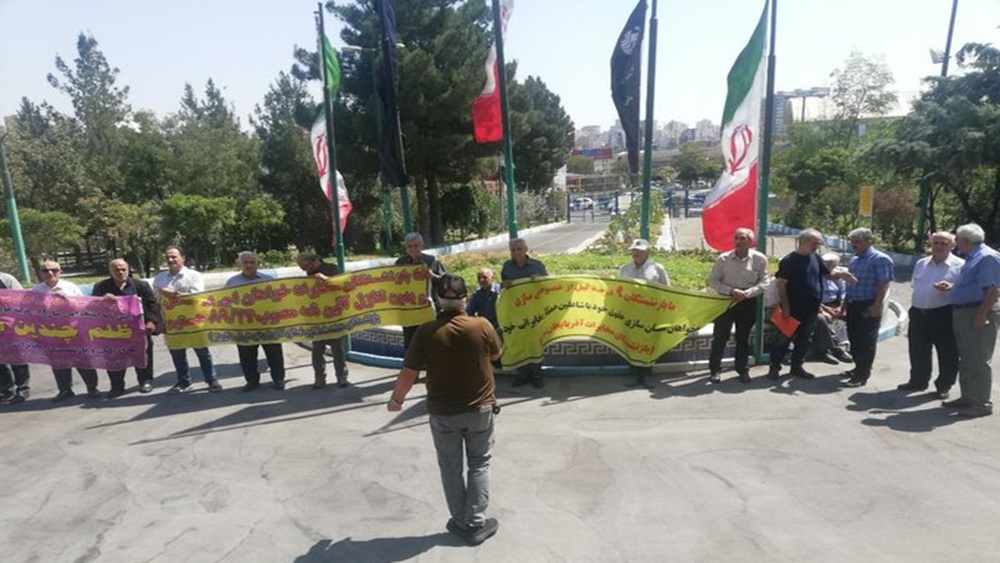
A new wave of widespread, ongoing protests swept across Iran on August 11, 2025, set against a backdrop of systemic collapse openly acknowledged by the regime’s own leadership. Just one day prior, on August 10, President Masoud Pezeshkian offered a stunning confession of the country’s dire state: “We have a problem with water, we have a problem with electricity, we have a problem with gas, we have a problem with money, we have a problem with inflation. Where do we not have a problem?” He added that cutting essential services is no longer a choice but an “obligation,” admitting his government has no other options.
This admission of failure from the highest level of the executive branch confirms what millions of Iranians experience daily and what fuels the nationwide resistance against the ruling theocracy. The protests are a direct response to these crises, spanning critical sectors from the strategic oil and gas industry to retired civil servants and local communities.
The Heart of the Regime Under Siege: The Oil & Gas Sector Uprising
In a direct challenge to the regime’s financial lifeline, official employees of the oil industry staged coordinated protests on August 11 in Iran’s key energy hubs. Protests were reported at the Pars Oil and Gas Company at both Site 1 in Asaluyeh and Site 2 in Kangan, as well as among workers from the 40 POGC platforms and the South Pars Gas Complex.
August 11—Southern Iran
Widespread protest by oil and gas workers across various regions in southern Iran. Protesters demand better wages, fair employment contracts, and the removal of unjust deductions.#IranProtestspic.twitter.com/5TABs4WlPh— People's Mojahedin Organization of Iran (PMOI/MEK) (@Mojahedineng) August 11, 2025
Their specific demands reveal a system riddled with injustice: the removal of salary and retirement caps, the full implementation of the long-ignored “oil law” to protect their rights, and the refund of illegally over-taxed wages. This organized action demonstrates that even in the regime’s most vital sector, discontent has reached a boiling point.
The Cry of the Betrayed: Retirees and Professionals Demand Justice
The unrest is not confined to industrial workers. On August 11, retired telecommunications workers rallied in Tabriz, protesting dire living conditions after a lifetime of service. Their protest comes as Tabriz itself is a flashpoint of public anger. According to state-run media, crippling, unplanned power outages have “pushed people to their limits,” especially as citizens watch government offices and banks continue to consume electricity without restriction—an “obvious discrimination” that has “doubled the anger of citizens.”
August 11—Tabriz, northwest Iran
Protest rally by retirees of the Telecommunications Company of Iran (TCI), demanding higher pensions and access to basic services that the regime is denying them.#IranProtests pic.twitter.com/Jz7CWt9Ngz— People's Mojahedin Organization of Iran (PMOI/MEK) (@Mojahedineng) August 11, 2025
This daily struggle for survival is compounded by a housing crisis that has turned into a permanent nightmare. State-media reports from late July confirm that soaring rents, increasing by 30-35% in Tehran alone, are forcing families into city outskirts where price hikes have also “cut off their last resort.”
A day earlier, on August 10, supervising engineers protested in Tehran, decrying the municipality’s role in corrupt building projects and invoking the catastrophic Metropol building collapse as a symbol of the regime’s deadly negligence.
In Ardakan, Yazd province, locals blocked a road leading to a local mine to protest environmental degradation and unfulfilled commitments by regime officials.
August 11—Ardakan, central Iran
Locals blocked a road leading to a local mine to protest environmental degradation and unfulfilled commitments by regime officials.#IranProtestspic.twitter.com/dGSw9v2mVz— People's Mojahedin Organization of Iran (PMOI/MEK) (@Mojahedineng) August 11, 2025
A Regime Sitting on a Powder Keg
The regime’s own media and officials are increasingly sounding the alarm. “Social demands are no longer limited to the elites but are also manifested in public and daily settings,” warned the state-run Arman Emrooz newspaper in early July, concluding that stability cannot be maintained with old, top-down policies. Regime MP Mojtaba Yousefi recently admitted the crushing price hikes targeting people’s livelihoods have “no justification.” Other outlets warn that staples like bread, rice, and oil are on the verge of a “new inflationary shock.” Analyzing the psychological impact, the Eco Iran website noted that economic pressures have created a “nervous society” where many people react with “explosive rage” to the slightest grievance.
The protests on August 11 in Asaluyeh, Kangan, Tabriz, Ardakan, and Mirjaveh are not isolated events. They are the visible eruptions from a social powder keg that the regime itself acknowledges is about to detonate. Faced with a crisis of its own making, the clerical leadership offers no solutions, only admissions of helplessness and continued repression. The Iranian people, however, are providing their own answer. The regime is sitting on a powder keg that grows more unstable by the moment. Now, the people’s voices are heard from rooftops, subways, and streets with chants like “Death to the dictator,” leaving no doubt as to their ultimate goal.