

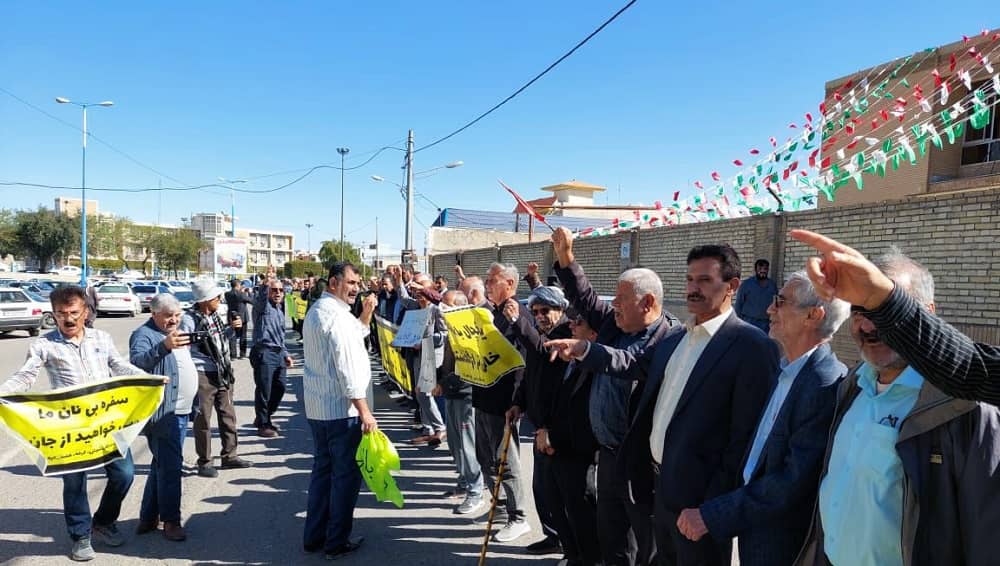
On February 23, Iran witnessed a new wave of protests across multiple cities as retirees, students, and investors took to the streets to demand their rights amid worsening economic conditions and government corruption.
In Isfahan, central Iran, steel and mining retirees marched on Neshat Street, chanting, “Our enemy is right here, they lie that it’s America,” and “Neither the parliament nor the government cares about the people.” Their slogans reflected mounting frustration with the regime’s mismanagement and failure to address economic grievances.
In Ahvaz, southern Iran, Social Security retirees rallied with demands for their unpaid pensions, chanting, “They looted Social Security, leaving us destitute” and “We don’t want charity, we demand our rights with dignity.” Protests extended to the city of Shush, southern Iran, where demonstrators decried inflation and government mismanagement with slogans like, “Inflation has broken the people’s backs” and “From Khuzestan to Gilan, down with corrupt officials.”
In Tehran, the nation’s capital, those who had invested in Farda Motor staged a demonstration demanding accountability for unfulfilled promises by the company, another sign of growing unrest over financial corruption and fraud.
Meanwhile, protests erupted at the University of Tehran over the recent killing of Amir Mohammad Khaleghi, a 19-year-old student stabbed near the university dormitory on February 12. Students gathered outside the central library, chanting, “Law enforcement, security officials—you are responsible for this crime!” and “So many morality police, but not one real guardian.”
Authorities deployed security forces at university gates to intimidate demonstrators, while students denounced the regime’s failure to provide campus security. Some slogans directly called out plainclothes agents involved in repression: “Security guards in disguise, they’re just plainclothes forces.”
More footage of the protest rally by retirees of the steel and mines industry in Isfahan.
Protesters chant, "Neither the government nor the parliament care about the people."#IranProtestspic.twitter.com/1RpBkurBO5— People's Mojahedin Organization of Iran (PMOI/MEK) (@Mojahedineng) February 23, 2025
The violent crackdown extended beyond protests, with security forces escalating repression in Sistan and Baluchestan Province. On February 22, authorities returned the bodies of four young Baluch men to their families, more than three months after they disappeared following a confrontation in Saravan. No details were provided on the circumstances of their deaths.
In another incident, Mahmoud Bireichi, a 24-year-old Baluch man, was shot dead in Ferdows, South Khorasan Province, simply because his vehicle had a Sistan and Baluchestan license plate. Eyewitnesses confirmed that he was unarmed, and security forces provided no justification for the killing. His body was handed over to his family two days later, with his funeral held at Makki Mosque in Zahedan.
The regime’s violent campaign against Baluch citizens has continued relentlessly, with human rights groups reporting that over 1,000 fuel carriers have been killed or injured over the past seven years due to direct gunfire or high-speed chases by security forces. This latest killing further fuels outrage in the already volatile province.
Iran’s deepening economic crisis, with the rial now trading at 92,310 tomans per USD, has further eroded purchasing power, driving more people to the streets. As economic hardship worsens, the regime continues to pour resources into regional destabilization and proxy warfare, confident in its ability to crack down on dissent at home. But no amount of repression can mask the reality: more Iranians are reaching the breaking point, and the protests show no signs of stopping.