

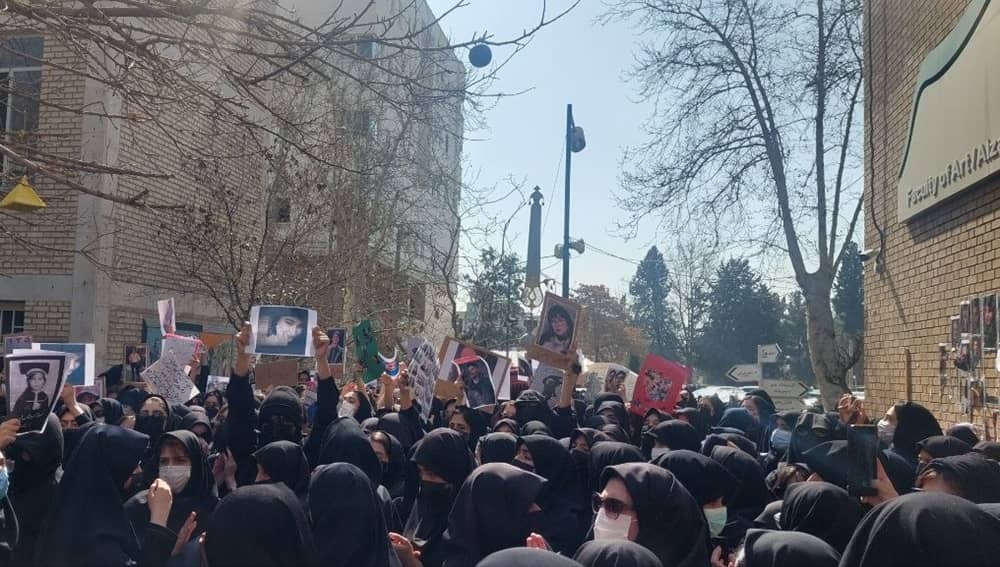
A coordinated wave of popular defiance has paralyzed major Iranian urban centers as student-led revolts enter their third consecutive day, synchronized with localized urban uprisings and a historic economic freefall. From the corridors of Tehran’s elite universities to the streets of Ilam province, the Iranian people have demonstrated a sophisticated, rebellious momentum.
The clerical regime’s “machine of repression” is now facing a multi-front crisis where academic rebellion, regional strikes, and systemic financial insolvency have merged into a singular movement for a democratic change.
The academic vanguard has fundamentally redefined the struggle by explicitly rejecting all forms of autocracy. At the University of Tehran, Amir Kabir, and Sharif University, thousands of students have adopted the rallying cry: “Down with the dictator, down with Khamenei”.
Another ideological clarity—targeting both the current “wali al-faqih” (the Supreme Leader) and the “dead political actors” of the past—was formalized in a joint declaration by University of Tehran students who described the campus as an “impenetrable bastion of freedom”. In Mashhad, the uprising at Ferdowsi University saw “rebel youth” engaging in direct physical confrontations with Basij paramilitaries, chanting “We didn’t give martyrs to compromise, to praise the killer leader”.
February 23—Tehran, Iran
More footage of protest rally by students at Al-Zahra University. Protesters are chanting, "We did not give martyrs to praise the murderous leader!"#IranProtests pic.twitter.com/Z8c86Z10jw— People's Mojahedin Organization of Iran (PMOI/MEK) (@Mojahedineng) February 23, 2026
Inside the campuses, the regime has resorted to punitive “entry bans” and disciplinary committees to stem the tide, yet students at Khajeh Nasir and Science and Research University responded by trampling images of the Supreme Leader and chanting “Khamenei the murderer, your fantasy is in vain”. The persistence of these protests—despite the presence of plainclothes “filming crews” and physical assaults by the Basij—indicates a breakdown in the regime’s ability to maintain order even within its most guarded institutions.
Systemic Collapse and the Bankruptcy of the Mullahs
The political firestorm is fueled by a terminal economic catastrophe that state-aligned outlets like Sharq and Tose’e Irani can no longer ignore. The Iranian rial’s plummet has left the monthly minimum wage at a staggering $66, compared to $845 in neighboring Oman, effectively liquefying the purchasing power of the working class. Reports from the “National Medical Council” indicate that this misery has triggered a “massive migration of skilled human resources,” with over 5,000 physicians fleeing the country in a recent period. Economists warn that the regime is “hollow-selling” the nation’s future, printing unbacked currency to fund basic imports, which has driven inflation to an agonizing 50% to 60%.
Iran Protests Update, February 23, 2026 – A Tribute to a Hero
Tehran University students gathered today to honor their classmate Raha Bohloulipour (23), killed by security forces in January. On the third day of renewed protests, students chanted, “For every person killed, a… pic.twitter.com/rF2a3BBmSp
— SIMAY AZADI TV (@en_simayazadi) February 23, 2026
This economic misery has transitioned into active urban combat in the western provinces. In Ilam, the town of Mormori erupted in support of the uprising in Abdanan, with protesters specifically targeting the regime’s Praetorian Guard, chanting “Death to the IRGC” and “Death to Khamenei”. These regional victories are increasingly organized; residents in Abdanan used the slogan “Honorable” to call for wider civilian participation, successfully breaking the “barrier of fear” and forcing security forces to retreat in several sectors. The regime’s own media admits that the university and the street have become the “last remaining channels of protest” because all institutional avenues for grievance are dead.
A Global Front for a Democratic Republic
The internal struggle has found a powerful echo on the international stage, as the Iranian diaspora and global human rights organizations demand the “recognition of the right to resistance”. In Washington D.C., protestors gathered before the Capitol with massive banners displaying the faces of martyrs from the “January 2026 uprising,” calling for a “secular and non-nuclear” republic. Activists emphasized that the Iranian people have “finished their business with this regime” and are now moving toward a democratic future that bypasses both the clerical “turban” and the monarchical “boot”.
February 23—Tehran, Iran
During today's protests, the regime's Basij and security agents attacked students, who stood their ground and fought back.#IranProtests pic.twitter.com/Kunoj3Hemj— People's Mojahedin Organization of Iran (PMOI/MEK) (@Mojahedineng) February 23, 2026
Flashback to the January Uprising
Today’s nationwide coordination is the direct evolution of the “January Uprising” of 2026, which shattered the regime’s aura of invincibility. The current movement draws its moral authority from the “blood of our fallen comrades,” with students at the University of Tehran holding memorials for martyrs like Mohammad Reza Morad-Ali and others.
By linking their current slogans—”I swear by the blood of our comrades, we will stand until the end”—to the pivotal battles of January, the resistance has ensured that the “popular uprising” remains a continuous, escalating conflict rather than a series of isolated events. This continuity, spanning from the local “rebel youth” to the international diaspora, signals the terminal phase of the clerical dictatorship.