

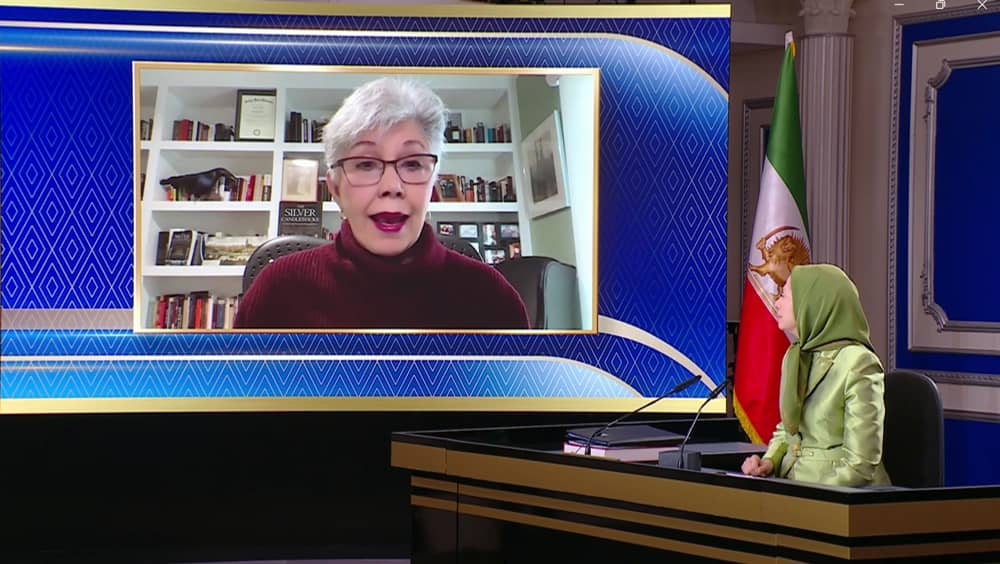
At an online conference held by the National Council of Resistance of Iran (NCRI) on March 15, 2026, former White House Office of Public Liaison Director Linda Chavez said military strikes alone cannot bring democratic change to Iran and urged Western governments to engage with the Iranian Resistance as a credible partner for political transition.
Mrs. Chavez said the war had dealt major blows to Tehran’s military apparatus but had not resolved the central political question of who would replace the ruling system. “Wars, no matter how successfully fought from the air, cannot bring about regime change,” she said.
Chavez argued that Iran’s future should not be handed to another hereditary ruler, whether from the current clerical establishment or the former monarchy. “We are talking about giving the people of Iran the right to choose their own leader,” she said.
Praising NCRI President-elect Mrs. Maryam Rajavi, Chavez said the opposition’s Ten-Point Plan could serve as “a blueprint for a new Iran” and described Mrs. Rajavi as “a bulwark for the protection of women and for asserting the rights of women, and indeed all Iranians.”
She also warned that Iran remained a threat because enriched uranium had not been fully eliminated and said a stable outcome would require political change inside the country. “The only other way that it will happen will be in fact if there is regime change,” she said.
Chavez called on democratic governments “to open up a dialogue” with what she described as Iran’s “true forward-looking leaders.”
The full script of Linda Chavez’s speech follows:

Thank you very much.
It is a pleasure to be here. It was just about two and a half weeks ago that I was last with Madame Rajavi in Paris at a women’s conference that was discussing many of these issues. And I think few of us expected that literally within days of that conference, the war would begin with the bombing in Iran by the US and Israel.
Whatever your views are of this war, one thing is clear: it is very successful in eliminating the air force, eliminating the navy, and in attacking the regime and decapitating that regime. Unfortunately, wars, no matter how successfully fought from the air, cannot bring about regime change. And I know that those of us who have been with the National Council of Resistance for Iran many years know that the goal has never been just about removing the mullahs and replacing them with yet another autocratic regime.
The goal has always been to give the people of Iran the chance to choose their own leadership. And no group of people in Iran have been more affected by this regime of terror that has gone on since 1979 than the women of Iran. And one of the things that we know, those of us who have worked with Madame Rajavi over the years, is that she has been a bulwark for the protection of women and for asserting the rights of women, and indeed all Iranians. And in fact, she has put together a Ten-Point Plan that can in fact be a blueprint for a new Iran.
Unfortunately, that cannot happen as long as anyone associated with the mullahs remains in power, remains in control of the country of Iran. And what we see is that despite the military failures of this regime, the regime itself is still able to mobilize a government. They are still able to appoint a successor to Ayatollah Khamenei, actually only having to substitute a first name since it is a son of the Ayatollah who has been put into place.
"Former White House official Linda Chavez explains how Mrs. @Maryam_Rajavi inspires people both inside and outside #Iran to pursue their dreams of a free and democratic Iran."#FreeIran2024 pic.twitter.com/IqoO6QP6zI
— NCRI-FAC (@iran_policy) June 9, 2024
The other thing that we know, as Americans at least, is that Iran’s threat to not just the region but indeed to the world is exacerbated because they still have enriched uranium. That uranium, despite some hope that it was destroyed in June in the first attack by the US military and by Israel on Iran, clearly did not happen. And in fact, more dangerously, what has happened is that material has been moved around the country. And being able to eliminate that threat can only come about either by massive amount of troops on the ground, and I can tell you that as an American, that would be highly, highly unpopular with the American people. The only other way that it will happen will be in fact if there is regime change.
We know that there are people who claim to have a right to become the leader of Iran, asserted primarily because of birth, because they happen to be the son either of the Ayatollah in one case or of the late Shah in another. But that is not the kind of regime change that we are talking about. We are talking about giving the people of Iran the right to choose their own leader. And the National Council of Resistance has in fact been in place now for decades, has developed leadership, has been a voice for all of the freedoms that we want to see the people of Iran to have.
And what I would call on my own government and the governments of all of those nations of the free world is to open up a dialogue. Only by opening a dialogue, only by sitting down with the true forward-looking leaders of Iran and discussing how to have a transition between a defeat of this country and the establishment of a democratically elected government can we have any hope that we will have a kind of regime change that we can support.
Thank you, Madame Rajavi, for being a stalwart. Thank you all of the people on this call for being supporters of this movement. And may it truly be that we will at some point be able to meet not just on Zoom, not just in Paris or other foreign capitals, but in Tehran.