

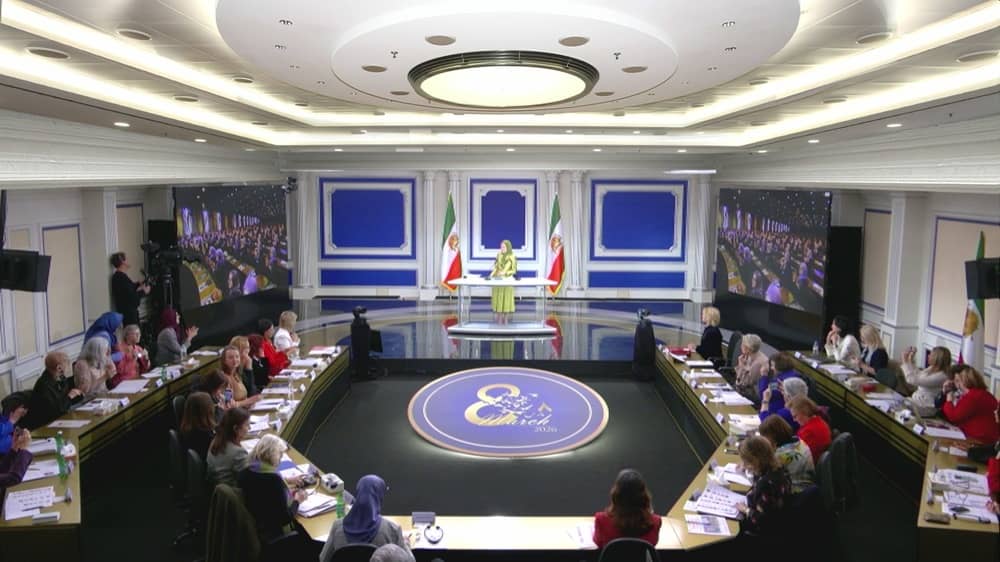
At an international conference on February 21, 2026, held ahead of International Women’s Day, Iranian opposition figures and foreign delegates centered their remarks on women’s leadership as the decisive factor in Iran’s democratic future. Across the speeches, participants praised the organizational depth of the Iranian Resistance, pointed to the NCRI’s Ten-Point Plan as a ready political framework, and highlighted the role of Resistance Units and women-led networks inside Iran. Several speakers also explicitly rejected both clerical rule and a return to monarchy, but the dominant theme of the event was that no democratic transition in Iran is credible without women at the center of political power.
Chair of the Women’s Committee of the National Council of Resistance of Iran (NCRI) Sarvnaz Chitsaz opened the conference by tying International Women’s Day to the bloodshed of the January uprising and to what she described as a long struggle reaching back decades. She said the NCRI had identified 2,411 dead, including women and children, and accused the authorities of trying to bury the scale of the crackdown through internet blackouts. Framing the moment as both mourning and political clarity, she said protesters had delivered a clear verdict on dictatorship in all forms, quoting the slogan, “Death to the oppressor, whether Shah or Supreme Leader.” Ms. Chitsaz then sharpened the conference’s political line, saying Iran’s future “does not lie in a return to a monarchy” and instead lies in “freedom, equality, and a republic based on the will of the people,” before presenting Mrs. Maryam Rajavi’s Ten-Point Plan as a practical democratic path.

Mrs. Maryam Rajavi, President-elect of the National Council of Resistance of Iran, used the keynote to argue that women’s leadership is not a secondary rights issue but the operating condition for democratic change in Iran. She said the NCRI’s alternative was defined by women’s participation in political leadership and by a rights-based program that includes free choice in dress, marriage, work and political life. In one of the speech’s clearest formulations, Mrs. Maryam Rajavi repeated the movement’s rejection of coercion: “No to compulsory hijab, no to compulsory religion, and no to compulsory governance.” She also emphasized organizational readiness, citing the NCRI’s women-majority structure, decades of women in command roles and a movement she described as capable of managing a democratic transition after the regime’s fall. On the monarchy question, Mrs. Maryam Rajavi was explicit, saying Iranians want “neither the crown nor the turban” and arguing that women’s leadership is the “litmus test” separating a democratic alternative from recycled authoritarianism.
In the wake of the regime’s collapse, Iran will need a unifying force; a movement that can bring together all groups and currents within the people’s front, respecting their political stances and aspirations, to march toward a democratic transformation.
One of the most vital… pic.twitter.com/QysoDKNB2s— Maryam Rajavi (@Maryam_Rajavi) February 21, 2026
Former French foreign, defense, justice and interior minister Michèle Alliot-Marie framed the conference as both a Women’s Day gathering and a political declaration of solidarity with Iranians opposing what she called a deeply sexist dictatorship. She praised Mrs. Maryam Rajavi’s consistency over many years and repeatedly linked democracy to women’s participation in power, saying, “There is no democracy without the presence of women in all decision-making bodies.” Alliot-Marie did not dwell on monarchy, but she made clear that any post-clerical system that sidelines women would fail the democratic test. She also tied her support directly to the NCRI program, describing the freedoms outlined by Mrs. Maryam Rajavi – political, religious and social – as the substance of the democratic Iran supporters in Europe should defend. Closing on a broader geopolitical note, she argued that a democratic Iran led with women’s full participation would matter not only for Iranians but for regional stability.
Former U.S. Ambassador to Denmark Carla Sands delivered one of the conference’s most pointed interventions against monarchy-era nostalgia, saying claims that women enjoyed equality under the Shah were “false.” She argued that dictatorship itself forecloses equality, stating, “A dictatorship, by definition, cannot offer gender equality,” and used the Shah’s own recorded remarks in interviews to illustrate what she described as entrenched misogyny under the previous regime. Sands then pivoted from historical critique to the achievements of Iranian women, saying the movement’s women leaders had transformed resistance from a story of victimhood into one of organized political force. She praised Mrs. Maryam Rajavi’s leadership and said Iranian women had moved from being denied agency to shaping history directly. In her closing passages, she linked women’s freedom to regime change “whether crowned or turbaned,” and cast the Ten-Point Plan as the route to a free, secular democratic republic.
International Women's Conference with Maryam Rajavi: Standing with with the Women's Resistance in Iran #IWD2026 #WomenForce4Change pic.twitter.com/yIHqhmypf0
— Firouz Mahvi (@FirouzMahvi) February 21, 2026
Former Prime Minister and former Minister of Justice of Finland Anneli Jäätteenmäki focused on sustained repression, international policy and the need for long-term backing for Iranian civil society. She said protests had continued despite heavy crackdowns and warned that killings and executions reported by rights groups were rising. Jäätteenmäki welcomed moves in Europe targeting the IRGC and cited recent European positions as evidence of a firmer approach.
Returning to the conference’s core theme, she praised Iranian women and other peaceful rights defenders for risking their lives and said they had shown the country was ready for democratic change. She closed by thanking Mrs. Maryam Rajavi for what she called years of “huge work” and pledged continued support for “a free and secure Iran.”
Former Colombian senator and presidential candidate Ingrid Betancourt placed women’s leadership at the center of a broader argument about legitimacy, memory and democratic transition. She said women’s rights in Iran could not be postponed until after political change, warning that “Equality without democracy was merely cosmetic, conditional, fragile, reversible” under the Shah. Betancourt described the current moment as a continuation of a longer struggle against both dictatorship and misogyny, and argued that women’s presence in recent uprisings was transformative, not symbolic. She rejected dynastic succession in blunt terms, saying, “But lineage is not legitimacy,” and insisted that any platform that fails to guarantee women’s rights cannot credibly claim to represent Iran’s future. She contrasted that with the NCRI’s internal structure, praising a movement that “built equality in its structure,” and said women’s leadership under Mrs. Maryam Rajavi was strategically indispensable to a democratic republic.
Ingrid de Betancourt spreekt haar steun uit voor de Iraanse vrouwen die strijden voor een vrij en democratisch Iran olv Maryam Rajavi. 🧵 pic.twitter.com/eMeZMuuyoM
— Dorien Rookmaker (@RookmakerDorien) February 21, 2026
Former President of Ecuador Rosalía Arteaga Serrano gave a short but emphatic speech that reinforced the conference’s women-led democratic framework while also repeating the event’s rejection of dictatorship in both forms. Referring to arguments made earlier in the session, she said the message had to be repeated “very loud and repeatedly: No to the Shah, no to the mullahs.” Arteaga then narrowed her focus to two planks she said were especially urgent in Mrs. Maryam Rajavi’s Ten-Point Plan: the separation of religion and state, and opposition to Iran’s nuclear ambitions. Drawing on her own political experience, she argued that religion and government must not be fused, and she linked that principle directly to the political rights of women in any future Iranian system. She also voiced solidarity with Ashraf 3 and urged continued vigilance in the weeks ahead to protect women’s place – and Mrs. Maryam Rajavi’s place – in Iran’s political future.
Member of Parliament and former Canadian immigration minister Judy Sgro cast the conference as a late-stage moment in a long struggle, telling the audience, “The finish line is close. We can feel it.” Sgro praised women in the NCRI, MEK and PMOI for building a durable leadership core, arguing that the prominence of women and youth in recent protests was the product of decades of organizing rather than a sudden development. She echoed the conference’s anti-dictatorship line, saying Iranians reject all forms of authoritarian rule, including both the Shah and the mullahs, and she backed a democratic, secular republic. Sgro also connected women’s leadership to institutional preparedness, describing Mrs. Maryam Rajavi’s Ten-Point Plan as “a constitution ready to go.” In one of the clearest references to internal organization, she said the role of “Resistance Units” in organizing protests should be recognized as part of the broader democratic struggle, while also urging tougher international action against the IRGC.
Iran’s future does not lie in a return to monarchy.
Nor does it lie in the current religious dictatorship.
Iran’s future lies in freedom, equality, and a republic based on the will of the people.#IWD2026 #WomenForce4Change pic.twitter.com/Swl2kuLAIM— سروناز چيت ساز (@s_chitsaz) February 21, 2026
Member of the Chamber of Deputies of Italy Naike Gruppioni argued that in Iran, misogyny is not a social byproduct but a governing technology, which is why women-led resistance now strikes at the system’s core. Opening with Mrs. Maryam Rajavi’s line, “Women are the force for change,” she said she had come to see women’s leadership as a strategic necessity rather than a symbolic demand. Gruppioni repeatedly stressed that democratic change requires changing the nature of power itself, adding, “Power rooted in equality generates democracy.” She also offered one of the strongest endorsements of the Resistance’s organizational capacity, recounting a visit to Ashraf 3 where she said she saw “not a theoretical abstraction, but a concrete organization,” marked by discipline, competence and long-term vision. For Gruppioni, Ashraf 3 was proof not only of endurance but of a viable democratic alternative grounded in gender equality and rule of law.
Italian Senator Elisa Pirro approached the issue through legal and institutional language, describing clerical rule in Iran as a system in which “gender discrimination is not an anomaly, but a system.” She pointed to exclusion from high office, discrimination in family and inheritance law, and compulsory veiling enforced by arrests and intimidation, then contrasted that architecture of repression with what she called a deep social shift since the 2022 protests. Pirro said women were not just symbols of dissent but “organizers, leaders, and the political engine of the mobilization,” and she argued that later protest waves showed demand for democratic transformation, not reform. She then tied that transformation directly to women’s leadership in the organized opposition, saying the NCRI had played a key role in advancing women in leadership and that Mrs. Maryam Rajavi had made equality a foundational principle. Pirro summarized the Ten-Point Plan as a democratic, secular and non-nuclear roadmap, and said foreign governments’ credibility on women’s rights depended on taking that struggle seriously.
#NWRI-Veranstaltung zum #IWD2026: Aktivistinnen in der iranischen Widerstandsbewegung halten die Fotos der Demonstrantinnen hoch, die während des Januar-Aufstands im #Iran getötet wurden, und gelobten ihnen, den Kampf für den Sturz des frauenfeindlichen Mullah-Regimes… pic.twitter.com/FtwaVIL6bs
— Javad Dabiran (@JavadDabiran) February 21, 2026
Former Director of the White House Office of Public Liaison Linda Chavez said this year’s conference felt different because the central question had shifted from whether change would come to timing and transition. “The only questions are when and how,” she said, arguing that recent protests spread because organized resistance networks inside Iran were prepared to mobilize and bring others into the streets. Chavez warned against both military shortcuts and elite succession schemes, and she dismissed efforts to market the former Shah’s son as a democratic replacement, asking what movement he had built over decades in exile. In contrast, she described the NCRI as an organized political movement rather than a single personality, and told the audience that Mrs. Maryam Rajavi “deserve[s] to lead because [she has] followers,” especially women in active leadership roles. Chavez also defended the Ten-Point Plan as a practical political program, not just a declaration of principles, and pushed back on attempts to caricature the MEK.
Former Vice President of Costa Rica and former Costa Rican ambassador to Spain Ana Helena Chacón Echeverría framed the conference in explicitly international terms, saying the women of Iran were demanding not only dignity at home but a voice heard beyond their borders. She invoked the slogan “Woman, Resistance, Freedom” and called it “more than a slogan,” adding, “This is courage. This is resistance.” Chacón linked women’s rights in Iran to broader democratic security, arguing that the same regime violence used against women is also exported abroad through the IRGC, including to Latin America. She highlighted Costa Rican parliamentary and diplomatic efforts to condemn abuses and welcomed recent European action targeting the IRGC, warning that “International law must not be timid in facing tyranny.” She also pointed to support from thousands of parliamentarians for Mrs. Maryam Rajavi’s Ten-Point Plan and saluted the “Resistance Units” inside Iran, saying international advocacy would continue until Iranians can “breathe the air of freedom.”
✊ Brave young Iranian women testifying with courage about atrocities in Iran #IWD2026 #ForAllWomenAndGirls#WomenForce4Change https://t.co/hMNUabWZcB pic.twitter.com/CrROBiOIiS
— Hanif 𝕏 FreeIran (@HanifFreeIran) February 21, 2026
Former President of the European Bars Federation Dominique Attias cast Iranian women as the central political force in a long historical struggle, saying they are “not spectators of history” but its actors. She argued the post-2022 uprising was not a spontaneous rupture but the product of decades of repression and organized resistance, highlighting the role of women-led Resistance Units and naming slain resistance fighter Zahra Bohlouli. Attias drew a direct line from “Woman, Life, Freedom” to what she called the PMOI’s “Woman, Resistance, Freedom,” describing women not as symbols of suffering but “the motor of change.” She also praised Mrs. Maryam Rajavi as the “legitimate political leader” of the resistance and ended with an explicit political message, urging supporters to keep shouting both “Woman, Resistance, Freedom” and “No to the Shah, no to the Mullahs.”
I am in Paris at a conference in support of women in the Iranian Resistance. The women in a Resistance Unit day “hello,” by riding their motorcycles in the street. Such COURAGE. https://t.co/C2KYPrRNb0
— Donna M. Hughes (@dignitydh) February 21, 2026
Chair of the Spanish Senate Foreign Affairs Committee Pilar Rojo focused on institutional backing from Madrid, detailing a Senate resolution pushed by her group that condemned executions, torture, arbitrary detention, and repression of women and minorities in Iran. Senator Rojo said the text also called for sanctions, international investigations into crimes against humanity including the 1988 massacre, and stronger protection for human rights defenders. She stressed that the resolution explicitly endorsed Mrs. Maryam Rajavi’s Ten-Point Plan and the demand for a “free, democratic, and secular” Iran, and noted support for adding the IRGC to the EU terrorist list. Senator Rojo underscored that the measure passed unanimously in Spain’s polarized political climate, calling that consensus evidence that “when it comes to dignity” there can be no division, and closed with a direct assurance: “Women of Iran, you are not alone.”
Professor Emerita of Gender and Women’s Studies Donna Hughes delivered a synthesis of the day’s earlier panel, saying the morning session had brought together 14 speakers from Europe and North America around one core theme: women’s leadership in achieving freedom in Iran. Prof. Hughes said speakers repeatedly described “gender apartheid,” executions, and violence against women, including cases in which women were punished after defending themselves. She highlighted calls for international accountability and rule of law, and said participants consistently endorsed women’s leadership in the PMOI and NCRI and praised Mrs. Maryam Rajavi’s role in shaping women’s empowerment. Prof. Hughes also flagged a former political prisoner’s appeal for more women to join Resistance Units, quoting her message: “we can and we must,” and noted that NCRI U.K. Representative Dowlat Norouzi had separately warned about what Prof. Hughes described as deception by the Shah’s son through social-media networks and bots.
Chair of the Spanish Senate Equality Committee Rosa Romero described Iranian women as “active protagonists of change,” not passive victims, and tied their struggle directly to a democratic future built on equal rights. Senator Romero said the Spanish Senate’s Equality Committee stood behind the same political framework endorsed by her colleagues, pointing to Mrs. Maryam Rajavi’s Ten-Point Plan as a proposal for a democratic republic with separation of religion and state, full legal equality, and abolition of the death penalty. She emphasized the Spanish Senate’s adoption of the slogan “Women, Resistance, and Liberty,” saying it represented not only protest but a political vision in which women are “subjects of full rights,” not wards of the state. Senator Romero closed by calling gender equality a cross-border obligation and telling Iranian women they had “all our support.”
Zinat Mirhashemi, a member of the National Council of Resistance of Iran and the editor-in-chief of the Nabard-e Khalq publication opened by praising Mrs. Maryam Rajavi for forging what she called a “colorful and powerful solidarity” among women from different countries, then turned to a distinctly Iranian image of resistance: families singing and dancing in mourning to show the regime, as she put it, “You have failed, not us.” Mirhashemi, identifying herself as a veteran of the 1979 anti-monarchy struggle, spoke sharply against royal restoration and referred to the Shah’s son dismissively while arguing that Iranian women had become the decisive force against clerical rule. She said women’s leadership in the latest uprising showed that discrimination was the regime’s central pillar and that an accumulated historical anger had now become irreversible political action. Mirhashemi argued that the women’s movement’s “minimum achievement” was the relative defeat of compulsory hijab, calling that a structural blow to the ruling order, and said the lesson was now global: without women’s freedom, no society can be free.
Eve Borg Bonello, @eveborgbonello Member of the House of Representatives of #Malta
International Women's Conference with Maryam Rajavi: Standing with the Women's Resistance in Iran @RobertaMetsola @EP_President @DavidCasaMEP #WomenForce4Change #FreeIran pic.twitter.com/U1eHTMxc57— Firouz Mahvi (@FirouzMahvi) February 21, 2026
Former Portuguese Minister of National Defense Helena Carreiras placed the Iranian uprising in the context of Portugal’s own post-authoritarian transition, arguing that Iran’s women now play a similarly decisive role in pushing democratic change across generations. Carreiras said this year’s uprising was not an isolated outburst but the result of “over four decades of organized resistance,” nationwide coordination, and the expanding role of Resistance Units, many of them led or staffed by women. She also drew one of the clearest anti-dynastic lines of the event, saying “democracy does not rhyme with dynasty” and insisting Iran needed leaders legitimate through democratic choice. Carreiras praised Mrs. Maryam Rajavi’s leadership in training a generation of women leaders and cited the Ten-Point Plan’s program of secular government, gender equality, abolition of the death penalty, and a non-nuclear republic as a credible democratic framework.
Member of the Irish Senate Fiona O’Loughlin mixed personal reflection with political endorsement, recalling how women in her childhood home were expected to serve rather than speak before thanking male staff at the conference in a deliberate reversal. Senator O’Loughlin said her earlier work with the NCRI Women’s Committee in Strasbourg had convinced her of the organization’s international importance, and she described the January events in Iran as a moment that compelled her to act “as a politician, as an activist, as a woman.” She said she had backed Mrs. Maryam Rajavi’s Ten-Point Plan in European parliamentary settings and called Mrs. Maryam Rajavi “a beacon of hope” at a time of heavy sacrifice. Ending on solidarity, Senator O’Loughlin said she heard not victimhood but “hope, courage, strength, dignity, determination” in the room, and echoed one of the conference’s sharpest refrains: “We can and we must, no to the Shah, no to the Mullahs.”
Linda Chavez Former Director of the White House office of Public Liaison understands the Iranian Regime is on the brink of collapse. pic.twitter.com/USZVEHKD44
— Dorien Rookmaker (@RookmakerDorien) February 21, 2026
Dr. Azadeh Akhbari, a historian and consultant, gave one of the most personal accounts of the conference, introducing herself by noting that her name means “free” and that she was born just after the 1979 revolution, when many Iranians believed freedom had arrived after the Shah. Instead, she said, she was imprisoned at age two with her family and later lost eight relatives, including women executed or sentenced to death for ties to the PMOI. Dr. Akhbari described her family story as “a century of oppression, first by monarchy and then by the religious dictatorship,” and used it to argue against both restoration and clerical rule. She praised Europe’s move on the terrorist designation of the IRGC but urged stronger action, including ending appeasement and shutting embassies she called spy hubs. She then pointed to Ashraf 3 and the Resistance Units as the movement’s “engine,” and described Mrs. Maryam Rajavi’s Ten-Point Plan as the blueprint for a democratic, secular, pluralist Iran.
Former U.K. Shadow Minister Helen Goodman said the January crackdown made clear, even to outside observers, that the Iranian regime lacks public legitimacy and survives through force, citing internet shutdowns and reports of shootings at hospitals, homes, and even cemeteries. Goodman argued Western coverage often narrows the Iran file to nuclear and regional security issues, while Iranians are demanding something broader: regime change and an end to the possible return of Pahlavi autocracy as well as clerical rule. Recalling women she met after the 1979 revolution, she said Iran “does not need to go backwards; it needs to go forwards.” Goodman praised the “heroic involvement” of women in the Iranian Resistance and said women must hold an equal place in a future democratic Iran, adding that Mrs. Maryam Rajavi’s Ten-Point Plan “is the way forward.” She also pledged to press in Britain for formal IRGC terrorist designation.
#IWD2026 Conference – Women’s Leadership, an Imperative for a free Iran, a Democratic Republic
.@naike_gruppioni, Member of the Chamber of Deputies of Italy#WomenForce4Change#ForAllWomenAndGirlshttps://t.co/w2yDwj4Pz0… pic.twitter.com/uLtfQBQzqd
— Women's Committee NCRI (@womenncri) February 21, 2026
Dutch senator Elly van Wijk centered her remarks on femicide, saying the same pattern of violence against women runs from Western Europe to Iran and should never be treated as incidental. Senator Van Wijk said she spoke “on behalf of the women whose voices were taken” and argued women are attacked not because they are weak but because of “their strength, their freedom, their power.” She then tied that lens to Iran’s uprising, emphasizing that women of all ages and backgrounds stood at the front lines in January, and that those women “have faces” and names that must not be forgotten. Echoing Mrs. Maryam Rajavi’s line that the question is not whether the regime will fall but when, Senator van Wijk said dictatorships appear invincible until they collapse. She closed by saying Western women must use the “space” they have to speak, organize, and ensure the silenced are heard.
Maltese MP Eve Borg Bonello used a vivid generational frame, asking listeners to imagine a young girl in Tehran already marked by the statistics of repression, then insisting that child still possesses the same “inherent dignity” and rights as anyone else. Borg Bonello said the Iranian uprising had moved beyond demands for reform and become “an existential struggle between theocratic tyranny and basic human dignity,” with families forced to identify loved ones from rows of bodies. She argued the regime’s blackouts proved fear rather than strength, saying governments that jail journalists and kill protesters are “terrified of light.” In a line aimed at both authoritarian camps, she said Iranians “do not need saving from one dictator by another”; they need self-determination. Borg Bonello stressed that the movement is organized and knows what it wants — democracy, rule of law, equality, and separation of religion and state — and urged foreign governments to recognize legitimate representatives and isolate the regime.
#IWD2026 Conference – Women’s Leadership, an Imperative for a free Iran, a Democratic Republic
.@PilarRojoN, Chair of the Senate Foreign Affairs Committee of Spain: "I am very happy to be here with you. In the recent years, at the Spanish Senate, we have followed and supported… pic.twitter.com/vd7CoeTPOO
— Women's Committee NCRI (@womenncri) February 21, 2026
Former Member of the European Parliament Dorien Rookmaker told the conference she had initially approached the NCRI skeptically after hearing familiar allegations that it was extremist or cult-like but said her own “risk manager” review led her to the opposite conclusion. Rookmaker said she questioned both NCRI supporters and regime-linked figures and found the latter “incongruent,” adding that some pro-Shah voices also struck her as “empty” and motivated by money rather than principle. She described the current moment as one in which “fear has shifted sides,” with the regime now afraid of the Iranian people and the organized opposition, and said the intensity of repression now signals weakness, not strength. Rookmaker also argued that women’s leadership under Mrs. Maryam Rajavi had changed “the nature of leadership” itself — from authority to equality — and urged Europeans to support, while not dictate, Iran’s democratic future.
Former UN Assistant Secretary-General and Special Adviser to the UN Secretary-General on the Responsibility to Protect Karen Smith brought a legal and multilateral framework to the conference, warning that the recent crackdown fits a decades-long pattern of systematic state violence rather than an isolated episode. Citing the U.N. fact-finding mission, Smith said women activists have been specifically targeted through detention, torture, and executions that may amount to crimes against humanity. She linked support for Iranian women not only to gender equality but to the 2005 World Summit commitment by all U.N. member states to prevent atrocity crimes, including beyond their own borders. Smith argued that obligation now requires keeping Iran on the agenda of both the Human Rights Council and the Security Council, broadening investigations to possible atrocity crimes, and centering human rights in all engagement with Tehran, including nuclear diplomacy. She concluded that any stable future Iran must rest on rule of law and women’s full participation in political leadership.
Deze vrouwen vertegenwoordigen Iraanse vrouwen in Europa. Ze komen uit heel Europa. Allemaal hebben ze ingrijpende dingen meegemaakt, verhalen te vertellen. Vrijheid is geen gift en ze laten niemand meer hun revolutie stelen. # #NoShahNoMullah ! pic.twitter.com/B7w99DOMaP
— Dorien Rookmaker (@RookmakerDorien) February 21, 2026
Representative of the Women’s Association for Democracy in Iran Vida Niktalean offered a long-view account of exile, organization, and women’s political training, tracing her path from forced departure from Iran to activism in Germany after classmates were arrested for selling the Mojahed newspaper and relatives were executed. Niktalean said she joined a support network for the Iranian Resistance in Germany not “to forget, but to continue,” working on women’s rights campaigns, demonstrations, and political outreach. She credited Mrs. Maryam Rajavi with building a generation of women who learned to lead, make decisions, and define success collectively rather than individually, calling that model a strategic answer to dictatorship. In language closely aligned with the conference’s central theme, she said women’s visible role in international advocacy is the product of years of intentional empowerment, not symbolism. Niktalean closed with a blunt rejection of both authoritarian poles — “without the Shah and without the Sheikh” — and said women will be the architects of a free Iran.
Former Italian MP Elisabetta Zamparutti argued that the conference’s women-led movement offers not only resistance to the current regime but a democratic way to block any restoration project, warning against what she called the “anti-democratic conformism” of those who think Iran can move from “the mullahs’ turban” back to “the Shah’s crown.” She sharpened that point by naming Reza Pahlavi directly, saying he “represents the darkness of the past,” and citing a June 2023 press conference in Paris in which, she said, he claimed direct contact with the IRGC and described its members as “brave men” — remarks she presented as evidence that restoration politics could blur, rather than break with, Iran’s repressive apparatus. Zamparutti said supporters should treat pro-monarchy disinformation seriously, alleging fake videos are being circulated to manufacture support for the Shah and that Basiji-linked actors have used pro-Shah chants during protests to sow confusion inside protests and abroad. In contrast, she praised Mrs. Maryam Rajavi’s Ten-Point Plan as a coherent, non-violent political method consistent with the rights the movement demands. Zamparutti also highlighted weekly hunger strikes by prisoners in dozens of Iranian prisons under the slogan “Stop the death penalty, stop the repression, stop the oppression,” saying she joins them in solidarity and urging governments to treat Mrs. Maryam Rajavi as a legitimate political interlocutor.