

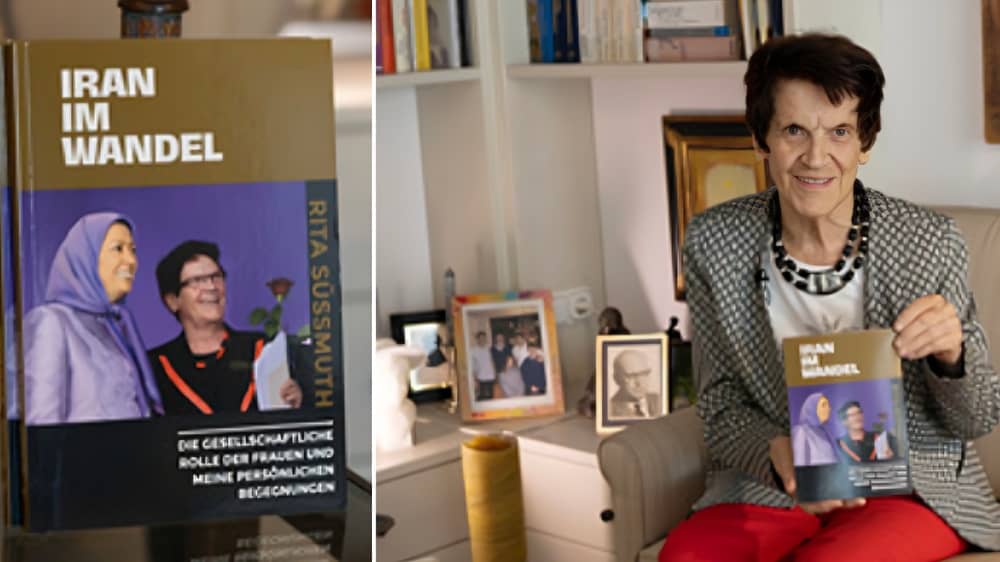
When a woman who has stood at the very peak of political leadership in Europe turns her attention to the struggle for freedom in Iran, the world should listen. Professor Rita Süssmuth, who served for a decade as President of the German Bundestag, has dedicated her new book Iran on the Brink of Transformation: The Social Role of Women and My Personal Experiences to telling a story that is both profoundly personal and globally significant.
Born in 1937, Rita Süssmuth is a pioneer in German politics and society. For ten years, she presided over the Bundestag—the first woman to hold such a high office in the Federal Republic. Before that, she served as Minister for Youth, Family and Health. An accomplished academic in philosophy, sociology, and history, she has combined intellectual rigor with political leadership throughout her life. But as she writes in her book, nothing shaped her political and moral compass more deeply than her encounter with Iran’s democratic opposition.
“Had someone told me that my life would one day be bound so closely to the Iranian Resistance, I would have doubted it. And yet this unexpected path became one of the defining journeys of my life.”
Rita Süssmuth Introduces New Book, Iran im Wandel, on Women’s Role in Iranian Resistance
Former Bundestag President Rita Süssmuth speaks during the presentation of her new book, Iran im Wandel, (#Iran in Transition), published on August 13, 2025. In the book, she reflects on her… pic.twitter.com/RVii2Vthau— Javad Dabiran (@JavadDabiran) August 16, 2025
The Moment That Changed Everything
In one of the book’s most moving passages, Süssmuth recounts the day in 2008 that altered the course of her life: “I was stepping out of the car in front of my office at Unter den Linden 71 in Berlin when a young woman wearing a headscarf approached me with determined steps. In perfect German, she asked me to sign a petition against executions in Iran. I do not know why, but in that moment, I stopped. Her words were logical and well-founded, but it was her conviction, her inner strength, and her unshakable faith in a better future that touched me most deeply. I signed. She smiled, grateful for that small success, but as she walked away, questions began to form in my mind: Why did these people have to stand outside Parliament to collect signatures? Why were their voices not heard inside the halls of power?”
That moment, she writes, was a turning point. From it flowed years of deeper involvement, solidarity, and eventually, friendship with the Iranian Resistance.
Former German Parliament Speaker Prof .Dr. Rita Süssmuth: I support the Sep 6 #BrusselsFreeIranRally for a free Iran & @Maryam_Rajavi's Third Option — no war, no appeasement — regime change by the people & their organized resistance. pic.twitter.com/zp35SjlRyz
— NCRI-FAC (@iran_policy) September 5, 2025
Women at the Center of a Democratic Revolution
Throughout her book, Süssmuth returns to one theme with passion: the centrality of women in Iran’s struggle for freedom. She describes meeting three generations of women—students, mothers, leaders—each with a different story but united in one goal: freedom for Iran.
“With these women I saw something extraordinary: their vision of freedom was inseparable from women’s freedom. In their stories of prison, torture, and exile, I saw not despair but extraordinary courage. Their resistance was not only political—it was a profound inner revolution.”
She writes with admiration of the five women she met in Ashraf-3, the MEK’s community in Albania, who had survived years of imprisonment and emerged as symbols of endurance.
“Their voices must be heard. Their stories are not just personal accounts; they are inscribed into the very history of Iran’s struggle for freedom.”
I extend my heartfelt congratulations to Professor Dr. Rita Süssmuth, Former President of the German Bundestag, on receiving the 2025 German-Polish Special Award.
For people around the world, she is a symbol of unwavering commitment to the universal values of #HumanRights and… pic.twitter.com/1ujYFRrSw9— Maryam Rajavi (@Maryam_Rajavi) February 17, 2025
Encounter with Maryam Rajavi
No figure impressed her more than Maryam Rajavi, the President-elect of the NCRI.
“Maryam Rajavi is far more than a symbol. She embodies a profound unity of seemingly opposing qualities: resilience and compassion, determination and vision. I have met many presidents, ministers, and political leaders in my career. Yet there are only a few—like Nelson Mandela or Maryam Rajavi—who transcend politics itself. They are not merely representatives of a party; they carry the deep aspirations of a nation.”
Süssmuth notes that Rajavi leads not only a political movement but also a “revolution within the revolution,” where women play the leading role in dismantling dictatorship and building democracy.
Maryam Rajavi meets in Auvers-sur-Oise with a delegation of German politicians headed by Prof. Dr. Rita Süssmuth, fmr Speaker of the German Bundestag. Mr. Martin Patzelt, Federal MP until 2021, and Stefanie Bung, CDU Vice-Chair in the Berlin Parliament, accompanied her. #Iran pic.twitter.com/kaSnD4K61k
— Maryam Rajavi (@Maryam_Rajavi) January 18, 2022
Standing Beside the Resistance
The book recounts Süssmuth’s battles to support the Resistance: her role in advocating for the delisting of the MEK from unjust terrorist blacklists, her efforts to protect the residents of Camp Ashraf in Iraq, and her visits to Ashraf-3 in Albania. She faced political pressure and hostility at home, yet she never wavered.
“Among all the confrontations I have faced, supporting the Iranian Resistance was one of the most challenging and yet the most inspiring. Why? Because it was not only a political cause. It was a struggle for life itself—for freedom, for human rights, for survival.”
What began as curiosity grew into conviction, and finally into solidarity rooted in personal bonds.
“In the Resistance, I was not only a politician or a scholar, but at times a student, at times a fighter—and always a human being who cannot remain silent in the face of injustice.”
What makes this book particularly moving is its balance between realism and hope. Süssmuth does not shy away from recounting the regime’s darkest crimes, such as the 1988 massacre of political prisoners. Yet she insists that through the Resistance—especially through its women—she has witnessed a vision of Iran’s future that is brighter, freer, and more humane.
“In Maryam Rajavi and the Resistance, I found not only a political leader but also a sister in spirit, bound by shared values and the struggle for human dignity.”
Rita Süssmuth believes in #IranFreedom! What about you? #Iran_Maryam pic.twitter.com/O2fpolf11g
— NCRI-FAC (@iran_policy) June 17, 2015
A Call for Global Solidarity
The book ends with a call that resonates far beyond Iran. Süssmuth insists that the Resistance in Iran is not an isolated fight but part of a global movement for human dignity. Quoting Martin Luther King, she concludes: “Here, a new history is being written that must be heard. A brighter future for Iran, the region, and the world is taking shape. This is no longer a distant dream but a growing reality. And it assures me that we are standing on the right side of hope.”
Why This Book Matters Today
Iran on the Brink of Transformation is not merely the testimony of a former parliament president; it is the moral voice of a woman who has chosen to stand where it matters most—beside those fighting for freedom. It is both a historical document and a human invitation: to recognize the courage of Iranian women, to grasp the urgency of democratic change, and to join in a struggle whose outcome will resonate far beyond Iran’s borders.
For readers seeking inspiration, for advocates of human rights, and for anyone who believes in the power of women to shape history, this book is not just recommended—it is essential.