

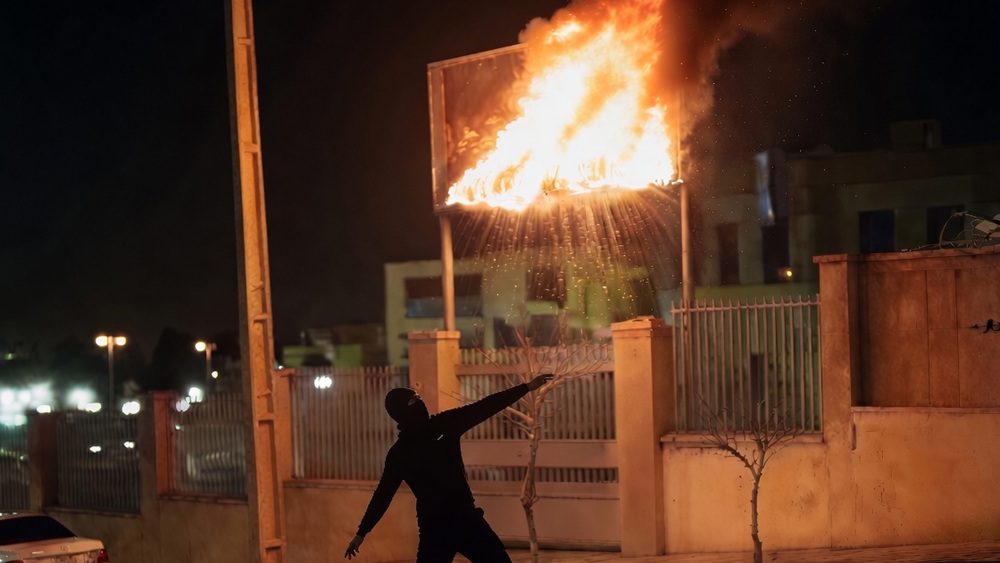
Resistance Units, members of the internal network of the People’s Mojahedin Organization of Iran (PMOI/MEK) carried out widespread activities inside Iran throughout the week of May 3–10, 2026. These included the formation and expansion of National Liberation Army (NLA) units, public displays of support for the provisional democratic government based on Maryam Rajavi’s Ten-Point Plan, commemorations of PMOI martyrs, the 119th week of the “No to Execution Tuesdays” campaign, and a major wave of 20 targeted operations in 15 cities on May 7.
All actions were explicitly in response to the regime’s recent executions of protesters from the December 2025–January 2026 uprising, including Sasan Azadvar (Isfahan, April 30), and Mehdi Rasouli, Mohammadreza Miri, and Ebrahim Dowlatabadi (Mashhad, announced May 4). Activities emphasized armed resistance, rejection of both monarchical and theocratic rule, and commitment to a democratic republic.
May 7, 2026
PMOI Resistance Units conducted 20 coordinated operations in 15 cities in direct retaliation for the executions.
- Mashhad: Fire set at IRGC headquarters, and to an IRGC Basij base; fire set to the entrance of an IRGC base; multiple fires set to propaganda posters of Ali Khamenei.
- Chabahar: Fire set at a Basij base (with a Resistance Unit member chanting support for the National Liberation Army and Maryam Rajavi while targeting the site).
On April 30, Iran's regime executed 21-year-old karate champion Sasan Azadvar, arrested during the January uprising, to prevent future protests. In response Resistance Units targeted the regime's centers of repression, proving that the flame of resistance can't be extinguished. pic.twitter.com/XQmGiCTndB
— People's Mojahedin Organization of Iran (PMOI/MEK) (@Mojahedineng) May 8, 2026
- Karaj: Fire set to the General Directorate of Culture and Islamic Guidance (a state censorship center) using Molotov cocktails; targeting of a regime center used for promoting terrorism and fundamentalism.
- Isfahan: Fire set to a propaganda poster of Mojtaba Khamenei.
- Dehdasht: Fire set to propaganda posters of Ali Khamenei and Mojtaba Khamenei.
- Zahedan: Fire set to the signpost of an IRGC Basij base; fire set to a student Basij base.
- Kazerun: Fire set to a large propaganda poster of Ali Khamenei.
- Ahvaz: Fire set at the student Basij base, and to the entrance of an IRGC Basij base.
- Dezful: Fire set at a suppressive center operating under the guise of a seminary.
- Kermanshah: Fire set to an IRGC Basij base and its entrance.
- Buin Zahra: Fire set to an IRGC Basij base.
- Hamedan: Fire set to an IRGC Basij base and its signpost.
- Kerman: Fire set to a regime propaganda poster of Ali Khamenei.
- Hafshejan: Fire set to a regime propaganda banner.
- Charam: Fire set to a billboard promoting the IRGC’s espionage apparatus against citizens.
PMOI Resistance Units in Zahedan prove the regime’s executions have backfired https://t.co/XBHXJaIfCR
— People's Mojahedin Organization of Iran (PMOI/MEK) (@Mojahedineng) May 9, 2026
May 6, 2026
Rebellious youth carried out coordinated activities across multiple cities in support of the provisional government of the Democratic Republic of Iran based on Maryam Rajavi’s Ten-Point Plan, while honoring executed PMOI members and uprising protesters and condemning the regime’s repression.
- Bushehr: Placards declaring support for the provisional government and supporting Mrs. Rajavi.
- Ahvaz: Placards declaring support for the provisional government; slogans of “Death to the oppressor, whether shah or leader” and supporting Mrs. Rajavi.
- Qaen: Placards stating “Democracy and freedom with Maryam Rajavi — the Democratic Republic is the only way to save Iran.”
- Zahedan: Graffiti reading “Death to Khamenei” and “Death to Khamenei the murderer.”
- Iranshahr: Placards reading “We swear on the blood of our comrades that we will stand till the end” and explicit condemnation of the execution of rebellious youth Erfan Kiani.
- Karaj: Placards reading “We swear on the blood of our comrades that we will stand till the end” and rejection of both monarchy and religious dictatorship (“No to monarchy, no to religious dictatorship — neither Mojtaba nor Pahlavi — yes to democracy and equality”).
- Mashhad: Placards saluting “steadfast PMOI and the proud examples of sincerity and sacrifice.”
Mashhad
PMOI Resistance Units set fire propaganda poster featuring eliminated regime supreme leader Ali Khamenei pic.twitter.com/oKTl86LStG— People's Mojahedin Organization of Iran (PMOI/MEK) (@Mojahedineng) May 10, 2026
May 5, 2026
Resistance Units conducted activities nationwide for the 119th week of the “No to Execution Tuesdays” campaign, displaying solidarity with resistant PMOI prisoners and emphasizing the torch of struggle against the execution machine.
May 4, 2026
NLA (Army of Freedom) units expanded and carried out public activities in cities across the country, promoting armed resistance by workers and the Iranian people as the only path to freedom.
- Isfahan: Placards held with slogans including “Spring of freedom with the Army of Freedom,” “The Army of Freedom is returning — spring,” supporting Mrs. Rajavi, and “No to Shah, no to mullahs.”
- Kermanshah: Placards held with slogans including “Salute to Rajavi, long live the National Liberation Army of Iran,” and “No to Shah, no to mullahs.”
- Damavand: Activity by Resistance Units with slogans “Long live the National Liberation Army” and “Death to Khamenei, long live Rajavi.”
- Dezful: Placards held with slogans “The only path to liberation is the PMOI path — long live the National Liberation Army” and “Long live Rajavi.”
- Qaen: Placards held with slogans “Long live the National Liberation Army” and “Death to the oppressor, whether the Shah or the leader.”
- Karaj: Placards held with slogans “The end of mullah rule will come with the National Liberation Army” and “No monarchy, no leadership, no Mojtaba, no Pahlavi — democracy and equality.”
- Bushehr: Placards held with slogans “Death to the oppressor, whether the Shah or the leader” and “Salute to Rajavi.”
- Sari: Placards held with slogans “Death to the oppressor, whether the Shah or the leader.”
- Chabahar: Placards held with slogans “Death to the oppressor, whether the Shah or the leader.”
May 7—Iran
The regime executed Mehdi Rasouli, Mohammadreza Miri, and Ebrahim Dowlatabadi, three protesters arrested during the December-January uprising. In response, PMOI/MEK Resistance Units carried out daring operations, targeting the regime's centers and symbols of… https://t.co/PxM9k5lXrV pic.twitter.com/swANINrEMV— People's Mojahedin Organization of Iran (PMOI/MEK) (@Mojahedineng) May 10, 2026
May 3–4, 2026
PMOI Resistance Units honored the martyrs of May 2, 1982 (when regime forces attacked PMOI bases and killed dozens, including Commander Mohammad Zabeti) through public displays and messages across the country.
- Iranshahr: “The martyrs of May 2 were the PMOI’s great and blood-sacrificed offering to freedom.”
- Tehran (multiple sites): Messages declaring the martyrs as “standard-bearers of sacrifice and sincerity,” “forgers of a shining legacy of heroic struggle,” and “enduring, unforgettable heroes of Iran.”
- Rasht: “Salute to Commander Mohammad Zabeti and dozens of PMOI fighters who fought to their last bullet.”
- Arak: Images of the May 2 martyrs.
- Shiraz: “Salute to Commander Mohammad Zabeti and dozens of PMOI fighters who fought to their last bullet.”
- Sanandaj: Images of PMOI martyrs.
- Kerman: “The martyrs of May 2 stand as enduring, unforgettable heroes of Iran. Salute to the martyrs of May 2, 1982, and Commander Mohammad Zabeti.”
- Kamyaran: “At the head of the martyrs of May 2 stood one of our most prominent heroes, Mohammad Zabeti.”
- Bandar Abbas: “The martyrs of May 2 stand as enduring, unforgettable heroes of Iran.”
- Khorramabad: “The martyrs of May 2, 1982, are flagbearers of self-sacrifice and honesty.”
- Yasuj: “The martyrs of May 2 were the PMOI’s great sacrifice for freedom.”
- Mashhad: “The heroic saga of PMOI member Mohammad Zabeti and his comrades broke the grip of fear and surrender to the mullahs’ regime.”
These actions demonstrate a sustained, nationwide campaign by PMOI Resistance Units, directly linking internal defiance to the overthrow of the regime and the establishment of a democratic republic. The operations and public activities continued despite intensified repression, underscoring the growing reach of organized resistance inside Iran.