

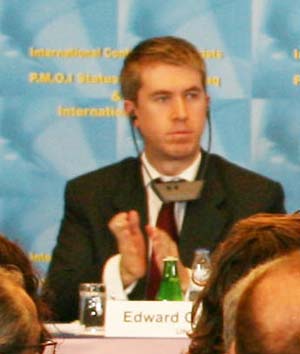
 NCRI – On October 25, Mrs. Maryam Rajavi addressed a meeting in Brussels by international jurists and lawyers in defense of People’s Mojahedin’s rights in Iraq. Edward Grieves, of the Bar Human Rights Committee from Great Britain gave the following speech :
It is clear that the PMOI personnel in Ashraf find themselves increasingly in an unacceptably precarious and vulnerable legal position; evidence not least by the worrying intelligence suggesting that the Iraqi authorities are considering expelling the PMOI personnel from Iraq. It is also clear that the Iraqi authorities have been emboldened to follow this course of action because the PMOI have been categorized in Europe as an organization which is concerned with terrorism.
Such a potent terrorist label makes it easier for the Iraqi government to assert that PMOI personnel are not deserving of the protections under the Iraqi Constitution and customary international law.
Therefore, the position the PMOI personnel find themselves in today is in part on account of the signal being sent by European states on how those states view the PMOI. But, when the European states exported their own view of the PMOI for the world at large they did not in tandem export any of the protections for the PMOI personnel which would be afforded for those claiming political asylum inside the European states.
In fact, if any of the PMOI members were instead of being in Iraq situated in a European state then there would be a straightforward process of application for asylum and humanitarian protection. In the United Kingdom, for example, PMOI members, in order to prevent being returned to Iran, would have to show that they fear torture or fear ill-treatment in Iran in order to secure the absolute protection of Article 3 of the European Convention on Human Rights, a hurdle they could very easily cross, one would imagine, particularly in the light of the events of this year in Iran.
In order to cross the first hurdle to secure protection under the 1951 Refugee Convention, which the United Kingdom is a signatory to, they would have to show a well-founded fear of persecution in Iran on the basis of their political opinion – again, not a very difficult line to cross, one would think.
There would be legitimate arguments that could be forwarded in the courts of the United Kingdom that PMOI members should receive full refugee protection notwithstanding the United Kingdom government proscription of the PMOI as a terrorist organization and the reason for this is simple:
The judiciary of the United Kingdom has long recognized the difference between those who carry out indiscriminate violence with no legitimate aim and those who find themselves compelled to act against repressive regimes. This judicial line of authority provides an informed, sober, and nuanced approach to acts sometimes mischaracterized as terrorism.
For example, in 1996, the House of Lords in the United Kingdom were faced with defining what was meant by a political crime in terms of the 1951 Refugee Convention. They were faced with this question because an individual who commits a political crime will not necessarily be excluded from the protection of the 1951 Refugee Convention as a terrorist.
The judges in that case, therefore, sought to define the difference between permissible and non-permissible acts in the context of a power struggle in the third country. The definition alighted upon was derived from a discussion on the nature of a terrorist act and therefore provides useful guidance on what does not constitute a classical terrorist act.
Their lordships suggested the following test: A crime is a political crime and therefore essentially not a classical terrorist one if:
– Number one – the crime is committed for a political purpose. That is to say, with the object of overthrowing or subverting or changing the government of a state or inducing it to change its policy, and,
– Two – There is a sufficiently close and direct link between the crime and the alleged political purpose. In determining whether such a link exists, the court will bear in mind the means used to achieve the political end and will have particular regard to whether the crime was aimed at a military or governmental target on the one hand or a civilian target on the other; and in either event, whether it was likely to involve the indiscriminate killing or injuring of members of the public.
It is interesting to note that when the Secretary of State for the Home Office in the United Kingdom proscribed the PMOI, he described it as an “Iranian dissident organization based in Iraq which claims to be seeking the establishment of a democratic socialist Islamic republic in Iran.”
The Secretary of State went on to say that the organization undertakes cross-border attacks into Iran which includes attacks against government buildings in Tehran and elsewhere. And he also stated that the organization has not attacked the United Kingdom or Western interest.
It is therefore at least arguable that in the past – because the PMOI no longer conducts any activities in Iraq – that these acts possibly could be defined as political acts and would not justify exclusion of PMOI members on that basis from the protection of the refugee convention.
However, the United Kingdom’s statutory definition of terrorism does not take into account any acts which may be on account of power struggles and ignores the contextual circumstances; hence, the terrorist label.
The issue of context was crucial in another United Kingdom case where the president of the United Kingdom’s appeals tribunal in 2002 stated the following: “Judges have not always taken a contextual approach. We think it is useful to consider cases along a continuum. On the one end of the continuum, let us postulate an organization that has very significant support among the population and has developed political aims and objectives covering political, social, economic, and cultural issues. Its long-term aims embrace a parliamentary, democratic mode of government and safeguarding of basic human rights, but it has in a limited way or for a limited period created an armed-struggle wing in response to atrocities committed by a dictatorial government. In such a case, a judge should be extremely slow to conclude that an appellant’s mere membership of such an organization raises any real issues of exclusion under the refugee convention.”
Hence, while the United Kingdom government does not see fit to grapple with such subtleties in its own statutory definitions of terrorism, the judiciary of the UK has seen fit to do so in this area of law. Therefore, individuals caught by the domestic legislation in the UK can expect to receive some sort of protection from unlawful interference by the United Kingdom government from an independent and robust judiciary and a set of procedural safeguards and avenues of appeal.
Unfortunately, this legal environment of the United Kingdom is not available for the PMOI members in Iraq. The PMOI personnel, therefore, unfairly suffer the consequences of the international terrorist tag but receive none of the protections normally afforded by the states that make that very accusation.
The proscription of the PMOI as a terrorist organization by Europe sends a signal to the world, including the government in Iraq, that the individual members are not worthy of protection. This, however, is simply incorrect on any reading of the preemptory norms of international law and the models enshrined within the European community.
Proscription has made the PMOI personnel politically vulnerable to the unlawful expulsion from Iraq and the harassment they now suffer as their water food and supplies are interrupted.
In light of this, it is only to be hoped that the international community discharges its moral and legal obligation to restore the balance of protection and ensure that the government of Iraq continues to respect the protected status already conferred upon the PMOI and prevent the grave consequences that refoulement to Iran would obviously entail. Thank you.