

THIS PAGE WILL BE UPDATED WITH THE LATEST NEWS
UPDATE: 05:00 PM CET
Man Who Decapitated Wife and Paraded Her Head Through Streets ‘Pardoned’ By Parents

An Iranian man who beheaded his wife and paraded her severed head through the streets has been sentenced to eight years in prison. He avoided a harsher penalty after her parents reportedly decided not to invoke Iran’s Islamic law of retribution. According to court proceedings, Mona Heydari, a mother of one, was only 17 when she was pulled from a vehicle outside her family home and killed in February 2022.
Her husband, Sajjad Heydari, along with his brother Heydar, committed the brutal murder in Ahvaz, the capital of the southwestern Khuzestan Province.
A judiciary spokesperson confirmed that the lenient sentence was given because Mona’s parents had “pardoned” him for the killing instead of demanding retribution.
UPDATE: 12:30 PM CET
‘Iran Execution Machine’ In Overdrive: Opposition Group Claims 353 Hanged in a Month

Iran’s opposition coalition, the National Council of Resistance of Iran (NCRI), on Saturday alleged that at least 353 prisoners were executed across the country during the Iranian month of Bahman (January 21–February 19), describing it as an unprecedented surge under Supreme Leader Ali Khamenei.
In a statement issued on February 21, the NCRI claimed that the total number of executions carried out over the past 11 months has reached at least 2,587, a figure it termed the highest since 1988. The coalition said the rise reflects what it called the regime’s increasing reliance on capital punishment.
According to the NCRI statement, executions during Bahman were reported in 31 provinces and 65 cities. Razavi Khorasan province topped the list with 42 executions, followed by Lorestan (26), Khuzestan (22), Isfahan (20), Fars and Kerman (17 each), and Mazandaran (16).
Iran Unrest Escalates as Gunfire, Tear Gas Hit Universities Amid Looming US Strike

Tensions flared Sunday across Iran as anti-government protests reignited at major universities and in the streets of Tehran, with reports of tear gas and shots fired in the capital.
Students gathered in Tehran and the northeastern city of Mashhad to mark 40-day memorials for those killed during January’s nationwide anti-government demonstrations before violence broke out.
Ali Safavi, a member of Iran’s Parliament-in-Exile, the National Council of Resistance of Iran (NCRI), told Fox News Digital anti-government protests at the University of Tehran featured chants such as, “This is the year of blood,” and noted that Iran’s Revolutionary Guard Corps (IRGC) shot at protesters at another location in the city.
“At Khajeh Nasir University in Tehran, students trampled on Khamenei’s picture, while similar acts took place at Ferdowsi and Sajjad universities,” Safavi said.
UPDATE: 08:00 AM CET
Iranian Students Rise in Multiple Cities, Commemorating Uprising Martyrs and Defying Regime Forces
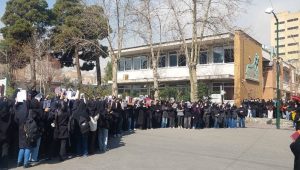
On February 22, 2026, a massive wave of anti-regime protests swept through Iranian universities for the second consecutive day. Across the country’s most prominent academic institutions, students boycotted classes and took to the campuses, chanting slogans that categorically rejected all forms of dictatorship. The demonstrations spanned major universities in the capital, including Tehran University, Amir Kabir, Khajeh Nasir, Iran University of Science and Technology, Sharif, Beheshti, and the Art University, as well as Ferdowsi and Sajjad universities in the northeastern city of Mashhad.
At Tehran University, the country’s oldest and largest academic institution, the core message of the protests was unmistakable. Massive crowds of students chanted, “Death to the oppressor, be it the Shah or the Leader,” and “Neither monarchy, nor mullahs’ rule; yes to democracy and equality.”
New Criminal Case Opened Against Political Prisoner Forough Taghipour in Evin Prison

Forough Taghipour, a political prisoner held in the women’s ward of Evin Prison, is facing a newly opened judicial case and the imposition of severe communication restrictions. The measures come amid reports of escalating security pressure on political detainees aimed at forcing them into silence and compliance. Forough Taghipour was recently served with an official notice informing her of a new judicial case initiated against her while she remains incarcerated. The notice requires her to appear via video conference on February 22 before Branch 2 of the Prosecutor’s Office in District 33, known as “Moghaddas,” for interrogation on the charge of “propaganda against the state within prison.”
New Phase of Judicial Repression in Iran – Part 2

Amid the killing of protesters during the January 2026 uprising and following the relative decline of street demonstrations, repression entered a new phase. Parallel to large-scale arrest operations, security forces and Revolutionary Guard units carried out coordinated night raids on homes, workplaces, and universities, initiating a renewed wave of violent detentions. Numerous arrests were conducted without judicial warrants, and detainees were transferred to undisclosed locations. In many instances, families remained unaware of their whereabouts for days. Subsequent accounts indicate the transfer of detainees to unofficial and so-called “temporary” detention facilities; centers operating outside the formal registry of prisons.
MEK Supporters in Copenhagen Honor Iran’s Uprising Martyrs, Demand a Democratic Republic

Copenhagen, Denmark – February 20, 2026: Supporters of the People’s Mojahedin Organization of Iran (PMOI/MEK) gathered in Copenhagen to honor the martyrs of Iran’s nationwide uprising and express strong solidarity with protesters demanding freedom and democracy. The event, held on the 40th day after the killings of protesters, aimed to honor the fallen and demand justice.
UN Experts Warn About Fate of Disappeared Protesters in Iran

A group of United Nations human rights experts, in an official statement, called on officials of Iran’s regime to transparently disclose the fate and whereabouts of detainees and those who have disappeared during nationwide protests, and to immediately halt the implementation of all death sentences related to the demonstrations. The statement, published on Thursday, February 20, 2026, warns about the situation of thousands of detained protesters and the widespread concerns of their families. According to the experts, Iranian authorities have so far confirmed 3,117 deaths and around 3,000 arrests, but human rights organizations estimate the real number of those killed and detained to be in the tens of thousands. Among the detainees are children, civil activists, journalists, lawyers, doctors, artists, and even Afghan nationals.
Iran’s State Media Sound the Alarm: Economy in Freefall, Trust Eroding, Protests Looming

In an unusual display of candor, several Iranian state-affiliated newspapers have published analyses that collectively paint a stark picture: the aftershocks of the January protests are far from over, and the structural crises driving public anger remain unresolved. From inflation nearing 60 percent to warnings about renewed unrest during memorial ceremonies for slain protesters, the regime’s own media outlets are acknowledging what officials have largely avoided—public trust is deteriorating, economic pressure is intensifying, and social stability is fragile. The state-run daily Arman Melli warned that unless meaningful reforms are implemented, “the possibility of renewed protests remains.” It emphasized that if demonstrations resume, containing violence could prove far more difficult than before.