

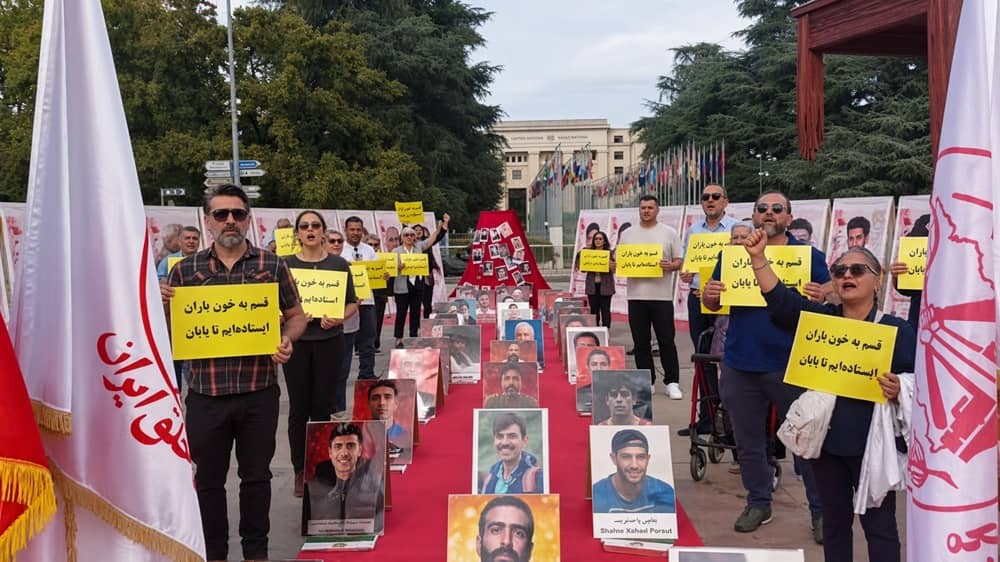
A coordinated international campaign by supporters of the National Council of Resistance of Iran (NCRI) and the People’s Mojahedin Organization of Iran (PMOI/MEK) spanned major European centers between September 26 and October 3, 2026. Demonstrations, photo exhibitions, diplomatic sit-ins, and public outreach events in Paris, Berlin, Geneva, Stockholm, Gothenburg, Copenhagen, Bucharest, and Lyon condemned Tehran’s escalating wave of executions—specifically highlighting the recent execution of January 2026 uprising detainees Ali Hemmati and Majid Nikandish. Protesters sustained ongoing embassy blockades, commemorated the historic September 27, 1981, anti-regime uprising, expressed solidarity with internal “No to Execution Tuesdays” hunger strikes, and advocated for international recognition of the NCRI’s provisional government based on Maryam Rajavi’s Ten-Point Plan.
October 2, 2026
In Paris, supporters hosted a public book stand and photo exhibition exposing the regime’s systematic execution of political prisoners and uprising detainees. Organizers announced plans for a symbolic 3.5-kilometer solidarity run scheduled for Saturday, October 10, at Parc Montsouris to mark the World Day Against the Death Penalty under the campaign banner #StopExecutionsInIran. In Berlin, protesters marked the 217th consecutive day of their sit-in outside the Iranian regime’s embassy. Demonstrators reiterated demands for the immediate closure of the embassy, designating it a center for state espionage and terrorism, and called for international recognition of the NCRI provisional government to oversee the transition to a democratic republic.
4-Malmö, Oct 3, 2026: Iranian Resistance supporters held a rally to condemn executions in Iran. They also commemorated the September 27, 1981 uprising in Tehran and the anniversary of Zahedan’s Bloody Friday in 2022.#StopExecutionsInIran #WeSupportMEK #FreeIran pic.twitter.com/c8S35c8VOo
— Iran Freedom (@4FreedominIran) October 4, 2026
October 1, 2026
In Paris, PMOI supporters conducted a photo exhibition highlighting ongoing human rights violations in Iran. The display focused on the continued imprisonment of protesters detained during nationwide uprisings and urged the international community to take concrete diplomatic steps against capital punishment while supporting the Iranian populace’s rejection of both theocratic and monarchical dictatorships.
September 30, 2026
In Copenhagen, supporters held a rally to protest the regime’s execution of Ali Hemmati and Majid Nikandish, two dissidents arrested during the January 2026 uprising. Demonstrators displayed portraits of the victims, denouncing the executions as signs of regime desperation and calling for global action to halt further death sentences. In Berlin, the ongoing embassy sit-in reached its 215th day, with participants specifically condemning the executions of Hemmati and Nikandish while demanding legal accountability for Iranian officials responsible for systematic repression.
🇮🇷 Winchester, UK — 3 October 2026
Members of Academics in Exile and supporters of the NCRI took to the streets of Winchester with a clear message: Iran’s executions must stop.
Through a book table and photo exhibition, we exposed the Iranian regime’s escalating executions and… pic.twitter.com/ElHpHm7Fml
— Academics In Exile Association (@iranianacademic) October 3, 2026
September 29, 2026
At Place des Invalides in Paris, a public exhibition presented photographic evidence and testimonies documenting state repression and political executions. Concurrently, in Gothenburg, supporters gathered in solidarity with the 140th consecutive week of the “No to Execution Tuesdays” campaign. Demonstrators warned that political detainees face imminent risk of execution as Tehran attempts to enforce societal compliance, echoing NCRI President-elect Maryam Rajavi’s call to expand anti-execution campaigns globally.
September 28, 2026
For the second consecutive week outside the UN European headquarters in Geneva, supporters staged an exhibition during the 63rd session of the UN Human Rights Council. The event coincided with an international human rights conference where a message from NCRI President-elect Maryam Rajavi was presented to attending jurists and experts. The message detailed the escalation of executions, torture, and prisoner mistreatment, calling on international bodies to end impunity for regime leaders.
2-Stockholm, Sweden – October 3, 2026: PMOI supporters held a rally outside Sweden’s Parliament to condemn executions of protesters and call for a democratic republic in Iran.#StopExecutionsInIran #No2ShahNo2Mullahs #NCRIAlternative pic.twitter.com/w49NM0urUU
— Iran Freedom (@4FreedominIran) October 4, 2026
September 27, 2026
In Bucharest, an interactive photo exhibition featured a timeline of human rights abuses and the ongoing detention of January 2026 uprising participants. Visiting Romanian citizens expressed solidarity with the Iranian people’s struggle, while organizers urged the international community to refer senior regime figures to an international tribunal for crimes against humanity.
September 26, 2026 (Late Submission)
Demonstrators across multiple cities marked the anniversary of the September 27, 1981, uprising, which signaled a historic confrontation between PMOI fighters and the clerical regime. In Berlin, the embassy sit-in completed its 211th day with commemorative events honoring fallen PMOI dissidents. In Gothenburg, a public rally reaffirmed adherence to Maryam Rajavi’s Ten-Point Plan, calling for a democratic republic based on the separation of religion and state.
7-#Copenhagen — Sept. 30, 2026: PMOI supporters protested the Iranian regime’s execution of Ali Hemmati & Majid Nikandish, two protesters from the January 2026 uprising. They stand with all saying “No to Execution” and will keep raising their voices.#StopExecutionsInIran pic.twitter.com/ATvTCYEn6l
— Iran Freedom (@4FreedominIran) October 1, 2026
The sustained momentum of diaspora actions across Europe—exemplified by continuous blockades in Berlin and weekly mobilizations in Geneva, Paris, and Scandinavia—demonstrates a structured international movement capable of keeping the Iranian regime’s execution machinery at the forefront of Western political discourse. By linking daily anti-execution protests with explicit policy demands—such as the shuttering of diplomatic missions identified as intelligence centers and the formal recognition of the NCRI provisional government—the diaspora provides a clear, democratic framework for transition. The explicit rejection of both the ruling theocracy and monarchical restoration remains the central political pillar, unifying domestic resistance efforts with international diplomatic pressure.