

Three-minute read
Today, April 2, 2026, the Iranian regime executed Amirhossein Hatami, an 18-year-old protester arrested during the January 2026 uprising. Convicted in a grossly unfair trial on charges of “enmity against God” (moharebeh) for allegedly setting fire to a Basij base in Tehran, Hatami was hanged at dawn in Ghezel Hesar prison. He is the latest in a growing list of political prisoners the regime is rushing to the gallows even as it fights a regional war.
This is not random cruelty. It is a calculated signal of panic. While the world watches missiles and bombs, the clerical dictatorship is far more terrified of its own people than of any foreign enemy. Decades of corruption, economic mismanagement, suffocating repression, and systemic hatred have pushed Iranian society to the breaking point. The people have risen whenever they saw an opening — and the regime knows the next explosion is coming.
The January 2026 uprising proved it. In just weeks, thousands were killed, more than 50,000 arrested, and tens of thousands injured or disappeared. Yet the fury did not die; it only paused when external bombing began. The bombs continue to fall today, but they will stop sooner or later — and when they do, Iranian society will pick up exactly where it left off, with even deeper grievances, heightened expectations, and a regime that is far weaker and more vulnerable than before.
The criminal execution of the 18-year-old Amirhossein Hatami, a courageous rebellious youth, is yet another sign of the ruling religious fascism’s desperation in the face of public anger, and the regime’s fear of a growing uprising aimed at its overthrow.
I call on the… pic.twitter.com/GsXn3A7GkC— Maryam Rajavi (@Maryam_Rajavi) April 2, 2026
That is exactly why the regime has intensified executions of political prisoners. According to the National Council of Resistance of Iran (NCR-Iran), at least 345 people were executed in January 2026 alone — one of the bloodiest months in recent history. The killing machine has not slowed since. In February and March, the pace remained ferocious, with batches of hangings reported almost daily.
The regime’s targets are deliberate. In late March it executed four members of the People’s Mojahedin Organization of Iran (PMOI/MEK): Mohammad Taghavi Sangdehi (59), Ali Akbar (Shahrokh) Daneshvarkar (60), Babak Alipour (34), and Pouya Ghobadi (33). On March 19 it publicly hanged three young January protesters in Qom: Saleh Mohammadi (19, a national wrestling champion), Saeed Davoudi (21), and Mehdi Ghasemi. These are not “criminals.” They are symbols of resistance — young men the regime wants to turn into warnings for every other Iranian youth.
🚨 URGENT CALL TO ACTION: Two more MEK political prisoners are at imminent risk of execution in Iran.
Vahid Bani-Amerian and Abolhassan Montazer could be executed at any moment, just as four other MEK political prisoners were murdered this week. #SAVE_VAHID #SAVE_ABOLHASSAN https://t.co/Cv25fHqYac pic.twitter.com/5G10yopyYT
— Rudy W. Giuliani (@RudyGiuliani) April 2, 2026
By slaughtering its political prisoners in the middle of war, the regime is desperately pursuing four overlapping objectives at once:
- Intimidate the entire society so that no one dares join the next wave of protests.
- Suppress internal feuds and reassure its own demoralized follower base that the regime is still ruthlessly in charge.
- Postpone the inevitable internal explosion — the civil war between the people and the regime that it knows is coming.
- Project raw brutality to the world as a show of strength, while deliberately breaking the spirit of the young generation so their peers lose all courage to dream of freedom.
But every hanging is backfiring. Iranian society has grown radically defiant. Protesters no longer just chant slogans — they confront and punish regime agents in the streets. The atmosphere is explosive. After the pause in bombing, people are waiting, watching, and organizing. The regime feels it.
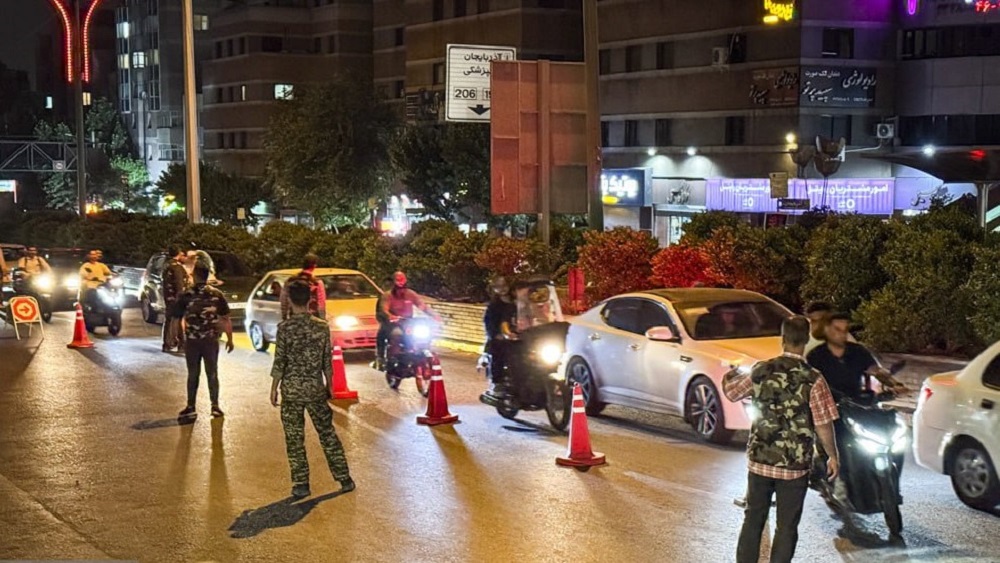
Look at the daily reality inside Iran: security forces, military units, and police flood every street and checkpoint. Patrols and raids never stop. Regime officials repeat the same desperate warning on state television: “The streets must not be empty!” They stage forced pro-government rallies every day and artificial nighttime gatherings to pretend they still control the public space. The entire apparatus of repression is on permanent high alert.
#Iran: @volker_turk says as if pain & suffering of war are not enough, Iranians are being arbitrarily rounded up, jailed, subjected to unfair trials & even executed by own Govt. This is outrageous. All executions must be halted immediately. The human rights of the Iranian people… pic.twitter.com/YuZL5fQ50e
— UN Human Rights (@UNHumanRights) April 1, 2026
Many observers keep asking the same question: “When will the Iranian people rise again?”
The regime itself gives the clearest answer every single day.
Every execution, every checkpoint, every forced rally, every hysterical warning that “the streets must not be empty” is a scream of terror from a dying dictatorship. If it were not afraid of another uprising, it would not need to kill Amirhossein Hatami today. It would not need to rush political prisoners to the gallows while fighting a war.
The mullahs are buying time they do not have. Their fear is the greatest proof that the end is near.
The Iranian people have already shown they will not be silenced. The January uprising lit the fuse. The regime’s own panic is fanning the flames. The next wave is coming — and this time the world should stand with the people, not with the executioners who are desperately trying to hold back history.