

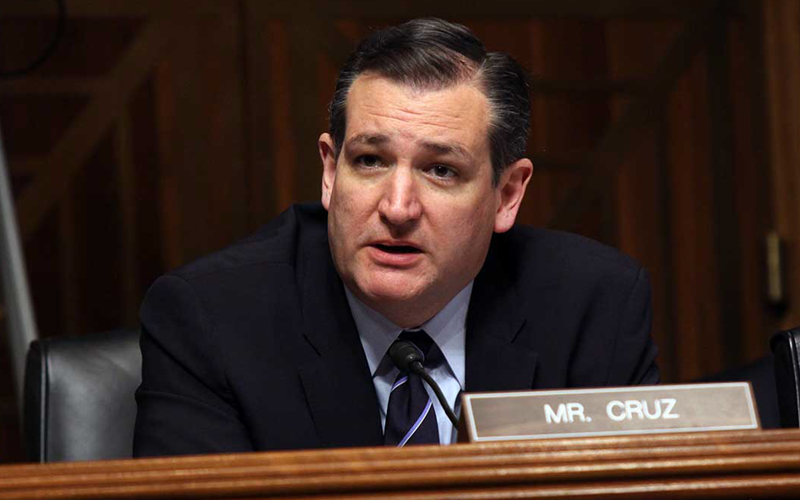
Texas Senator Ted Cruz said it would be a “serious mistake” for United States President Donald Trump to ease sanctions against the Iranian regime to help secure a meeting with the regime’s President Hassan Rouhani.
“Whether or not a meeting occurs, lifting sanctions on Iran, giving the ayatollah an economic lifeline while Iran remains the world’s leading state sponsor of terrorism, would be profoundly harmful and a serious mistake,” Senator Cruz told Bloomberg on Wednesday.
Senator Cruz said that while President Trump’s policy on Iran’s regime has been maximum pressure, he suspects career officials at the State and Treasury departments have been working to undermine that policy and revive the Obama-era nuclear deal with the regime. President Trump withdrew the U.S. from that accord in 2018.
Senator Cruz said the 2015 nuclear deal was “catastrophically dangerous,” in part because it freed up more than $100 billion for the Iranian regime. The Republican Senator said President Trump shouldn’t go down the same road.
“That approach was foolhardy when the Obama administration embraced it, and I hope and pray that President Trump is not convinced by his staff to embrace those failed Obama policies,” Cruz said.
Earlier this month, the U.S. State Department announced a monetary reward for information that can help disrupt the financial apparatus of the Iranian regime’s Islamic Revolutionary Guards Corps (IRGC).
“The IRGC trains, funds, and equips proxy organizations across the Middle East. Iran wants these groups to extend the borders of the regime’s revolution and sow chaos and sectarian violence,” Brian Hook, the State Department’s special representative for Iran and a senior adviser to Secretary of State Mike Pompeo, said.
“We are using every available diplomatic and economic tool to disrupt these operations,” Hook said.
The Rewards for Justice program was established more than three decades ago as a counterterrorism rewards program run out of the agency’s Diplomatic Security Service.
When asked by reporters what information the administration hopes to glean beyond details already known by the U.S. intelligence community, Hook said there were “many possibilities,” including leads from individuals involved in moving Iranian oil.
“It’s often the tips that you don’t think that are going to lead to something big that often do,” Hook said. “There are many possibilities.”
Additionally, this month the U.S. Treasury Department sanctioned more than two-dozen entities and individuals and 11 vessels involved in an Iranian shipping network supporting the IRGC that U.S. officials accused of moving hundreds of millions of dollars of oil to Bashar al-Assad’s regime in Syria and other illicit actors.
Hook said that taken together, the moves were designed to intensify the administration’s “maximum pressure campaign” on Iran’s regime.
The move came one day after Washington sanctioned the Iranian regime’s space agency and a pair of affiliated research groups, accusing Tehran of using them to advance its ballistic missile programs.